


Last week, I talked about returning when life hits. It seems to have resonated, and for some reason, I couldn’t stop thinking about the article’s content.
I usually try to keep my articles somewhat balanced in length for a couple of reasons: time, cognitive load, and throughline.
I want to bring you an article that focuses on one idea, uses your — and my — time wisely, and doesn’t overload you with a bunch of scientific terminology your brain won’t retain, because why should it? Well, maybe a couple of scientific terms, just because I like to geek out on that. But mixing too many of them across different subtopics is a recipe for disaster.
Free weekly reflections for sustainable discipline.
Straight to your inbox.
This led me to avoid going on a tangent about some of the ideas I laid out in last week’s article. One of them was elaborating a little more on meditation and how it can help us return to our baseline faster.
Burnout is the order of the day

Everywhere I turn, I’m hearing people talk about feeling burned out.
I wish I were exaggerating, but I think the feeling is that time is passing very quickly in today’s world — too quickly for many people. We feel like we have many things to do, and indeed, in many cases, we do have many things to do. This creates constant mental fatigue, and, left untreated, it can seriously affect our mental health.
I also think smartphones and AI have a big share of the responsibility for exacerbating this. They make us feel like we have less control than we actually do, which makes us freak out more than we should. I wrote about this at the very beginning of my journey, but smartphones have messed with our self-control and our attention. In fact, there is research concluding that our attention is fragmented nearly half of the time because of our own actions — what Gloria Mark, the researcher behind this work, calls self-interruption.
Burnout is real, and it’s a problem. Recovery can take weeks, months, or even longer. It really depends on how severe the burnout is, and whether the conditions around you actually change.
Why does this take so long, you may ask?
Well, our brains go through different changes, and not the best ones, I must say.
Our brains change during burnout
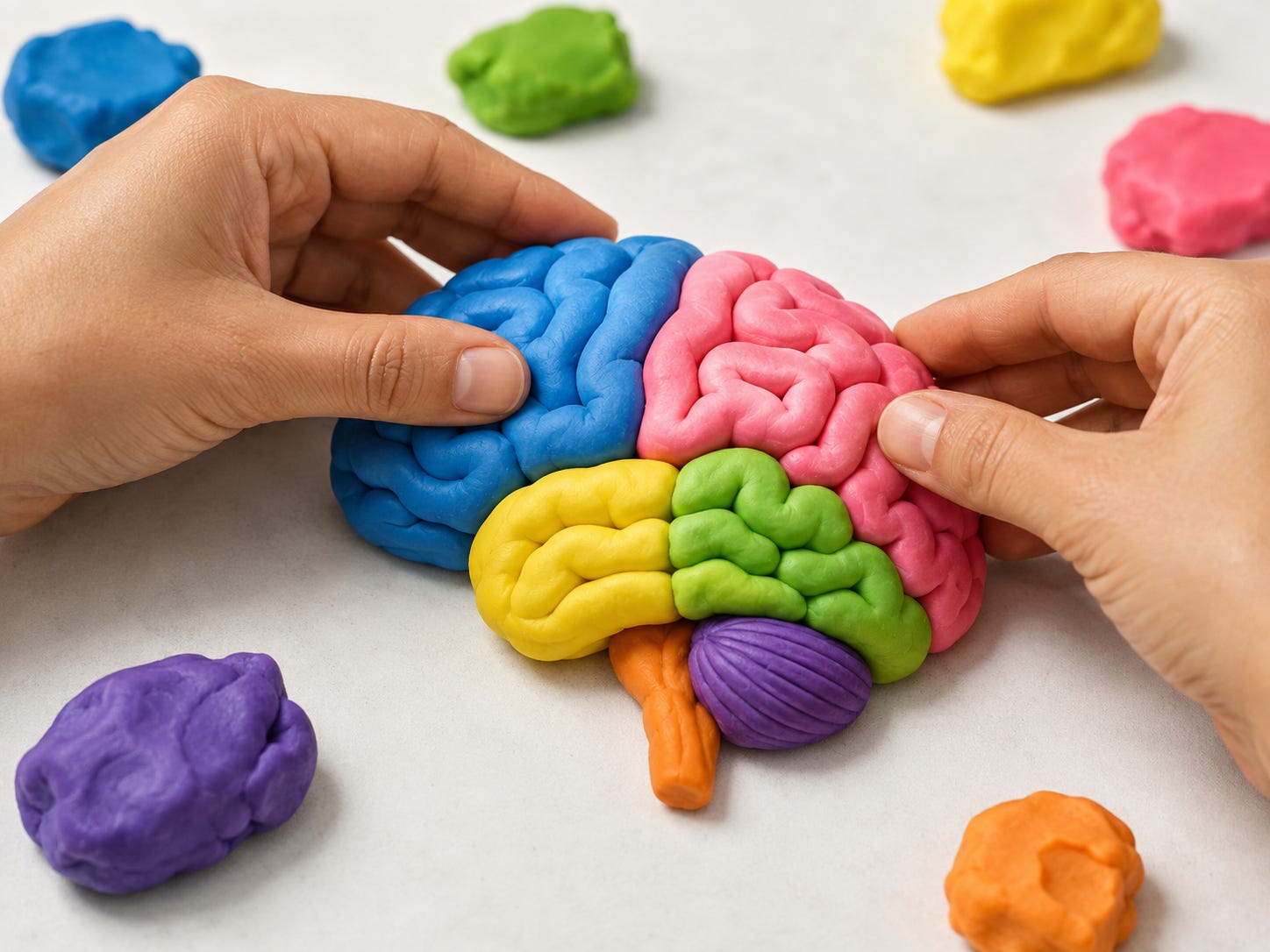
There are studies showing that our brains actually change when we go through chronic stress and burnout. Ivanka Savic and her colleagues at the Karolinska Institute found a pattern that has proven consistent in clinical burnout:
Your amygdala — as we have discussed before, our threat-alarm center — gets enlarged.
Your prefrontal cortex (PFC) gets thinner — you experience gray matter loss in exactly the regions responsible for emotion regulation and executive control. The striatum — responsible for action selection and habit machinery — also appears to be affected.
The connection between these areas weakens. Amygdala–PFC connectivity is reduced, which maps onto what burned-out people report: our emotions fire more intensely and are harder to talk down.
What I found interesting, while reading about this, is that the literature approaches it from different fronts. But all of those fronts, combined, present a comprehensive picture of how burnout reinforces itself. Now, I’ll present how I understand this — I’m not a neuroscientist or psychologist — so please take it with a grain of salt.
Our brain produces a chemical called glutamate, which plays a major role in learning and memory. When we engage in effortful mental tasks, our brain accumulates excess glutamate in an area called the lateral prefrontal cortex, which is, simply put, responsible for our ability to spend mental effort deliberately. Too much of this accumulation can result in cognitive impairment.
Have you ever felt that your head was fatigued, or even borderline headachy, after a long day of work?
If so, that might be your brain telling you that it needs to rest, so it can naturally drain this residue before it becomes toxic.
Sleep and spacing out demanding tasks help drain glutamate progressively as the day goes on.
When we are under chronic stress, our processing of glutamate gets wonky, which actually leads to this cognitive impairment. Besides, our amygdala becomes overactivated, and our weakened PFC can’t effectively modulate it. The more the amygdala overactivates, the less we can regulate ourselves.
This impairment causes us to perform worse on tasks that previously didn’t require the same effort. In turn, we compensate to reach the same — or a higher — perceived level of performance.
Subsequently, that compensation generates more metabolic effort — our brain’s ability to recover is also affected — and suppresses recovery. As a result, we become more dysregulated.
As you can see, once you get into this cycle, it’s really hard to get out because your brain is working so hard to demonstrate that it can still perform. At first glance, it’s easy to think that there is no way out.
The good news is that this is reversible — well, at least partially — and I think the recovery time I shared before helped serve as a teaser. Now, as a disclaimer, and as a sign that the burnout you might be going through is a real thing: some Swedish studies suggest that even years after chronic stress, some people still experience reduced stress tolerance. So, while this isn’t meant to alarm you, keep in mind that what you are dealing with is not minor, and you should pay it the attention it deserves.
And one practice that may help interrupt this cycle is, you guessed it, meditation.

👉 Want to actually train this, not just read it?
Each week inside Discipline Circle, I publish a short Paid Companion you can work through in 10 minutes on a slow day, so the idea sticks when a hard day hits.
$9.99/month.
Enter meditation
We talked about glutamate. Glutamate, along with other chemicals secreted by the brain, is what we know as a neurotransmitter.
Inside the brain, neurons don’t actually touch each other. There is a microscopic gap between them called a synaptic cleft, and the connection between neurons is called a synapse. Neurotransmitters are responsible for carrying signals across these gaps.
Some neurotransmitters you may have heard of:
Glutamate — you just heard of it, yay!
GABA — this is glutamate’s counterpart. It slows down nerve activity. Think of it as a stop signal.
Dopamine — this signals wanting and reward learning. When you do something that was worthwhile and want to do it again because of that, dopamine is responsible for it.
Serotonin, norepinephrine, and acetylcholine — in a nutshell, these chemicals are related to mood and impulse regulation, alertness and arousal, and attention and learning in the brain.
The mechanics of how the brain uses neurotransmitters are actually fascinating — at least to me. And please bear with me, because what I’m explaining now isn’t just to geek out. It serves a purpose.
I always thought that neurons communicated with each other through electrical signals. Well, it’s not quite like that. Actually, neurons communicate with each other through puffs. One neuron releases a puff of one of these chemicals, and the receiving neuron has receptors shaped to catch it. Depending on the signal, the receiving neuron is instructed to fire or stop. Once fired, an electrical signal travels across the neuron.
So today you learned: between neurons, puffs and chemical signals; within a neuron, electricity and electrical signals.
Now, this release and reception of signals is just one part of the brain’s job.
The next one is cleanup.
After the signal, the chemical needs to be vacuumed from the gap so the synapse can reset. Sometimes it doesn’t happen as expected, and the chemical lingers in the gap when it should have been cleaned up. This can happen, for instance, when we are subject to periods of sustained stress.
Unfortunately, because our attention has decreased and our context switching has increased, we don’t really leave space between effortful mental tasks. And for some people, like new parents or caretakers, good-quality sleep isn’t always possible, which interferes with the cleanup process. As a consequence, the self-cleaning process — which needs idle time to run — becomes impaired, leading to dire consequences. In the case of glutamate, for instance, this can contribute to the cognitive impairment and subsequent vicious cycle we described before.
Because we don’t leave space between effortful mental tasks, whether because of increased workload or other responsibilities, we need to find alternatives that help us do the janitorial work in our brains.
Turns out meditation is one of those alternatives.
I want to be clear, though, because there are different schools of meditation. I’m not talking about the type of meditation where you sit down and try to focus on your breathing, or try to direct your attention toward something in your head, like a mantra. By the way, this method is called focused attention — essentially, trying to harness your attention again every time it escapes.
I know that type of meditation works for some people, but it requires effort. Based on everything we described, effort is a scarce resource in a burned-out person’s brain. So while focused attention may not necessarily create more stress, for me, it felt like adding more strain to an already tired brain.
The meditation I’m talking about is different. With it, you just relax and let your brain run freely. You observe your thoughts without trying to grab them or judge them. You just see them as a third person who happened to observe an event. This also has a name: open monitoring.
This is the type of meditation I practice, and it has proven to be really helpful for me.
Until today, I didn’t know why I felt it helped so much. Every time I felt like my brain was heavy, like I had the weight of my thoughts in my head without even knowing what those thoughts were, I felt the impulse — the need — to find a silent space and just let my brain run.
Well, it turns out that this type of meditation is really helpful for brains that have gone through the loop I previously described. In fact, this tool sort of goes in the opposite direction. My interpretation is that open monitoring helps process some of the lingering thoughts in your head. It creates a kind of mental space that resembles the spacing we would naturally get between finished, effortful tasks — space that modern life doesn’t always give us.
You don’t necessarily need to find a space to sit down and do this. You can also do it while walking or exercising. What’s important is that, whatever you do, you let your brain run and avoid judging whatever comes from it. Think of this as emptying a dirty pool — one of those plastic pools we used to have as kids. In order to clean it, you need to take the cap out and let the water run and run. Same with your thoughts. Observe; don’t judge.
This type of activity takes mindfulness and presence, so I’d advise you to schedule time to do it, or to do it in moments when you are not in social environments. Mainly because, if you are interacting with others, like family and friends, you don’t want to be absorbed in your thoughts when you should be actively listening.
In fact, there is a method called scheduled worry that helps a lot of people dealing with anxiety. You set specific times when you let your brain worry about things, leaving the rest of the day open for you to actually perform. But that’s a story for another day.
How does it help me return, then?
You might be wondering, Cool. How does this help me return faster? How does this help me practice discipline better?
The answer is simple. You will have more difficulty returning with an exhausted brain. So meditating helps improve the conditions for your return — not completely, but at least enough to leave your brain primed for a good return. It helps you become steadily more level-headed and able to process your thoughts as they come.
I really recommend that everybody meditate. It has helped me, and I really think it may help you too.
In our next companion, I’ll bring some katas to help you start this practice. So tune in, because I think this will be an extremely valuable one.
In the meantime, make sure that if thoughts come sporadically into your head, you don’t get too hard on yourself. If possible, let them go as they come.
Hope you have a wonderful week!
✨Ideas Worth Exploring
If this piece resonated, here are a few more that go hand-in-hand.


Bibliography
Almén, N. (2021). A cognitive behavioral model proposing that clinical burnout may maintain itself. International Journal of Environmental Research and Public Health, 18(7), Article 3446. https://doi.org/10.3390/ijerph18073446
Chmiel, J., & Kurpas, D. (2025). Burnout and the brain — A mechanistic review of magnetic resonance imaging (MRI) studies. International Journal of Molecular Sciences, 26(17), Article 8379. https://doi.org/10.3390/ijms26178379
Eskilsson, T., Olsson, D., Ekbäck, A.-M., & Slunga Järvholm, L. (2024). Symptoms, work situation and work functioning 10 years after rehabilitation of stress-induced exhaustion disorder. BMC Psychiatry, 24, Article 525. https://doi.org/10.1186/s12888-024-05975-x
Mark, G. (2023). Attention span: A groundbreaking way to restore balance, happiness and productivity. Hanover Square Press.
Michel, A. (2016, January 29). Burnout and the brain. APS Observer, 29(2). https://www.psychologicalscience.org/observer/burnout-and-the-brain
Moss, J. (n.d.). How long does burnout last? Weeks, months or years. https://www.jennifer-moss.com/how-long-burnout-lasts
Popoli, M., Yan, Z., McEwen, B. S., & Sanacora, G. (2012). The stressed synapse: The impact of stress and glucocorticoids on glutamate transmission. Nature Reviews Neuroscience, 13(1)_, 22–37. https://doi.org/10.1038/nrn3138
Savic, I., Perski, A., & Osika, W. (2018). MRI shows that exhaustion syndrome due to chronic occupational stress is associated with partially reversible cerebral changes. Cerebral Cortex, 28(3)_, 894–906. https://doi.org/10.1093/cercor/bhw413
Wiehler, A., Branzoli, F., Adanyeguh, I., Mochel, F., & Pessiglione, M. (2022). A neuro-metabolic account of why daylong cognitive work alters the control of economic decisions. Current Biology, 32(16)_, 3564–3575.e5. https://doi.org/10.1016/j.cub.2022.07.010
Great article, Camilo! This connects a lot of pieces well, the brain changes from chronic stress, the glutamate buildup, and why one type of meditation helps more than another for someone already burned out
💜☮️💜☮️