


If you haven’t seen me so active on social media recently, there is a reason.
There has been a lot on my plate recently.
The industry is moving fast and everybody wants to move fast, and that takes a toll.
Some days my energy drops to the floor, and I try to do what I can with what I have.
That, on top of trying to stay present for my family, sometimes staying later at work, and progressing in this personal project I call Self Disciplined. It adds up.
Some of you have asked me: how do you do that much with limited time?
Free weekly reflections for sustainable discipline.
Straight to your inbox.
I just try to coordinate myself well, and I’ve been learning to deprioritize when needed.
Not to a complete halt, just to reduce cadence.
That’s why I haven’t been posting notes like crazy, that’s why I haven’t been promoting things.
Because I’m scaling myself down, temporarily, to keep up with myself.
This doesn’t mean at all that I’m going to stop.
I won’t.
I’m writing this post as a way to clear my thoughts, and share this with you so you can see what I do when I’m spreading myself too thin.
Let’s add a bit of science to this
Our ability to keep context is limited.
We can only carry so much context in our heads.
We call that cognitive load.
Cognitive load is, to say it in a simple way, very sensitive, and everything adds to it.
Work.
Relationships.
Family.
Yourself.
Life events, good or bad.
Everything.
When your cognitive load gets overloaded, you start spilling over.
Your body is smart enough to know when enough is enough. So, in order to prevent a meltdown, things start leaking.
You forget things. For instance, I realized that I forgot to share with you that I finally got my U.S. citizenship last week — yay 🇺🇸!
You become more reactive.
Lose track of things.
You get overwhelmed more easily.
And then bam! you start drifting.
And I don’t want that.
There are a lot of parts in play
During cognitive overload, multiple parts of the brain are in play, so I will try to keep it simple.
Please bear with me on this one.
The main part of the brain that gets impacted by this is the prefrontal cortex. If you haven’t read my articles before, the prefrontal cortex is like the decision center of your brain. The one that helps with rational decisions, controls your impulses and basically keeps you aligned. When your brain gets overwhelmed and it’s hard for you to keep track, it’s basically your prefrontal cortex saying, “how about no?”

Other areas get involved too: attention, memory, body awareness and error detection. That’s why overload doesn’t just feel like “too much to do.” It can make you forgetful, clumsy, reactive, and weirdly unable to track simple things.
Finally, your emotions are also at stake, because the amygdala also gets involved. Because apparently impacting executive function was not enough. When you get stressed and overwhelmed, your emotional reactivity can get amplified too. This is why you might feel more irritable, panicky, or sensitive than usual.
I do.
There’s a bunch of parts in your brain that are playing when you are overwhelmed, so it’s natural to feel like you are losing it.
I don’t feel quite like that, but that’s why I’m writing this.
To not lose it.

👉 Want to actually train this, not just read it?
Each week inside Discipline Circle, I publish a short Paid Companion you can work through in 10 minutes on a slow day, so the idea sticks when a hard day hits.
$9.99/month.
So what do I do?
What can you do if you are on your road to Overwhelm Town, just like me?
Well, this post — and you — are the witnesses that I’m aware. That my awareness kicked in.
So that’s the first thing you do. You work on becoming aware.
How does that help though?
Remember your prefrontal cortex? Well, turns out that research suggests that mindfulness — the practice of being aware of the present moment — can help support the parts of the brain involved in attention, self-regulation, and emotional control. In other words, it can help bring your prefrontal cortex back into the room and lower the volume of your amygdala, which helps you make more rational decisions, keep your cognitive load at bay and keep you under control.
But what if I’m already in the shiz?

Then use this post as a signal that you can still be aware of what’s going on.
The fact that you realized that you are pooped is already proof that you are aware.
So now you can choose better.
Remember the Return Loop?
Well, it’s back!
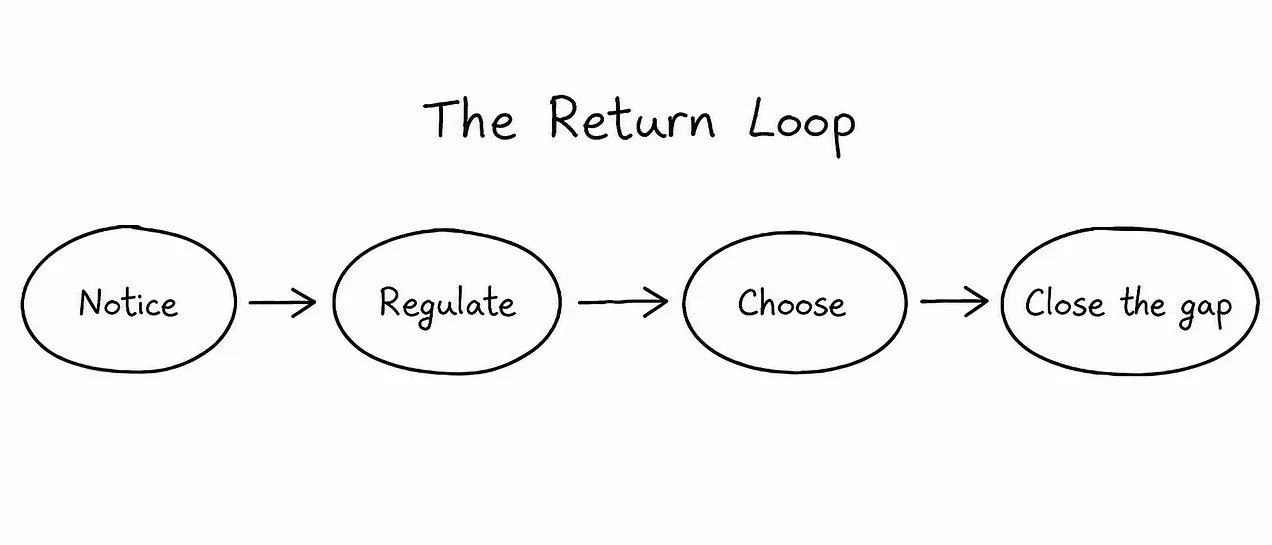
You noticed.
So now you regulate. That’s what I have been trying to do.
To chill down a bit. Still caring, but reducing the pace intentionally.
You know when you are running — haven’t done that in a while I must admit — and you run so hard that you start feeling pinches on the side?
What do you do when that happens?
I used to stop, and take a breather.
But the wiser decision — that I learned later — was to keep jogging at a slower pace, but not to stop.
Well, unless you really feel crappy...or crampy.
Same here.
You don’t need to stop. You can jog.
That’s what I’m doing now.
Keep moving. Slower pace, but still moving.
Then, you choose.
I calmed down, I regulated.
Now I choose to keep this pace.
Quiz time: if you intentionally changed what you were doing, for instance stopping or going slower, did you drift?
Many would say yes. But the reality is that if you do it as part of the direction you want to follow, then it’s a coherent decision.
You are not stopping because something else pulled you away unconsciously.
You are choosing.
Because you know that if you do this, you can return faster.
That’s how you close the gap.
Otherwise, you drift, and eventually you may try to force yourself back.
But that’s how we burn out. And burnout is recoverable, sure, but it is not pleasant.
Been there, done that.
So, if you have seen me less around, it’s not because I’m not being disciplined.

How rude of you to think of that — just kidding.
No. It’s because I’m recovering while still doing the job. While still jogging.
Because progress is not about how long the streak is, but how fast we come back on track.
If you are interested in some practices to work on this, how to prevent getting to Overwhelm Town, or even worse, burned out, in our next paid companion I’ll share some of them.
Stay aware, and keep rockin’. You got this.
Have a wonderful week!
✨Ideas Worth Exploring
If this piece resonated, here are a few more that go hand-in-hand.


Reclaiming my nervous system is a work in progress 😅 thank you for a great informative article!