


The house is silent.
There are no sounds around me. I can only hear my electric kettle boiling the water I’m heating to prepare myself a tea. That’s my drink of choice when the day is almost over.
The house is silent.
I have it all to myself, yet it feels incomplete.
The kiddos are out with their grandparents, and my wife is on a work trip to Australia.
I have the house to myself for the next five days.
The house is silent.
I have my dog with me. He chooses where to lay down because he doesn’t have little hands trying to hug him whenever they have a chance, or screams around the house to bother him. We keep each other company.
The house hasn’t felt empty in years, and it’s hard. I thought it would be easy because it was easy once before.
Free weekly reflections for sustainable discipline.
Straight to your inbox.
It’s not, and I miss my crew.
Ironically, this will be published the day before the kids are back, so when I read it by then, it will feel like something from a faraway time. I decided to get ahead of my feelings and start writing.
The kettle stopped sounding. The water is done, and the only noise around is my keyboard.
This brings back memories from another time, another land, and another self. Somebody who, at one point, was okay with the idea of living alone.
The thing is, that was my mindset for almost a decade, and part of me still believes it. This week, though, oof. Of course, solitude has its perks. I’m not going to be ungrateful. I’ve been able to sleep more, write earlier, and meet with friends.
Now I think it’s good to learn to be alone, but I’ve started to think that’s not all.
I think learning to be in company is also important. Today I’ll talk about that.
Learning to be alone
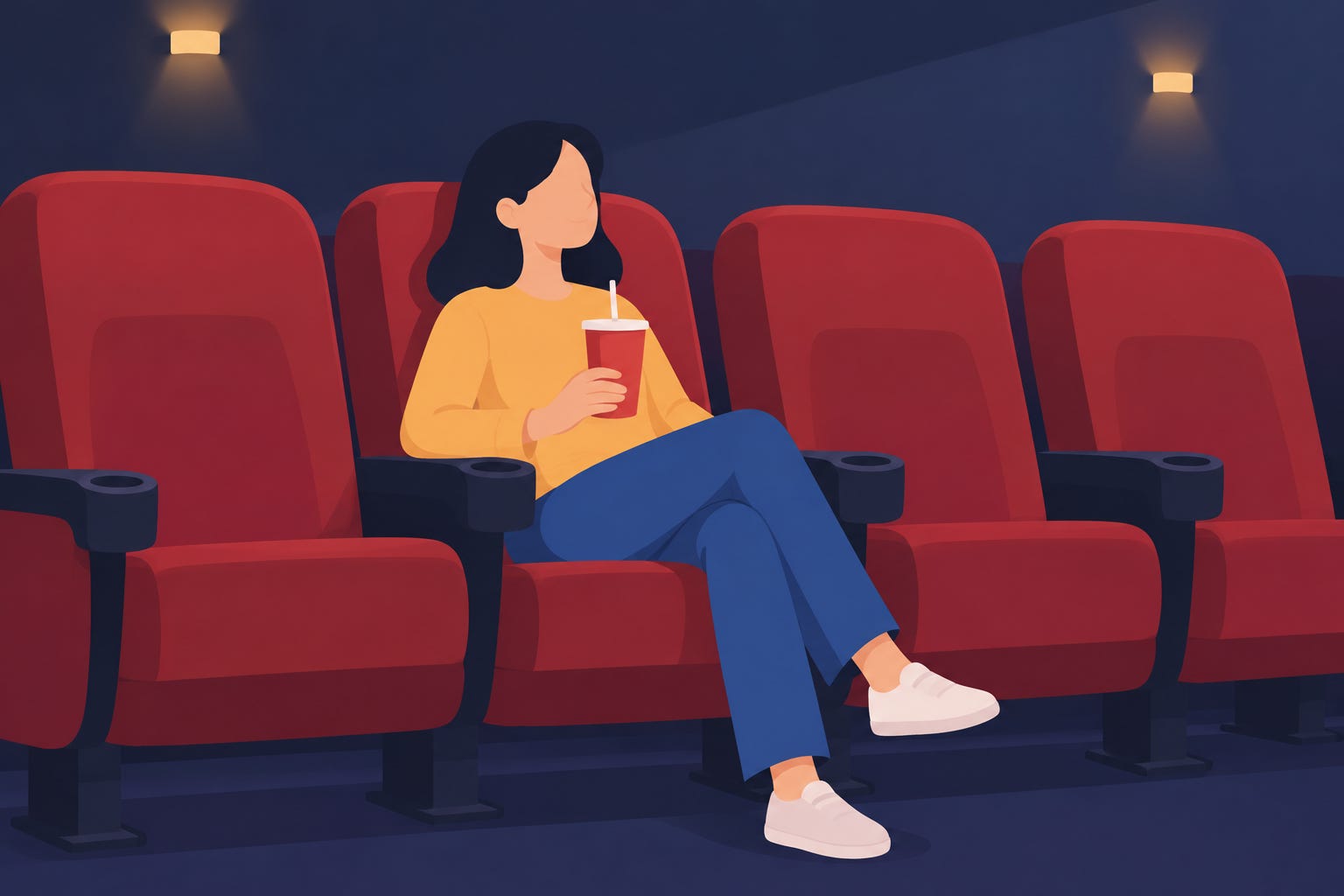
When I was younger, the idea of being alone was terrible. I wanted to be with my family and my friends. When you’re a teenager, social acceptance is important, so I held being surrounded by people in very high regard. The idea of going to a cinema alone, for instance, sounded lame. It sounded shameful.
And you know what’s interesting? This has been studied, actually. Researchers have found that what makes people reluctant to do activities alone — like going to the cinema — is the fear that others will think they have no friends. Funnily enough, that makes a lot of sense to me because that’s precisely what held me back for so long. The “what would others think,” the “oh, poor guy doesn’t have friends,” you know, that kind of stuff.
As I grew up and understood the idea of independence, and wanted to go to college, I had these ideas, these fantasies of what I would do when I lived by myself, outside the rule of my parents’ household.
Once I started college, life just became studying insane hours, partying, and relationships. Forget about taking care of my own room.
I started having my first romantic relationships, and with that, the idea of being with somebody eventually in the long term started circling around, more as an abstract idea than anything. I don’t think I was prepared for that type of relationship yet, but I didn’t want to be alone. So I found refuge in my friends and in partners in my business ventures.
I was surrounded by people every day, for the most part.
I hadn’t been in a formal relationship for years at that point, and I liked the idea of being surrounded by people while still being able to retreat to my own space and quietness.
It was my trip to Europe — where I backpacked for nearly forty days — that cemented the belief that I could be perfectly fine on my own, doing things on my own without feeling judged. It cemented the belief that I didn’t need to wait on anybody to do whatever I wanted, and particularly the idea of being no one. After that trip, I really felt invincible. I felt you could throw me anywhere and I would be able to move around and figure things out without help.
Then I started working, and my friends did too.
All of a sudden, I couldn’t surround myself with my friends all the time anymore. I lived in Santiago and actually made new friends there too, but I would spend three hours of the day just commuting, if not more. I would get home just to eat and go to bed.
That made me start feeling miserable, so I looked for another job. I found one back on the coast, in a city called Concón, in Chile, and I moved there.
I started liking this idea of living on my own, alone, in silence, doing things my way and not having to respond to anybody. Maybe liking isn’t the right word. Maybe I was enjoying it and embracing it at the same time. Maybe it was a survival mechanism. Who knows?
I got to go places alone and enjoy it. I would still meet with my friends and have fun. At the time, it felt like it couldn’t have been better.
I remember commenting all of this to my mom, who was probably scared of me ending up completely alone. She jokingly told me not to get too used to it, because otherwise I would end up like a grumpy old bachelor. I sort of believed that story because I hadn’t been in a relationship in years at that point, but the prospect of giving away my lifestyle — my preferences for how to live in my own space — made me want to be an urban hermit for a little longer.
I would go out every now and then, but boy, did I enjoy my solitude. I lived on a 13th floor with a view of the sea. I felt I didn’t need anything.
Silence became peace, and being a homebody became a lifestyle.
Then Amazon’s offer came.
When silence becomes a reminder
I remember being curious about the idea of moving to the U.S. more than feeling sheer excitement. It was a mix of feelings: anxiety over the uncertainty, excitement about a different culture, and fear of having to start over in a land where I didn’t know that many people. I moved to the U.S. on my own. I knew some people here in Seattle, but it was challenging at first. Moving to another country is completely different from a forty-day trip, and there are many other things to consider. Thankfully, the people I knew gave me support and helped me settle. They became my friends, and today I feel blessed to have them in my life.
Most of my friends in the U.S. had moved with their partners, so staying here was a bit more bearable for them. I was alone, and for the first time I felt the weight of that, because back in Chile I had at least been able to choose to see my family if I felt I needed them. Now I was on my own, in a big studio with industrial concrete and a cold floor.
I started realizing that I wanted to have moments of solitude, but I also wanted to be able to have company, not to be alone all the time. There were weekends when I was just on my own. My friends would hang out as couples, understandably. Going to the cinema alone could only take me so far. Silence became a reminder that I was not alone by choice anymore, and that didn’t feel good. It wasn’t sustainable.
When I understood the nature of my situation, another realization came with it: I had proved I could do things on my own, but that didn’t mean I had to do everything on my own. Have you ever felt like that? Knowing you can be alone but realizing you now prefer not to be?
That’s how I was feeling. So I started trying to meet people in town. After many years, I decided to see if it was time to meet somebody.
Learning to be in company
Wanting company, wanting not to be alone, made sense to me once I stopped treating it as a failure of independence. I had spent years learning to feel comfortable on my own, to the point that I enjoyed most of it. But once I had experienced a different kind of loneliness, I realized I could enjoy solitude and still want somebody to share my days with.
What I hadn’t figured out yet — to be honest, I hadn’t even realized it — was how much room I was willing to make for that person. I had my routines, my preferences, and my way of doing things. My personal time was sacred, and for years, almost every decision at home had been mine to make.
When I met my now wife, my world got shaken — in the best way possible. My life was pretty routine up until that point, and when I started dating her, I was rediscovering this idea of company. I didn’t want to rush, now more mature, because I was enjoying her company and didn’t want to scare her. She likes to joke about it because, according to her, I invited her to Chile when we were just starting to date. I remember it as a joke, oops. Either way, I tried to take things easy, to the point that she asked me what we were doing because I hadn’t asked her to be my girlfriend yet. In my defense, coming from a different culture, I didn’t know if I had to, and I told her that. I summoned the courage and I did ask her formally to be my girlfriend. That was the best decision I had made in a very long time.
Ever since then, we have done pretty much everything together. She is the love of my life.
We moved in together during COVID, after our engagement. Navigating life together — literally — was a whole different game. When you get to go home after an argument or after spending time together, you get to return to your own space and your peace. Once you live together, a large share of your time gets shared as well, and given my history, it took getting out of my comfort zone.
It has been years since then, and we now have kids. Our shared time is also devoted to them, to our family, and I think we are at a good point in our lives where, while we are still figuring things out, we are doing it as a team. Honestly, I couldn’t see myself without them. They are my life, literally.
This transition wasn’t easy for anybody. It took conversations, understanding, and acceptance, but all of it has brought me to the place I am today and to the reason I’m writing this.
I miss them, but I know this is temporary. I’m trying to embrace this solitude, do the things I have pending, get some more rest, and reflect.

👉 Want to actually train this, not just read it?
Each week inside Discipline Circle, I publish a short Paid Companion you can work through in 10 minutes on a slow day, so the idea sticks when a hard day hits.
$9.99/month.
How does this relate to the idea of self-discipline?
Because it takes a fair amount of falling and trying to get there.
I’ve known people who got into relationships or friendships that weren’t good for them because they didn’t want to feel alone. I get it. As you could read, I was in the same boat.
I’ve also known people who missed opportunities, let go of love, or regretted not following their hearts because they didn’t want to leave the comfort zone of keeping their space and life entirely to themselves.
I recognize both fears because I’ve felt them. I didn’t want to be alone, and I didn’t want to give up the life I had built around my own preferences. Getting to some middle point — and finding your way back to it — takes time, effort, and awareness.
Building a life with somebody else — friends, partners, spouses, you name it — takes listening, vulnerability, and trust. It also takes accepting that we will be wrong at some point, being okay with that, and letting go of our egos. That’s how you build bonds and become a team. It’s how doing things alone can remain okay while you develop a sense of community and company.
The act of getting there, through reflection, awareness, and action, is an act of discipline.
We don’t need to be consistent to be disciplined, and we don’t need to be right all the time. For me, discipline also means finding my way back to what matters, and right now, that’s my family.
In our next paid companion, we will talk about practices that can help if you are feeling alone, or if you are trying to become more comfortable with the idea of learning how to be alone.
Until then, remember: there’s nothing wrong with being alone, and there is nothing wrong with wanting company, but we can’t reach a middle point unless we learn both skills.
I hope you have a wonderful week!
✨ Ideas Worth Exploring
If this piece resonated, here are a few more that go hand-in-hand.


