


For the last week or so, I’ve just been hoarse.
In fact, there was a day where I literally couldn’t speak, my voice was not coming out.
I attribute it to allergies, maybe a seasonal cold? I’m not quite sure. Whatever.
The thing is that it affects me. Affects my work. Affects how I communicate. Affects my day-to-day. And it completely sucks because even something this small can make me feel out of myself.
Free weekly reflections for sustainable discipline.
Straight to your inbox.
Now, frustration and all, this is the reality. There’s not much to do, other than take the precautions I can take, and maybe go to the doctor if it lasts longer.
My voice sounds raspy, and sometimes I have to make more effort than usual just to communicate. I think that makes the problem worse, because I don’t let my throat rest. But unfortunately, this is not totally under my control. So I have to accept it. I have learned to accept it. Not necessarily accepting the fact of spending a chunk of time with a hoarse voice, but accepting that I don’t get to control everything that happens around me.
It doesn’t bring my voice back, but at least removes the weight of thinking that I should be able to fix it. Because that’s not true. I can do things for it to maybe improve, but nothing guarantees that that will be the solution.
It’s obnoxious, and I still spend some time complaining about it, but mainly as a way to channel the fact that it sucks, while still trying to do what I can.
You see, in life there are a lot of things that we believe we have control over when it’s not quite true. We think we can control outcomes and sometimes the only thing we can do is just to do damage control.
Recently, I watched The Smashing Machine, where Dwayne Johnson plays Mark Kerr, one of the pioneers of MMA. The movie follows the period when MMA was becoming real, Kerr was becoming important, and he still believed he was someone who wouldn’t lose. Until he did. Sometimes life has a way to teach you in the worst ways, and that is how it went for Kerr. I won’t tell more because I don’t want to spoil it, but I think you should watch the movie, it’s pretty good.
Of course, losing your voice and losing a fight are orders of magnitude away. But both expose the same illusion: the belief that because you prepared, cared, or tried hard, you are entitled to a successful outcome.
Kerr thought he had control over the outcome, until the outcome said “not today.” And when that happened, life suddenly seemed out of place, almost meaningless.
It’s the human dilemma.

👉 Want to actually train this, not just read it?
Each week, alongside this reflection, I publish a short practice guide — something you can work through in 10 minutes on a slow day, so the idea sticks when a hard day hits.
It’s called the Paid Companion. $9.99/month.
The truth is, we don’t really control what happens to us. We control what we do with it. On the small or the big stuff.
The Stoics knew it pretty well.
Marcus Aurelius mentions something close to this in his Meditations:
You have power over your mind - not outside events. Realize this, and you will find strength
It was because of Stoicism that I learned that for myself. It’s a tough lesson to learn, and you don’t learn it until you live it. But once you do learn it, your worldview flips upside down.
It’s very easy to lose it when things don’t go the way you want. When your kid acts in a way you don’t like, even if it is completely natural. When you lose something. When life kicks the hell out of you even when you’ve been doing things the right way. Losing control means handing the reins to the version of you that is not thinking about consequences.
Do you want that?
I for sure know that I don’t want that for myself.
And working on that is hard, because you shouldn’t be working to suppress that instinctual part of you that acts out as a survival mechanism. You should be working on teaching that version of yourself the signals it needs to return to you.
So you can return to yourself.
I’ve had a bumpy relationship with control due to my anxiety, because when you are anxious you try to control the outcomes, the mere thought of uncertainty makes your stomach twitch, and you try to predict the outcomes and plan for them before they even happen.
Going through this journey of discipline I learned that in order to return to myself, to come back to the version of myself that can choose and not just react, the key is not to prevent my instincts, but to be aware enough to notice when they kick in, and shepherd myself back on track so the blast radius is small.
Loss of control, in my opinion, is a form of drift. It just makes you act like a different person, and knocks you off your path of coherence. So learning the skill of returning here is crucial.
Returning helps you do damage control – speaking of control, lol –, but it also trains your brain to notice the slip earlier next time. Sometimes that means catching yourself before you lose control. Other times it means getting back to yourself faster once it already happened.
When you develop comeback speed in the domain of self-control, you are teaching your brain that reacting is human, but staying inside the reaction doesn’t have to define you.
In simple terms, this is where neuroplasticity matters. Every time you notice the slip and choose to return, you are not just fixing that moment. You are training the pathway that makes returning more available next time.
Because we are talking about return, I’ll share the same loop that I shared last week.
If you find yourself continuously making instinctual calls, losing control – even in little things – a way to kickstart your return practice is to actually try The Return Loop. We talked about it here.
The Return Loop is the cycle we follow from noticing drift to actually returning to what matters. In this case, it means noticing when emotion or instinct is taking over, regulating enough to create space, choosing the response you actually want, and closing the gap before the blast radius gets bigger.
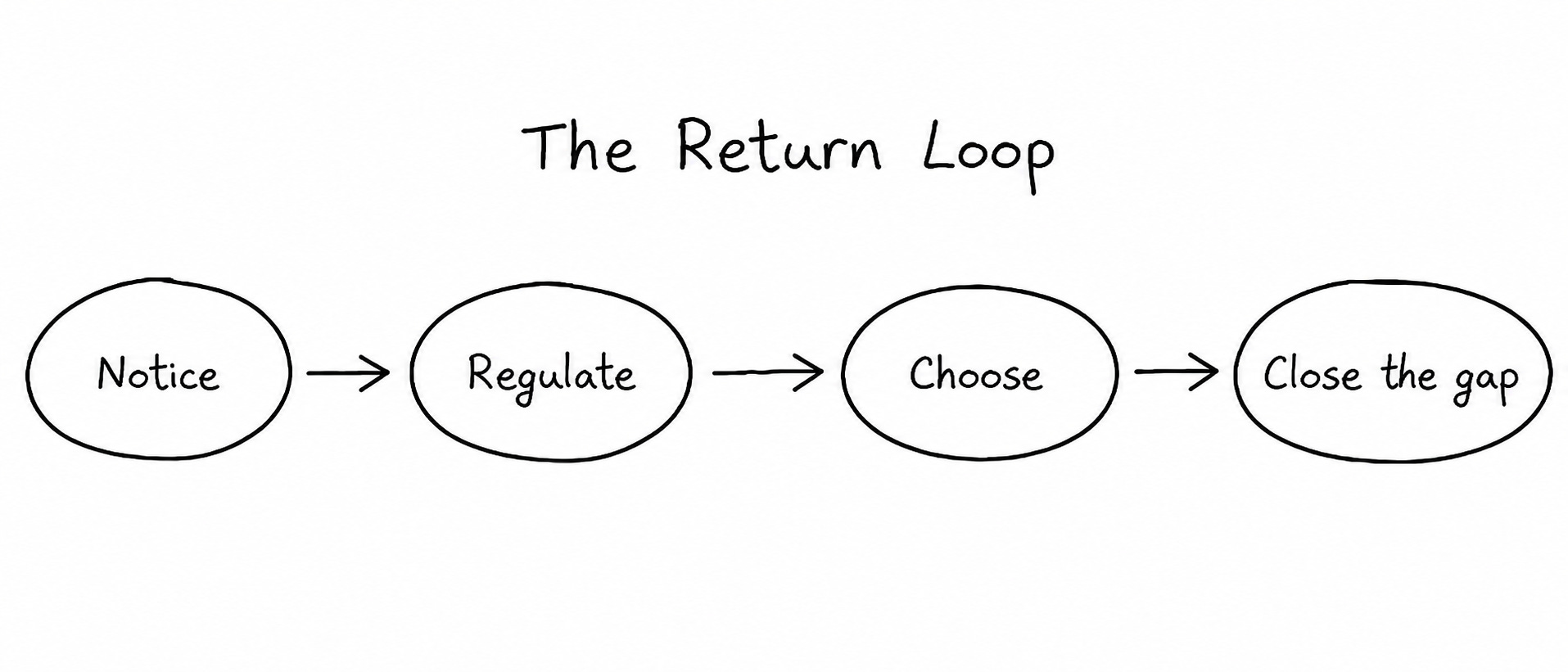
My invitation to you is to turn on your loss-of-control detector. Look for the moments where you act from instinct or emotion instead of choice, and ask yourself: was that the outcome I wanted?
If not, try the Return Loop. Use it to practice deliberate choosing, so little by little, returning becomes the new default.
In our next paid companion we will work on this more in-depth, and I will share some katas to help engineer the conditions for the Return Loop to work more smoothly.
Have a wonderful week!
✨Ideas Worth Exploring
If this piece resonated, here are a few more that go hand-in-hand.


