



Have you ever been in that situation, where you want to write about something, or maybe have an idea you want to do, and you have an inner voice that tells you: “if you thought of it, someone else already did, so what’s the point?” or, “you don’t really know everything about this, what makes you think you can write about it?”, or even worse “why you out of all the people out there?”.
Free weekly reflections for sustainable discipline.
Straight to your inbox.
We can be our worst critics.
It has happened to me multiple times. Damn, it happens to me every time I work on this side project of mine called Self Disciplined. It happens when I have ideas for every single part of my ecosystem.
And it’s detrimental. It makes me procrastinate around what matters. That voice tricks me into thinking that what I create might not be valuable enough maybe because I lack experience, somebody already did it...or if I thought of it and nobody has done it yet, then it might be for a reason.
You’d think that after it happens to you a couple of times, you learn to identify that voice, to shush it and to actually get stuff done. I’ve talked about this before.
But no, it keeps happening.
The funny thing is, that when you start on the journey, you typically tend to be more confident and just get the stuff done; or at least you put the effort on learning what it takes and the ropes of it.
So, why does it happen that as we learn more, and we do more, and we gain more visibility, experience and knowledge, it takes longer for us to actually get things done?
I think I have an idea.
When I started writing about discipline, I wasn’t even really motivated. I just didn’t know what I didn’t know, and really wanted to document what I was learning.
Motivation has some passion in it that pushes you to do things almost impulsively. That happened to me, and I don’t regret it.
You don’t get obsessed with it at first, you just do it because you feel the impulse of doing it, but you are not 24/7 thinking of it.
Around that time, I was navigating who I wanted to be for my children, that was my motivation. Writing about it wasn’t.
I just wanted to document my findings, my progress and to publicly hold myself accountable on becoming “a better person”. That, under the lens of performance, where being productive is treated as a synonym for becoming better, hence treated like a virtue. Moralized. I talked about that in a previous article.
As I got my own ideas on what discipline looked like, I had just so much to dump as material, that it seemed impossible to run out of it, so I wrote, and wrote, and learned more and more about the topic.
But as I wrote, and the more I wrote, I started doubting myself. Of my knowledge. What if what I’m writing is wrong? What if I make a wrongful statement? It’s funny, that voice gets louder and louder, and at first it’s easy to shut it up, because you tell yourself that it’s fine, that you are learning, but the more you learn, the more you question what you wrote, and you look back, and you feel embarrassed by some of the ideas you wrote. And that increases your doubt. And actually, because you discover that there is so much out there, you tend to believe it even more.
And more...
And more.
Until you reach the point in where you actually go back to square one. Well, for me was never really square one, but you reach that sluggish point of maximum avoidance, in where you just become extremely prone to drift.
In my case my backup was the fact I had already scheduled articles for those moments so I could negotiate with myself. But boy it was hard.

👉 Want to actually train this, not just read it?
Each week, alongside this reflection, I publish a short practice guide — something you can work through in 10 minutes on a slow day, so the idea sticks when a hard day hits.
It’s called the Paid Companion. $9.99/month.
I think of this as a cycle. Life is not linear, is sinusoidal.
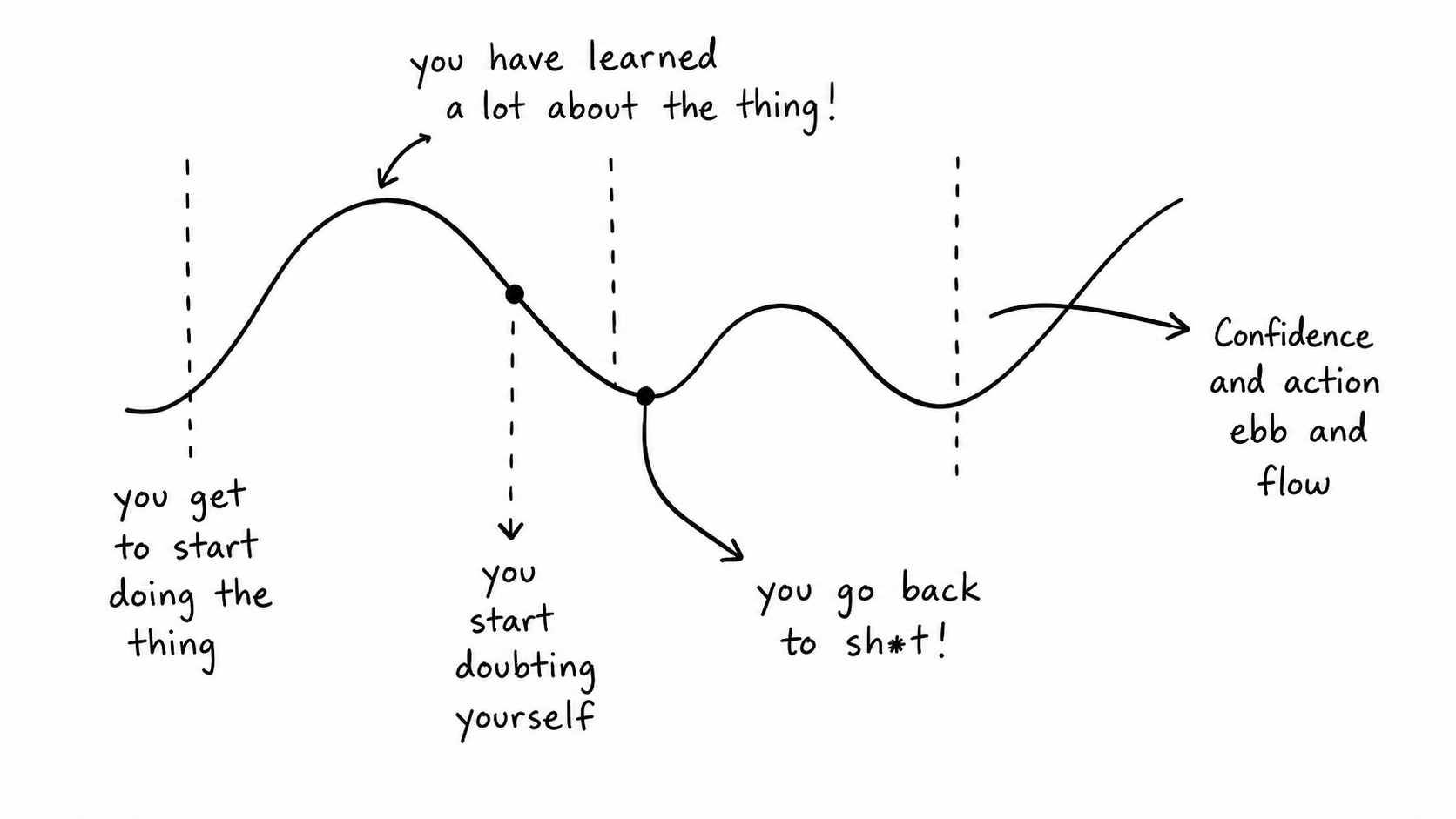
I think that this cycle is explained in part by the Dunning-Kruger effect.
According to PsychologyToday:
The Dunning-Kruger effect is a cognitive bias in which people wrongly overestimate their knowledge or ability in a specific area. This tends to occur because a lack of self-awareness prevents them from accurately assessing their own skills.
This would explain the cycle.
You don’t know much, so you share what you know and you are confident you know, even though you don’t know what you don’t know.
As you learn, your understanding of the matter peaks, and you are on a high, which motivates you to keep learning and to get out of your comfort zone.
With that learning, you start discovering that maybe what you learned before is just a drop of water in an ocean of information, that maybe you don’t know everything. You become less confident. Like what happened to me. I would think more than once before writing a sentence. You start becoming too self-aware. You fall prey of the curse of knowledge.
Then, you lose your confidence on what you know. What’s the point?
You become hyperaware, you compare your ideas with everyone’s. You think everybody has a point, and if they already shared it, then why to waste time sharing yours, at the end of the day, is just one more opinion. Who cares?
Then, you remember why you started this process, and the cycle picks up again, now starting with the baseline of the new knowledge, but with an unknown that you want to address, to keep yourself invested.
And so on.
I think the question at this very point is: is there a way to catch this before reaching rock bottom?
I would say there is a way: The Return Loop
The Return Loop is the cycle we follow from noticing drift to actually returning to what matters. In this case, it means noticing when our thinking is getting biased, seeing how it affects our confidence, and preventing it from steering our behavior into more avoidance.
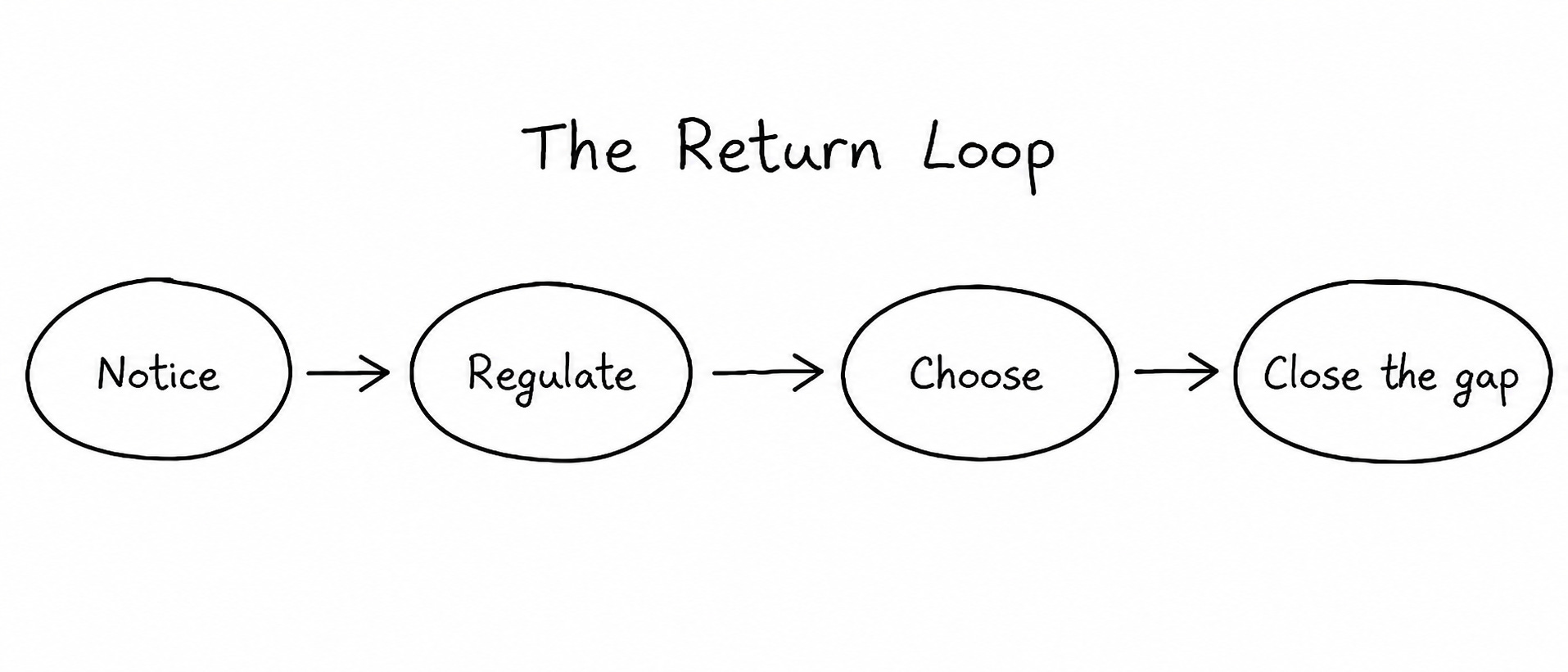
We’ve talked in the past about the idea of awareness: in this space meaning noticing, identifying drift before it has an impact on your behavior. In the case we described, awareness would mean noticing this: you have learned so much that now you are doubting yourself.
But noticing is not sufficient. You can notice and still not take action. And sometimes taking action won’t happen if we don’t regulate how we feel about it. Dysregulation works against that.
If, when you notice it, you freak out and focus on the implications of not doing what you were supposed to do, you might move into a fight-or-flight response, making it even harder to move to the next stage.
So you need to focus on regulation. Which is not suppressing how you feel about it, but slowing down, breathing and telling yourself what you already know, and that it’s fine.
I don’t have all the answers and that’s fine. I know what I know, and I can still share about it.
Once your emotions return to baseline, the next stage is choosing.
Choosing is the deliberate act of deciding what to do next.
You can be aware of your state, you can go back to an emotional baseline, and yet deciding that right now is not the time. And the internal messaging is hard, this is where most of us struggle, because we tell ourselves stories that we want to believe to make the blow less hard: what’s the point?, I already blew it, I’ll start tomorrow, etc...
When you choose, you make a commitment. Nothing crazy or irrational, although for many of us that’s the ideal avenue, the truth is when you choose, you need to start with a small commitment. By doing this, you are leveraging the foot-in-the-door effect. Just for context, in their experiment in 1966, two researchers, Jonathan L. Freedman and Scott C. Fraser, noticed that people who first agreed to a small request were later more likely to agree to a much larger request, like putting a large “Drive safely” sign in their yard1.
You can do the same by making small, focused commitments. It gives your brain proof that the work has already started.
So, you notice, you regulate and then you do a strategic, small commitment. Like writing the outline of your article, or just the rough idea around what you would like to say. You won’t even realize when you will be two hours in, with your article almost written. If it doesn’t happen that way, at least you will have an outline as evidence that you did what you said you’d do, because it’s stupid simple. It doesn’t take more than 5 minutes.
Once you choose and commit, comes the final stage: closing the gap.
You committed. Now you need to execute.
You know how this goes, you have two options here: you either follow through with your commitment, or you don’t.
If you do it, fantastic!
You just returned.
If you don’t, instead of beating yourself up for not carrying forward, ask yourself what drove you to that point. What caused that after noticing, regulating, and finally making a small, almost unavoidable commitment, you couldn’t close the gap?
Ask yourself using a curiosity lens, not a judgmental one.
Experiment and learn. That’s why this is a loop.
It’s not a one time thing.
You’ll realize that the more you do it, the more clearly you’ll see the stage where you get stuck, and the more clearly you see that, the less time it takes to close the gap and get back to what matters.
I would love to talk more about experimentation and learning, but I will leave that for another issue.
In our next paid companion, we will discuss some katas to practice the return loop, and support our practice with the tools it needs to actually work as we want.
For now, try the loop yourself, in the little things. Remember, return is a meta-skill. It’s transversal. This loop applies to every possible domain. So take it as a pro-tip: getting things done is not the only area where this loop excels.
But we can talk about that later.
Have a wonderful week!
✨Ideas Worth Exploring
If this piece resonated, here are a few more that go hand-in-hand.


Freedman, J. L., & Fraser, S. C. (1966). Compliance without pressure: The foot-in-the-door technique. Journal of Personality and Social Psychology, 4(2), 195–202. https://doi.org/10.1037/h0023552