


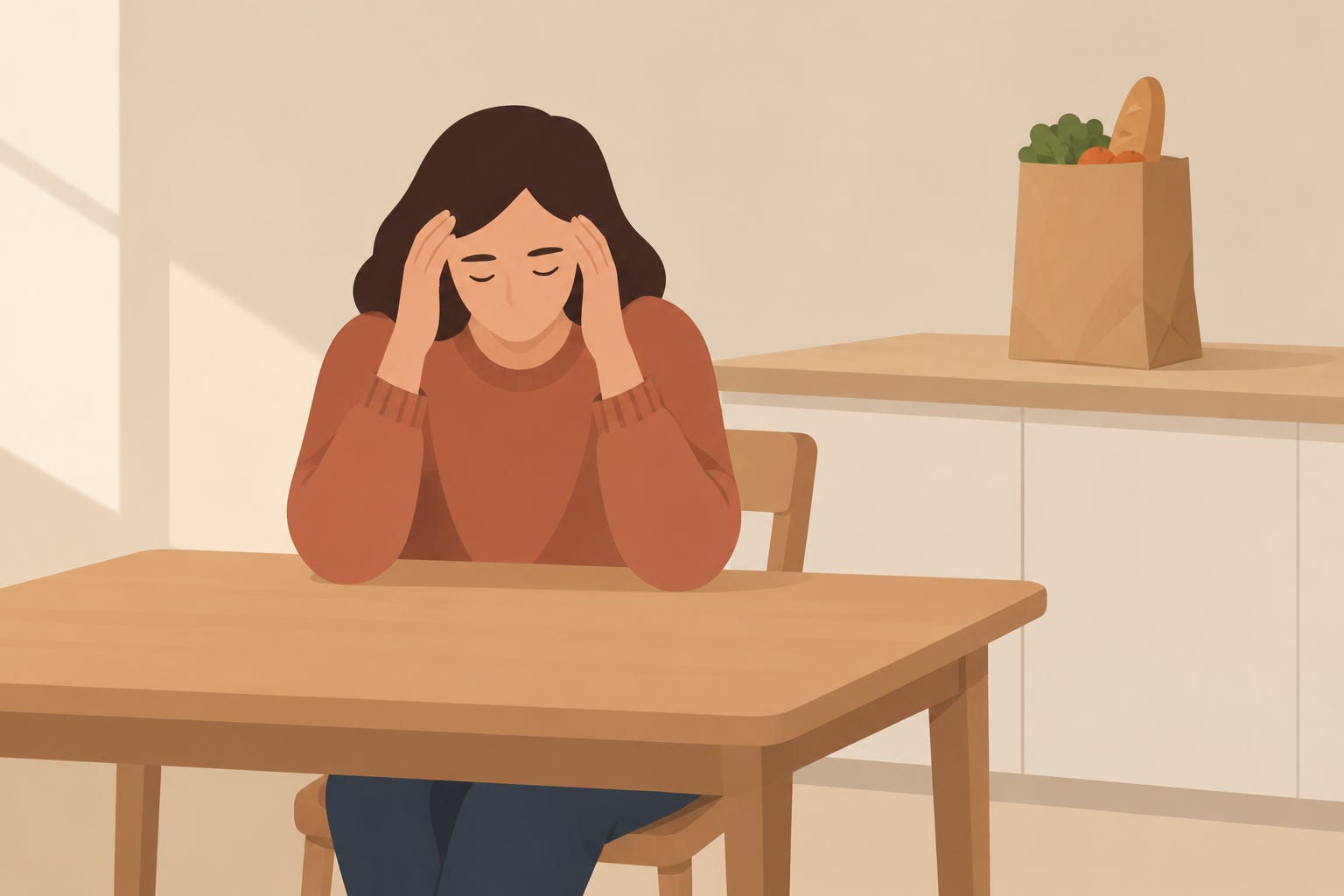
How many times have you caught yourself spiraling and ruminating over something small? Maybe a comment somebody made triggered a response from your brain, and things inside started escalating until you had to complain to that person … about something that was not even what started the cycle?
Free weekly reflections for sustainable discipline.
Straight to your inbox.
Taking things out of proportion was probably the number-one issue I experienced during my journey with anxiety. The chained what-ifs, and consequences that I sometimes knew would probably never happen, were still considered valid options. For my brain, it was just a good unhealthy snack.
I’m fairly sure I’m not the only one out there catastrophizing and getting negatively impacted by it. That’s sort of the signature of somebody who struggles with anxiety.
I’m working on it, and I can tell it has brought results, but it’s the kind of thing that doesn’t really leave; it’s something you learn how to control instead.
Being young, it didn’t really represent too much of an issue, mainly because I spent a long time without an actual formal relationship, and because whatever consequences came from that catastrophizing only exercised power over me, and only me. It was private. It was mine.
Turns out that becoming a husband and a dad changes the picture a little bit. On top of the catastrophization itself, there is the shame of doing it in front of those you love the most, and the guilt because they’re the ones who have to deal with that version of you.
But what if I tell you that, with the proper reframing, you can practice using this behavior in your favor, so it becomes an asset instead of something that drains you?
I’m writing this to show my kids — and you — something I’m still practicing myself. Now I can imagine a thousand ways in which a situation could go wrong and still come back to what actually matters when it happens. After reading this article, my hope is that you can also reach that point someday.
Where I think the habit begins

In order to reframe this, I want to briefly navigate how we get there.
How does catastrophizing become our automated habit? Where does the inner voice that makes us radicalize our thoughts come from? Is it learned? Is it genetic?
So many questions.
For the sake of brevity, the following is what I’ve been able to collect and interpret. Please take it with a grain of salt.
Catastrophizing could be an evolutionary response that simply went off the rails. We developed the ability to anticipate danger and detect threats — detecting a predator coming to get us by hearing the grass rustling, for example. Randolph Nesse, an evolutionary psychiatrist, calls this principle the smoke detector principle. If being cautious is cheap while actually missing a real threat is costly, then it makes sense to have an alarm going off when there is uncertainty, even when it could be a false alarm. This could be why we go from “I hope they got the message right” to “and what if not” to the “oh shit, oh shit” moment.
We learn to anticipate threats and assess risk based on previous consequences. If you fall because you tripped on a rock, you will — I hope — be cautious when you walk nearby next time.
Sometimes threats are associated with people. If somebody betrays your trust, you will naturally try to see what signs you missed, so you can learn how to spot the threat next time. The problem is that, if we don’t carry the right mental models to manage these risks, we can fall prey to the trap of catastrophe.
These mental models are acquired from different places as we grow up, but the most important influence on our worldview, when it comes to dealing with threats, is the one instilled by our parents.
These mental models are instilled in two different ways: through role modeling and through verbalizing them.
When we are young, our parents are our world. We see the world through their eyes, and we learn based on what they teach us. If they see you not making a big deal of a problem, then you probably won’t make a big deal of a problem either. For instance, something very common is kids spilling milk or water (or whatever liquid) on the floor. If the parent’s reaction is:
LOOK AT WHAT YOU DID?! Can you pay attention to what you are doing?
No more TV for the rest of the day.
Naturally, the kid will associate spilling milk with a big no-no, and they will freak out at the bare thought of spilling anything on the ground. Highly effective. Highly traumatizing. For the kid, it’s not only about not spilling milk, but also about a chain of thoughts they’ll carry as a weight. Seeing how effective it is, they’ll start applying it in other areas. Just as spilling milk can turn into no more TV for the rest of the day, other things, like “did I say the wrong thing?”, can trigger a chain of consequences made of pure air.
Sometimes we’re not trying to discipline our kids, but to educate them or share information we consider innocuous and helpful for their decisions. The risk lies in exaggerating the consequences for educational purposes and the kids taking it literally. Science backs this up. Here, the only thing we need to do is be cautious about how much we exaggerate consequences just for the sake of instilling an idea.
For instance, those who are parents are probably familiar with a version of this phrase:
“If you don’t share, nobody will want to play with you.”
You’re trying to help your kid understand why taking turns matters, but if they take you literally, they might hear, “If I say no when someone asks for my toy, I’ll lose my friends.” A small decision about a toy — an issue about sharing, which is proper depending on the age — suddenly feels like a decision about whether they’ll belong, and whether their boundaries are worthy or not.
When a small thing gets ten steps ahead of me
We are not kids anymore — wah wah — and many of those mental models are rooted in our identity.
I’m an engineer, and part of what I do for work is catastrophize. The more you are able to set yourself at the edge cases and think about what could go wrong, the better.
Many senior interviews include what’s called a system design interview, and a big part of the evaluated skill there is being able to identify scenarios where the systems you build won’t work as expected, so you can anticipate them and plan ahead.
While in real life catastrophizing is not an ideal skill, there are other contexts where it can be an asset and actually make the difference in whether you get hired or promoted. The question is: is this worth the pain?
What if we could use catastrophizing as a skill and learn how to control it and run it on demand, when we need it? I bet you think that’d be cool.
Catastrophizing, if you think about it, is sensing a threat and seeing the possible worst case, regardless of how likely it is. This last part is where the problem lies.
What if we were able to develop the ability to see the worst case and plan for it only when it matters?
The first mental model we need to get rid of: not everything is important. Not everything is urgent. If everything was urgent, then nothing would be urgent.
Relearning this is key.
Think about it. When we spend our time catastrophizing, it’s mainly because we see the worst-case scenarios in things we deem important. We keep spiraling because we think it could be very important. The problem is that sometimes what we deem important … is not really that important. For instance, let’s say you are planning your kid’s birthday party, and the night before the party you forget to order and put out the goodie bags. “Oh f*** me, I forgot the bags.” “What will the kids think?” “What will the other parents think?” “What will my kids think?” “Man, I ruined this birthday.” Come the time of the party, hours later, you keep trying to assess if anybody looks disappointed. You wonder if you really f’d it up; in the meantime, your kid is still talking about how much fun they had and how awesome the party their parents threw was.
The whole reason for the birthday, what mattered the most, was for your kid to feel special and have a great day with their friends. At some point, the goodie bags started to feel more important.
What would have happened if you had thought: “Oh f*** me, I forgot the bags.” “Well, it is what it is.” “We’re going to be fine either way. We’ll do our best with what we have, and {your kids’ name} will still have a great party.”
It stops there.
Now, yes, thinking like this sounds utopian and somewhat impossible at times. I mean, we’re not going to be able to change this thought chain overnight, but maybe we can identify what we have control over and practice over time?
Maybe the Return Loop can help us with that.

👉 Want to actually train this, not just read it?
Each week inside Discipline Circle, I publish a short Paid Companion you can work through in 10 minutes on a slow day, so the idea sticks when a hard day hits.
$9.99/month.
What returning looks like
Stick with first impressions. Don’t extrapolate.
Let’s go back to the hypothetical.
If you notice, the reaction is the same in both cases: “Oh f*** me, I forgot the bags.”
That’s instinctual, and if you think about it, it’s a factual reaction: you reacted to something that actually happened. You forgot the bags. Oh welp.
The problem is that we tend to drift away from the facts and get into what-ifs. Those what-ifs are a manifestation of drift — described as the force that pulls us away from coherence — exercising its pull away from what matters. We tend to extrapolate, to think many steps ahead. The problem, then, is not what happens to us, but how we react to it.
Stoicism talks about this too. Marcus Aurelius talks about it in his Meditations:
Nothing but what you get from first impressions. That someone has insulted you, for instance. That — but not that it’s done you any harm. The fact that my son is sick — that I can see. But “that he might die of it,” no. Stick with first impressions. Don’t extrapolate. And nothing can happen to you.
The example Marcus Aurelius shares is very gruesome, but an excellent one. He sees his son being sick, and his mind instinctively jumps to the conclusion that he may die. He then writes a reminder not to let that happen, and to stick to the facts.
In order, then, to be able to catastrophize intentionally, we first need to learn how to stick with first impressions and not extrapolate.
As I spoiled a bit ago, the Return Loop is perfect for this.
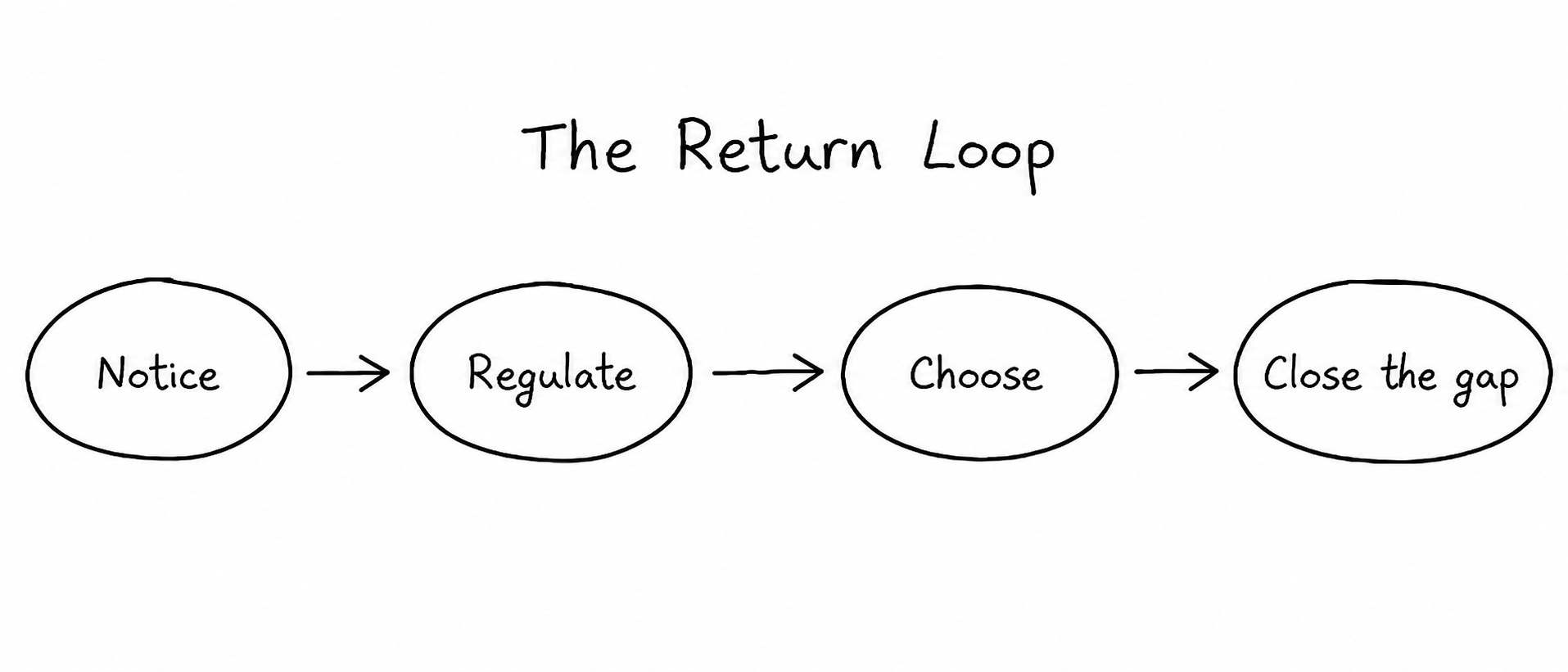
The Return Loop consists of a loop of four steps that help us, by practicing it every time, to return to what matters faster. In this case, if we want to learn to stick with first impressions, we need to:
Practice noticing when we don’t stick with first impressions, for example, the “what will the kids think?” in the birthday example.
Regulate, and when you feel the pull, do something that will help you get back to your baseline. Maybe stop intentionally and let yourself relax first.
Choose what you want to do next: is this really important to keep worrying about? Is there anything you can do? Sometimes the answer is just acceptance.
Act on it, maybe by accepting it: “Well, it is what it is.” This closes the gap.
Over time, your default will move from automatically catastrophizing over every little thought to actually stopping and assessing whether it’s even worth the mental toll.
Then, you will have the choice of whether to use it in your favor or simply not use it.
The constant practice of this is a form of discipline.
If you are going through this now
The first thing I’d say is: you are not broken, and there is nothing to feel ashamed of.
I’ve been in that spot, and I know how hard it is because I have loved ones telling me to stop thinking in the worst cases — even when, in some cases, it’s guaranteed — so you can feel gaslighted at some point.
What I would like to say is that a lot of people don’t have these types of thoughts, so it’s hard for them to relate to the way your brain operates. That doesn’t make them bad or toxic, and it doesn’t make you broken or wrong. The best thing you can do, which I know works because it worked for me, is to speak honestly about how your thought process works. People who really care will learn to help you identify when things matter versus when they don’t, and that will help a lot during the process of practicing the skill intentionally.
In our next paid companion, we will navigate ways to regulate when practicing this skill, because regulation plays an important role: it will decide what options lay out in your mind when you’re defaulting.
In the meantime, if you want to work on your catastrophizing and want to know more about my own experience, I’d be happy to help, so please shoot me a DM or leave a comment, and I’ll try to share as much as I can with you.
I hope you have a wonderful week!
✨ Ideas Worth Exploring
If this piece resonated, here are a few more that go hand-in-hand.


