


For some reason, my brain started spawning a lot of ideas about what to write.
I attribute it to the fact that maybe I’m not so burned out anymore. I’ve talked a lot about that, which, in its own way, has been therapeutic.
Now, my brain is starting to unlock again, and writing doesn’t even feel that forced. Not that it did that much before, but it took a toll on me trying to figure out the throughline, what my idea of the week would be, and how to make that compatible with my current journey. Now I’m enjoying it again. It’s cyclical, and that’s okay. Hey, I managed to keep writing in spite of — and because of — the journey.
Free weekly reflections for sustainable discipline.
Straight to your inbox.
So here we are. Fresh again.
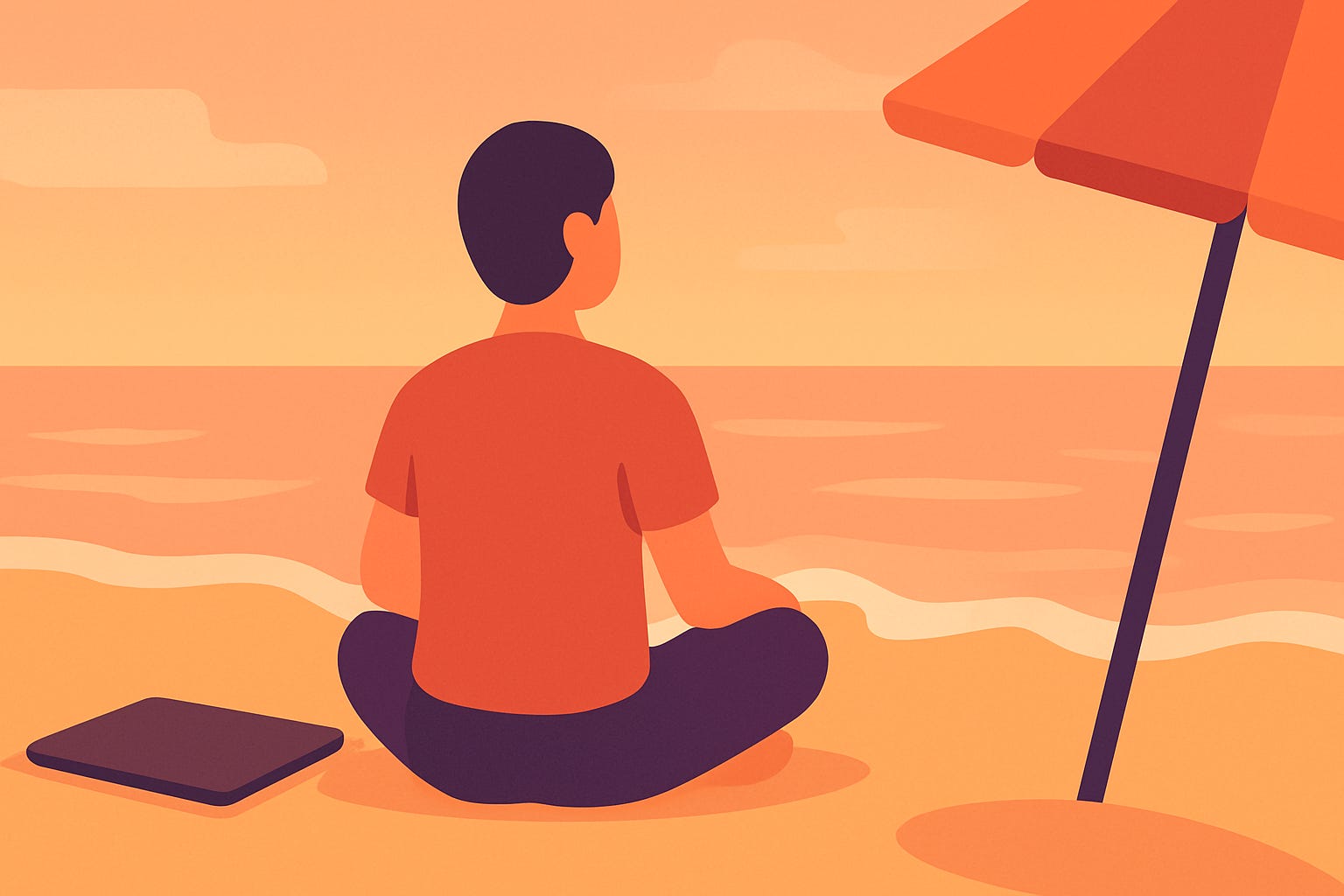
As I write this, I’m taking a short break from cleaning our house because we are going on vacation as a family, and we want to come back to a fairly decent house. We haven’t traveled since December 2025, and now feels like a much-needed opportunity to break the routine and build memories together as a family while relaxing in the process.
Now, I’ve given a lot of thought to what my idea of a vacation is, or more specifically, a getaway. I think it was Marcus Aurelius who said, in his book Meditations:
Men seek retreats for themselves, houses in the country, sea-shores, and mountains… But this is altogether a mark of the most common sort of men, for it is in your power whenever you shall choose to retire into yourself.
My interpretation of this boils down to the idea that those who travel to escape are not really escaping. What they’re looking for is to find peace elsewhere, when many times peace needs to be found within yourself.
This article will try to make sense of this: to introduce the idea of inner peace, how it can impact our behavior and decisions, and how we can use this idea to manage our return. Hold tight.
Escaping from what?
The idea of escaping is old. Like, millennia old. Lucretius writes about this in his book De Rerum Natura. There, he describes a man who gets tired of being at home, decides to leave the house where he lives, and rushes to his country villa. Once at the villa, he immediately gets bored, so he flees back to town. Lucretius describes this behavior — the man’s attempt to move around as a mechanism for putting down the issues in his mind — as “each human flees himself.”
This is interesting because it aligns with Marcus Aurelius’ quote. Now, this makes it sound like people just want to vacation to escape from themselves, but what are we really escaping from when we take vacations?
A study on motivations to go on vacation, performed by Doran, Larsen, and Wolff, surveyed 474 tourists in Bergen, Norway, and showed something interesting. The most popular motive was to “experience new things,” while the second most popular was to “get away from the normal environment.”
Okay, so when people want to escape, they are not trying to escape from themselves. They are trying to escape, momentarily, from the environment that wraps around their everyday lives, to experience life differently from how they would otherwise. If you are having a hard time at work, for instance, you might want to go to the beach so you can redirect your attention to an environment that triggers different emotions. Now, the study makes this very clear: people don’t always travel to overcome a bad mood, but to create different conditions that allow them to recover.
And it works, to a certain extent.
How sustainable is the recovery?
So, based on the shared evidence, it seems that many people are trying to go on vacation not to escape from reality or even themselves, but to experience different environments and be exposed to different experiences that can modify some of the environmental elements surrounding them on a daily basis. Sometimes, they do this with the intention of recovering from the demands of the environment they’re currently immersed in.
I think the distinction between escaping reality and trying to move yourself away from a specific environment is vast. Escaping reality, in my opinion, points more toward lying to yourself, not necessarily with ill intentions, but as a way to protect your mental well-being at the cost of living in a reality that is not real. Moving away from an environment is essentially that: taking yourself away from the environment you’re currently in and moving to one that is completely different, through different experiences, all of them very real.
So, while taking a vacation to relax, have adventures, and discover new things is a great start for recovery, this is just the first step.
When you take a vacation, you are removing many of the cues and demands that the environment you’re inserted into every day brings with it. On top of that, you have novelty, which can redirect your attention and help with psychological detachment from whatever situation you’re in back home. This is great because it creates the conditions that can actually help us start recovering.
But recovery doesn’t happen in a day. It does start very quickly after you take a vacation, but studies have found that, once you return, issues like burnout can begin to rebound within days. In one study, it returned to pre-vacation levels in three weeks. And one reason this can happen is that environmental elements that were ablated during vacation are now back in the game, bringing back the possibility of eroding some of the recovery gained during the getaway.
So, while vacationing is helpful, there is a risk of getting back to our old ways, which can become a vicious circle: we move from vacation to vacation, hoping that the next one will help us fully recover for good. The thing is, is that even possible? How can we make recovery sustainable and use vacations as checkpoints that help us build on recovery, rather than as reset points that take us back to zero every time?

👉 Want to actually train this, not just read it?
Each week inside Discipline Circle, I publish a short Paid Companion you can work through in 10 minutes on a slow day, so the idea sticks when a hard day hits.
$9.99/month.
Searching for inner peace
I’ll give you everything I’ve got for a little peace of mind… — “I’m So Tired,” The Beatles
I think that, while people are not necessarily looking to escape from reality, they are looking to move away from their current environment because that environment is having a psychological impact on their well-being, which may affect other areas of their lives.
We have talked before about the impacts of burnout and emotional bottling-up. In the same way, there are other phenomena and cycles that impact our well-being and are part of our day-to-day lives. When we want to go on vacation, we are usually not looking to get away from our essence, from who we are, but to leave behind — at least for a while — the factors that contribute to us being in those cycles; the cycles that are messing with our inner peace.
I have a hot take, which is that when we feel unhappy with a situation, many times it really means we don’t feel at peace with it. Now, this is just an opinion, but if you think about it, what you are looking for in many of these cases is not to be happy, but to be at peace with what surrounds you. If you have arguments with your partner, many times it can be over stupid stuff, and while you might be feeling unhappy, maybe you are startled by the fact that the peace at home has been broken and now needs to be restored — otherwise your inner peace is impacted. If your day is just not going well, things to do at home have been piling up, your family is not being supportive, or, I don’t know, maybe your neurodivergence is making things a little bit harder, then it’s not really that you are unhappy; it’s that your inner peace is being disrupted over and over without space for actual grounding.
I’ve been following forums and places where people talk about their work and the current market situation. It is awful out there for many: people are being blindsided, overworked, and burned out at work. It’s natural to want to get away from all of this, to get some sense of peace, especially now that we live in a remote-friendly environment. Before, for those of us, like me, who worked in an office, we would be able to go from the workplace to home and not necessarily forget about work altogether, but that created a physical boundary that marked the change of environment, a cue that brought us back to ourselves. Now it’s harder because the limit, many times, is to put your laptop down and try to carry on with the day, which, for many — myself included — is borderline impossible.
Now, while all of these occurrences don’t necessarily make you unhappy, I think the constant disruption of your inner peace can lead to unhappiness. And, actually, science has something to say about this as well. It turns out that what I’m describing here as inner peace has a close counterpart in psychology: peace of mind, the internal state of peacefulness and harmony.
I want to be very clear here. As I understand it, peace of mind, or inner peace, does not mean not experiencing disturbances. Science describes it more closely as having a relatively stable internal state; it’s more associated with the existence of that stable internal state in spite of those disturbances.
And studies show that developing peace of mind has a big impact. A 2022 study from the Belgian National Happiness Study looked at life satisfaction and positive and negative affect — affect is a technical term in psychology that essentially means “an internal emotional state.” The study showed that peace of mind was significantly associated with those three states, suggesting that it is meaningfully related to well-being. Something very interesting, which aligns with what I mentioned before, is that it also showed that, while related to subjective well-being, peace of mind is not a synonym for happiness.
The trifecta
So, if peace of mind is not a synonym for happiness, what is happiness in this case, and how is it impacted by peace of mind? And, most importantly, what is the impact of all of this on our behavior?
Well, for starters, and as a recap of what we’ve talked about — actually, what my thesis here is about — I think that when we look to get away from our current environment, it’s not because we are unhappy or because we want to be happier. I think that, at this point, we all know that the detachment from our environment that we feel during vacations is usually fleeting. So maybe we know this won’t make us magically happy. Maybe we are looking for the conditions that make peace of mind easier to recover because, somewhere, we know that by reaching a greater peace of mind, we might eventually become happier.
But what is happiness?
From what I understand, there is no universally accepted scientific definition for this concept, but the dominant one is the idea of subjective well-being (SWB). The OECD defines subjective well-being as:
Good mental states, including all of the various evaluations, positive and negative, that people make of their lives and the affective reactions of people to their experiences.
This, added to what we discussed in the previous section, helps support the thesis above: peace of mind is not equal to happiness, but is a contributor to it.
How can happiness impact our behavior?
Here I will share my understanding of the impact of happiness through the lens of drift, as an enabler of behavior. So please keep that in mind while reading this, and take it with a grain of salt.
We’ve talked about drift as the force that pulls us out of coherence, making us behave in ways that don’t make sense for us. We act out of character.
Drift manifests through many channels, and it is impacted by different factors — which can sometimes also be the channels through which drift manifests — for instance, your environment, your circumstances, your current physiological state, and so on.
Subjective well-being, then, may be another factor that makes drift easier or harder to resist. If you are not in a good mental state, you might be more inclined to make reactive decisions that might externalize as out-of-character behavior. On the other hand, if you are in a good mental state, you might see things differently, leading to more coherent behavior.
There are studies that show that higher well-being seems to be associated with better physiological recovery from stress, instead of simply preventing stress from happening. This makes me believe that people who tend to remain in a better mental state tend to recover faster.
This ability to emotionally regulate so that you remain relatively balanced in the face of pleasant or unpleasant experiences is what’s called equanimity.
Then the pieces connect:
Your inner peace contributes to a better, more positive mental state.
That positive state can help you recover better from stress.
Equanimity helps you remain more balanced when disturbances happen, making it easier to return to that state.
Then, as you develop equanimity, you become better at preserving — and returning to — your inner peace.
At the end, what the Stoics talked about — retreating into yourself and being able to govern your response to your emotions — was precisely this: developing equanimity so your emotions don’t rob you of your peace.
What can we do about it?
If you didn’t see it yet, the cycle I just shared for inner peace is essentially the idea of return applied to emotional regulation.
Developing equanimity means developing the ability to reduce how strongly disturbances govern you. As you learn this ability, you start learning to return to your emotional baseline when life disrupts it. Practicing this ability, then, becomes a form of discipline.
What this means is that the expectation shouldn’t be to avoid emotional disruptions. They will always happen. The focus now should be on embracing those emotions and learning how to return to your baseline so your behavior doesn’t perpetuate a damaging cycle.
Going on vacation can certainly interrupt these cycles, but you have to consider that it is only the first step: starting the recovery. Once it has started, your goal should not be to make vacations the next rescue operation, but to use them as checkpoints from which recovery can continue. That way, you can make sure that when you return home, you will be able to retreat into yourself and return every time you need to.
In our next paid companion, we will navigate strategies for emotional regulation so they can help you develop the equanimity we’ve been talking about today.
Until then, make sure that when you look for your next getaway, you also look inside and think about how you can make the recovery sustainable.
I hope you have a wonderful week!
✨Ideas Worth Exploring
If this piece resonated, here are a few more that go hand-in-hand.


