


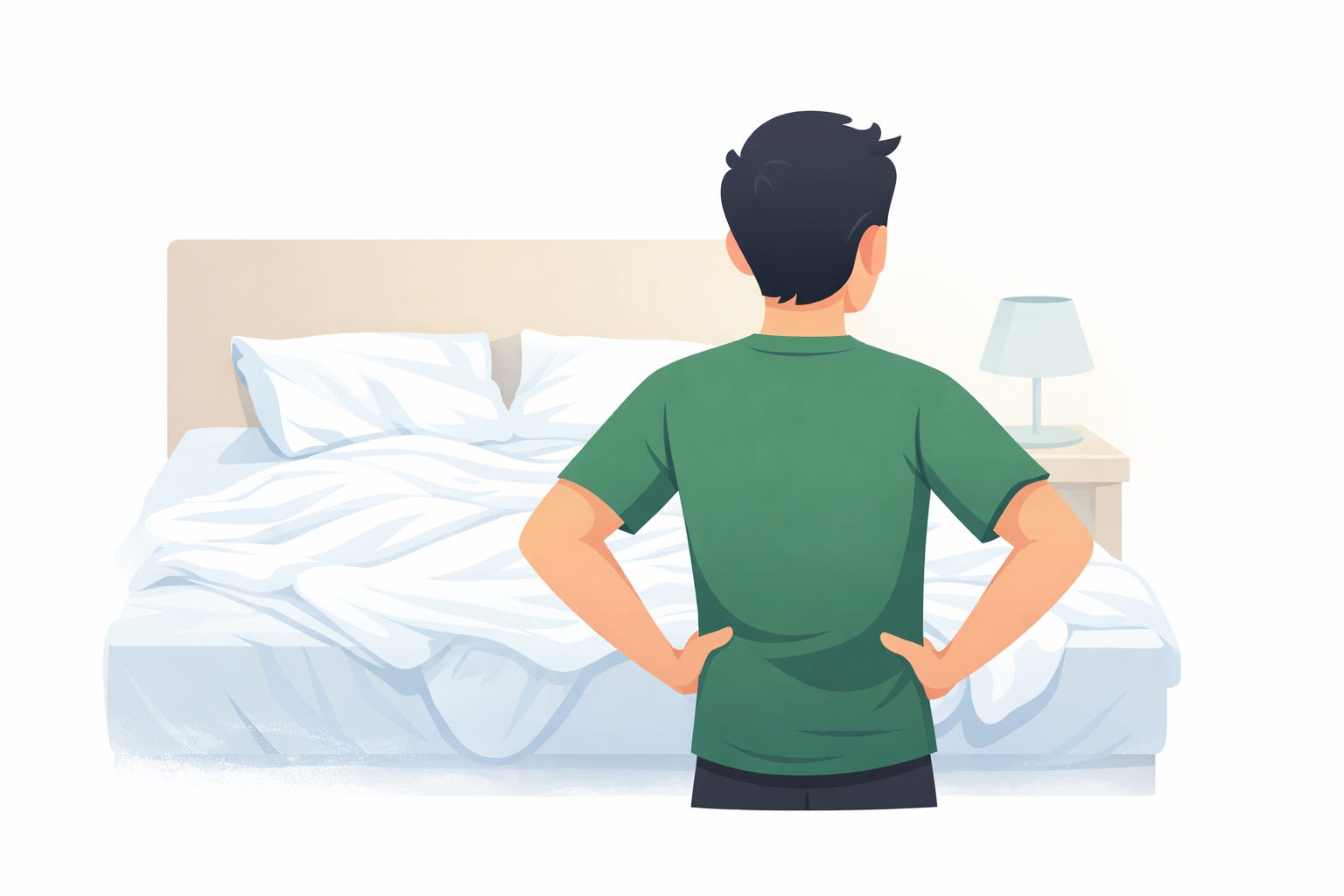
Not too long ago, I caught myself doing something I’ve done many times: standing there, looking at the bed, deciding if I’m going to make it or not.
It’s a small decision, I know, but I find it useful. I’ve had phases where I made the bed every day, phases where I didn’t do it at all, and phases where I’d do it for a week, drop it for two, then come back. What changed over time wasn’t the routine.
It was the story I attached to it.
Years ago I ran into Admiral William McRaven’s “make your bed” idea. The message was simple: start your day by finishing one task, get a first win, and let that win set the tone. Back then I loved it because I was chasing self-control. I wanted proof that I could keep myself in check, even with something as basic as making my own bed.
The problem is that proof turns into policing fast. I didn’t just want a made bed; I wanted to feel like I had myself under control, so when I didn’t do it, I paid for it twice: once with the mess and once with the story, the moral tax.
When I started, I had zero notion of what self-discipline entailed. For me, being self-disciplined was controlling myself and doing things even when I didn’t feel like it. Forcing willpower and pushing through.
Because, isn’t that what discipline is about?
Same mechanism, different lens
Over time that story stopped working for me. The mechanism is the same, but the lens changed, and that changed everything.
I stopped treating the bed like a discipline test and started treating it like a choice.
Now I know that I always have the choice.
If I don’t make the bed, it’s not an accident; it’s not me “failing” the routine. It’s me choosing to spend my energy somewhere else in that moment and accepting what comes with that choice.
And there’s a real consequence for me. I don’t like sleeping in an unmade bed because I get trapped in the bedsheets. I don’t sleep as comfortably.
That’s not a moral punishment; it’s just the outcome.
So the question isn’t, “Do I have enough self-control to do it?” The question is, “Do I want to pay that cost tonight, or do I want to invest the five minutes now?”
Sometimes I’m tired, and I still do it; sometimes I’m tired, and I don’t. Either way, I’m not letting it turn into a story about my character. I’m deciding. It’s under my control.
That being said, I think the real upgrade isn’t self-control.
It’s agency.
Self-control is the story where you fight yourself all day and hope you win. You are trying to keep the lion tamed for the show today, hoping it won’t bite you tomorrow.
Agency is the story where, even when you’re tired or stressed or the day has gone sideways, you still choose the conditions on purpose, knowing that whatever happens next comes from that choice.
Making the bed is just a clean example because it’s simple, it’s under your control, and it shows the difference fast. It’s not necessarily about being neat; it’s more about not outsourcing your day to luck.

👉 Want to actually train this, not just read it?
Each week, alongside this reflection, I publish a short practice guide — something you can work through in 10 minutes on a slow day, so the idea sticks when a hard day hits.
It’s called the Paid Companion. $9.99/month.
Why a made bed matters more than it should
On paper, this is a really dumb hill to die on — I actually laughed while writing this.
A made bed doesn’t pay your bills, doesn’t fix your marriage, doesn’t move your career forward, and doesn’t protect you from a hard season, but the bed shows you something most people forget under pressure: you still have a pocket of control.
When life gets heavy, we don’t just stop doing routines. We start acting like we don’t get to choose anymore. The day turns into a sequence of reactions. You wake up already behind, you take hit after hit, and you tell yourself you’ll reset later, but later never really comes.
That’s why a small, deliberate action matters. Not because it solves your problems, but because it interrupts the feeling that you’re being carried. It reminds you that you can still decide one thing, even if the bigger picture is messy.
And if you’re in a stretch where you feel stuck, that reminder is not trivial. It’s often the first step back.
What small actions do to your brain
This isn’t about making the bed itself; it’s about how small intentional actions affect your sense of control.
There’s a concept in psychology called self-efficacy, which is basically your belief that you can follow through and handle what’s in front of you1. That belief gets shaped by evidence, and one of the strongest sources of that evidence is succeeding at a task, even a small one2. When you take a small action you intended to take, you create evidence that you can direct yourself. When you don’t, and you interpret that as “I’m not the kind of person who follows through,” you create evidence in the opposite direction.
That last self-talk is the one that I had to snap myself from because it doesn’t just sit there as a thought. It changes your expectations, and expectations change behavior.
There’s a concept called the Pygmalion effect. It’s usually talked about in classrooms or workplaces, where expectations shape performance3. In the classic Pygmalion studies, teachers’ expectations influenced students’ performance; the same logic applies to how we expect things from ourselves. If you start expecting, “I don’t follow through,” you’ll act like it. You’ll hesitate to start, you’ll avoid committing, and you’ll treat the next rep like it’s already lost.
Neuroscience gives a simple explanation for why it compounds. Your brain is constantly learning from outcomes by updating predictions about what will happen next4. If you skip and tell yourself, “This is who I am,” you’re feeding that prediction model a stronger story to reuse.
On top of that, skipping often brings immediate relief, and relief is reinforcing. Avoidance gets rewarded, so returning starts to feel heavier than the task itself5.
That’s the downward spiral. The good news is the same machinery works in reverse. When you create a small win on purpose, you don’t just complete a task; you update your expectations, and your brain starts predicting follow-through again.
There’s also research on progress and “small wins” showing that making progress, even in small increments, tends to improve motivation and engagement6. Not because the task is important on its own, but because progress changes how you feel about the rest of your day.
And in general, perceived control matters. When life feels unpredictable, stress goes up. Regaining even a small sense of control is consistently linked to better coping and well-being, while chronic uncontrollable stressors are a classic pathway to helplessness-like responses7.
A five-minute practice for agency
If I had to recommend one action to someone who feels like life is just happening to them lately, it wouldn’t be “make your bed.”
It would be: pick one small action you can do daily that reminds you you still have agency.
Make it five minutes or less. Make it something fully under your control. Make it something you can do even on a bad day.
The action itself doesn’t need to be impressive; it just needs to be deliberate.
For some people, that will be making the bed. For others it’s clearing one surface, setting up tomorrow’s first move, stepping outside for a short walk, writing a few lines in a note, or anything that says, “I can still direct something.”
Then add the rule that prevents this from turning into another moral scoreboard.
If you skip it, don’t attack yourself. Just accept the consequence and come back tomorrow.
That’s the whole point.
You’re practicing return, not perfection.
Why returning beats being perfect
The part that usually breaks people isn’t the routine but the interpretation.
When you miss a habit and you treat it like proof that you’re failing, you add friction to the restart. You make the next rep heavier than it needs to be. In relapse-prevention research, there’s a well-known pattern where a lapse can trigger self-blame, guilt, and a drop in perceived control, which then makes further lapses more likely. That pattern has a name: the abstinence violation effect8. I’m not saying your bed is like alcohol. I’m saying the mechanism of “one slip becomes a story about me” shows up in a lot of human behavior.
People who can treat a lapse as a lapse, instead of a character problem, tend to recover and persist better, because they protect self-efficacy instead of shredding it.
And more broadly, self-compassion research suggests that being less punitive with yourself after failure is associated with more adaptive coping and better follow-through on self-improvement behaviors, while harsh self-criticism tends to predict worse persistence9.
On the habit side, the routines that last are the ones that survive disruption. Life doesn’t stay stable. So the skill that matters isn’t “never miss.” The skill is “return fast without drama.” A useful way to frame it is: habits that endure are often the ones that can re-form after breaks, not the ones that never get interrupted10.
That’s also what changed for me with the bed. If I don’t make it, I’m not banned from comfort. I can still make it later, or I can accept that tonight won’t feel as good, and either way I’m not using it as punishment. I’m choosing.
What to take home
Making the bed became more than a routine for me; it became a reminder.
Not that I’m perfectly disciplined — I’ll be working on that for the rest of my life. Nor that I’m better than anyone. It’s just a reminder that I still have choices, even on days where it doesn’t feel like it; that I can still control my actions and decide what I do next.
We forget that more often than we want to admit. We get stressed, tired, and pulled, and we start acting like the steering wheel isn’t there. When that happens, drift starts to dominate, but one small deliberate action is a sure way to stop the cycle and return to what matters.
In our next paid companion, we will work on training the muscle of deliberate choice. Choosing based on coherence rather than drift, including accepting the consequences of not taking action.
For now, pick your next action. Make it small. Do it on purpose, and if you miss it, come back tomorrow.
And remember:
You’re not proving you never drift; you’re practicing coming back on purpose.
Have a wonderful weekend!
✨ Ideas Worth Exploring
If this piece resonated, here are a few more that go hand-in-hand.


Bandura, A. (1977). Self-efficacy: Toward a unifying theory of behavioral change. Psychological Review, 84(2), 191–215. https://doi.org/10.1037/0033-295X.84.2.191
Artino, A. R., Jr. (2012). Academic self-efficacy: From educational theory to instructional practice. Perspectives on Medical Education, 1(2), 76–85. https://doi.org/10.1007/s40037-012-0012-5
Rosenthal, R., & Jacobson, L. (1968). Pygmalion in the classroom: Teacher expectation and pupils’ intellectual development. Holt, Rinehart & Winston.
Schultz, W. (2016). Dopamine reward prediction error coding. Dialogues in Clinical Neuroscience, 18(1), 23–32. https://doi.org/10.31887/DCNS.2016.18.1/wschultz
Krypotos, A.-M., Effting, M., Kindt, M., & Beckers, T. (2015). Avoidance learning: A review of theoretical models and recent developments. Frontiers in Behavioral Neuroscience, 9, 189. https://doi.org/10.3389/fnbeh.2015.00189
Amabile, T. M., & Kramer, S. J. (2011). The progress principle: Using small wins to ignite joy, engagement, and creativity at work. Harvard Business Review Press.
Maier, S. F., & Seligman, M. E. P. (1976). Learned helplessness: Theory and evidence. Journal of Experimental Psychology: General, 105(1), 3–46. https://doi.org/10.1037/0096-3445.105.1.3
Larimer, M. E., Palmer, R. S., & Marlatt, G. A. (1999). Relapse prevention: An overview of Marlatt’s cognitive-behavioral model. Alcohol Research & Health, 23(2), 151–160.
Neff, K. D., Hsieh, Y.-P., & Dejitterat, K. (2005). Self-compassion, achievement goals, and coping with academic failure. Self and Identity, 4(3), 263–287. https://doi.org/10.1080/13576500444000317
Gardner, B. (2024). What is habit and how can it be used to change real-world behaviour? Narrowing the theory–reality gap. Social and Personality Psychology Compass, 18(6), e12975. https://doi.org/10.1111/spc3.12975
Hey
Making a bed may be a small trivial thing but this puts your actions in a self discipline mode 👏👌🏽
Good article Camilo