


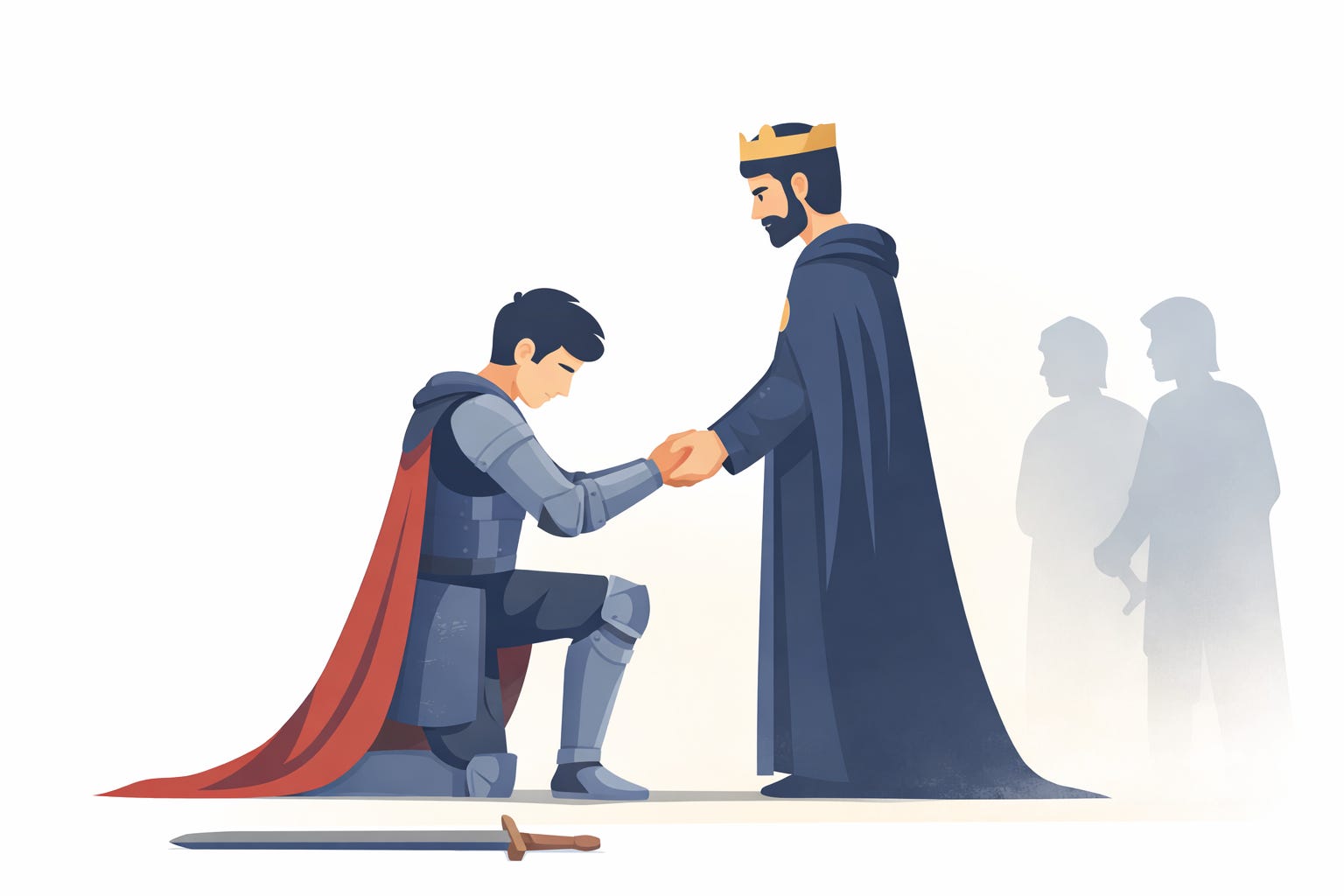
I was walking my dog the other night, while doomscrolling — I know, right? — and while looking at some posts and threads here and there, a thought came: I couldn’t remember the last time I’d heard somebody use the word honor.
I remember watching anime and reading comics and books and the word honor was somehow included, not explicitly in many cases, but implied through the actions performed by the characters.
I started looking back, and the last memories of exposure to the word honor were under a completely different context: talking with my wife about the honor society. So yeah, it was not something with legendary tints, but more mundane and accessible. In Chile we have a similar version, the cuadro de honor — or honor diploma — which is essentially the same thing: you perform well, and your performance, and maybe effort, gets publicly acknowledged.
That’s a more than legitimate use, but as with discipline — which I’ve discussed in other articles — it’s not what I mean.
The type of honor I mean — and the one that you probably recognize from movies and books — is the one tied to one’s words and acts. The one that sits underneath a person’s decisions. The type of honor that leads you to follow through even when nobody’s forcing you. The one that earns respect, because in the toughest moments, it leads you to conduct yourself according to who you want to be.
That’s gone from our speech. And I think something else left with it.
Honor is self-governance with a social edge
Look up the word and you get variations of the same cluster: respect, reputation, honesty, a code you live by. The Cambridge Dictionary ties it to respect, pride, and honesty.1 The Oxford English Dictionary puts “reputation, good name” near the center.2 Social science lands in a similar place — honor is part self-worth, part reputation. Both matter, and they feed each other.
The way I think about it:
Honor is the internal code you protect publicly and privately, expressed through integrity, keeping your word, and behaving in a way you would stand behind.
That overlaps with self-governance almost perfectly. The difference is the social edge. With honor, your standard is personal, and it also becomes visible. Your word becomes legible to other people. Your reputation becomes part of the incentive structure.
And that part matters more than people give it credit for. When a community expects you to follow through, the stakes change. Your “I’ll do it” means something because breaking it costs you something real — reputation, trust, standing. That’s not just social pressure. That’s a feedback loop that keeps self-governance alive.
My guess is that as honor faded from how we talk, some of that feedback loop went with it.

👉 Want to actually train this, not just read it?
Each week, alongside this reflection, I publish a short practice guide — something you can work through in 10 minutes on a slow day, so the idea sticks when a hard day hits.
It’s called the Paid Companion. $9.99/month.
When your word stops being enough, paperwork takes over
Think about how much of daily life now runs on documented proof that you’ll do what you said. Contracts, signatures, terms of service, screenshots of conversations, paper trails for things that used to just... happen on a handshake. Some of that is necessary — the world is more complex, transactions are bigger, strangers are involved. But the direction is hard to ignore.
When people’s word stops being enough, we outsource trust to systems. And over time, that changes how it feels to live alongside each other. You start assuming the worst-case scenario before anything has gone wrong. You protect yourself first. Not because you’re cynical, but because you’ve learned that plenty of promises don’t hold.
And once enough people operate that way, it becomes self-fulfilling. If nobody expects your word to mean anything, why would it? The cheap promise spreads because it’s the rational response to an environment where follow-through is optional.
The obvious word for what’s missing here is honor. But that word has its own problem now.
Honor has been around for a long time. Long enough that entire cultures were built around it. Take the Japanese and Bushido — for samurai, honor wasn’t a value you listed on a resume. It was the organizing principle of how you lived, how you fought, how you treated others, and yes, how you died. Seppuku — ritual suicide to restore honor — sounds extreme from the outside, but it only makes sense inside a framework where honor is genuinely load-bearing. Where it’s not just reputation but the foundation of your identity and your place in the world.
That kind of honor had real internal weight. And it did practical work too. In societies where formal enforcement was limited — no courts you could easily access, no contracts a stranger would honor — your reputation was the system. Your name was a signal. It told people whether you were safe to trade with, lend to, partner with, rely on. Honor wasn’t decoration. It was informal governance.3
That’s also why it shows up so often in older literature — not because writers thought it sounded noble, but because it was a live wire in the social world they were describing. Characters made decisions under the pressure of reputation, family standing, loyalty, betrayal. The stakes were real because the consequences were real.4
What I think happened is this. The internal principle faded. The sense that your word is a reflection of who you are, that following through is non-negotiable not because someone is watching but because you are — that part got harder to sustain in a world that kept getting bigger, faster, and more anonymous. But the rituals didn’t fade with it. The external pressure, the reputation obsession, the idea that family name or group standing had to be protected at all costs — that stuck around. And without the internal principle anchoring it, it turned into something else. Control. Punishment. Violence dressed up in the language of honor.
That’s why the word picked up such dark associations. It’s not that honor was always corrupted. It’s that we ended up with the shell of it — the extrinsic pressure, the public consequence, the rituals — without the substance that made those things meaningful in the first place. And because we couldn’t cleanly separate the two, we dropped the whole word.
Which left us with a gap we haven’t really named since. And it’s worth asking why — not just culturally, but mechanically. Why does modern life make it so easy to let your word mean nothing?
Why modern life makes dishonor cheaper — and why that’s not the end of the story
This isn’t just a feeling. There’s some science worth knowing here.
The first part is about scale. In a small community, breaking your word costs you something immediate and visible — your reputation, your relationships, your standing. In a massive, anonymous world, that cost drops. People can disappear, reinvent, present different versions of themselves to different audiences. The link between action and consequence loosens.
Psychologist John Suler studied exactly this — what he called the “online disinhibition effect.”5 When you remove face-to-face cues, visibility, and the sense that authority is watching, people behave in ways they wouldn’t in person. The social friction that normally keeps behavior in check gets thinner. And when that friction disappears, drift spreads faster. Not because people are worse online — but because the environment stopped making follow-through the default.
The second part is more hopeful. Your brain adapts to what you repeat. The research on neuroplasticity is clear on this: repeated behaviors build neural pathways that make those behaviors easier over time. That applies to returning to your internal code just as much as it applies to anything else. Every time you follow through when you could have drifted, you’re not just keeping a promise — you’re making the next return slightly cheaper. Do it enough times and coherence stops being an effort. It becomes the default.
Which is exactly what honor looks like from the outside. And the people who still operate that way? They’re not rare because honor is hard. They’re rare because most people never practiced the returning enough for it to become default.
The gap doesn’t mean the concept is gone
The word disappeared. The concept didn’t. And in a low-trust environment, the people who still operate by it — who follow through without being chased, who own mistakes without evasiveness, who repair quickly — stand out in a way that’s hard to fake.
It reduces friction everywhere you go.
Professionally, I think this matters more each year. Modern organizations are complex, remote, distributed, fast. They depend on people who can act without supervision, carry responsibility without constant monitoring, and do what they said they would do. The more a company has to build systems to protect itself from broken promises, the more overhead it carries. People often describe what’s missing as “accountability” — but accountability sounds like management language. What they’re actually describing is honor. The internal engine that reduces the need for external enforcement in the first place.
Personally, the effect is even clearer. When you keep your word to your kids, you build safety. When you keep your word to your partner, you build stability. When you keep your word to yourself, you build something closer to identity. Your life starts matching what you say, and that’s a different feeling than constantly managing the gap between the two.
That’s the part that connects back to what I keep writing about. Those people who still operate by their internal code — they didn’t get there by being naturally honorable. They’ve had to face drift, the same drift everyone faces. The difference is they kept returning to their internal code. That returning, practiced consistently, is what discipline actually is. And when that practice becomes default — when coherence stops being an effort and starts being who you are — that’s self-governance. Honor is what self-governance looks like when it’s visible to others. The reputation isn’t something you manage. It’s a byproduct of the practice being consistent enough that people can read it.
Which means honor isn’t something you either have or don’t. It’s something discipline builds toward.
Try this before the week is out
Set a timer for ten minutes and do a word audit. Write down a few promises you kept recently — including the small ones you’d normally not even register. Then write down a few you didn’t keep, especially the tiny commitments that are easy to shrug off. Pick one broken promise and ask one question: what would I change so this one is easier to keep next time?
If you draw a blank, go smaller. Replying when you said you would. Showing up on time. The errand you mentioned and forgot.
You’re not looking for a verdict on your character. You’re looking for a design flaw. Something in the setup that made drift the easier option. Fix that one thing and move on.
Do that a few times and something starts to shift — not dramatically, but noticeably. Your word starts to feel like something you actually carry, rather than something you issue and forget.
In the next paid companion, we’ll get into how to actually train this — the practice of returning to your internal code when drift happens, which it will. For now, the audit is enough.
Have a wonderful week!
✨ Ideas Worth Exploring
If this piece resonated, here are a few more that go hand-in-hand.


Cambridge University Press. (s.f.). Honor. Cambridge Dictionary. https://dictionary.cambridge.org/us/dictionary/english/honor
Oxford University Press. (s.f.). Honour, n. Oxford English Dictionary. https://www.oed.com/dictionary/honour_n
Uskul, A. K., Cross, S. E., Gunsoy, C., & Gul, P. (2024). Cultures of honor. En M. J. Gelfand, C. Y. Chiu, & Y. Y. Hong (Eds.), Handbook of cultural psychology (2.ª ed.). Guilford Press. https://social.psych.iastate.edu/wp-content/uploads/sites/521/2024/11/Uskul-Cross-Gunsoy-Gul-Chap30HndbkCultPsych2E.pdf
Cohen, D., Nisbett, R. E., Bowdle, B. F., & Schwarz, N. (1996). Insult, aggression, and the southern culture of honor: An “experimental ethnography.” Journal of Personality and Social Psychology, 70(5), 945–960. https://deepblue.lib.umich.edu/bitstream/handle/2027.42/92155/InsultAggressionAndTheSouthernCulture.pdf
Suler, J. (2004). The online disinhibition effect. CyberPsychology & Behavior, 7(3), 321–326. https://johnsuler.com/article_pdfs/online_dis_effect.pdf