


The things which are external to my mind have no relation at all to my mind.
— Marcus Aurelius
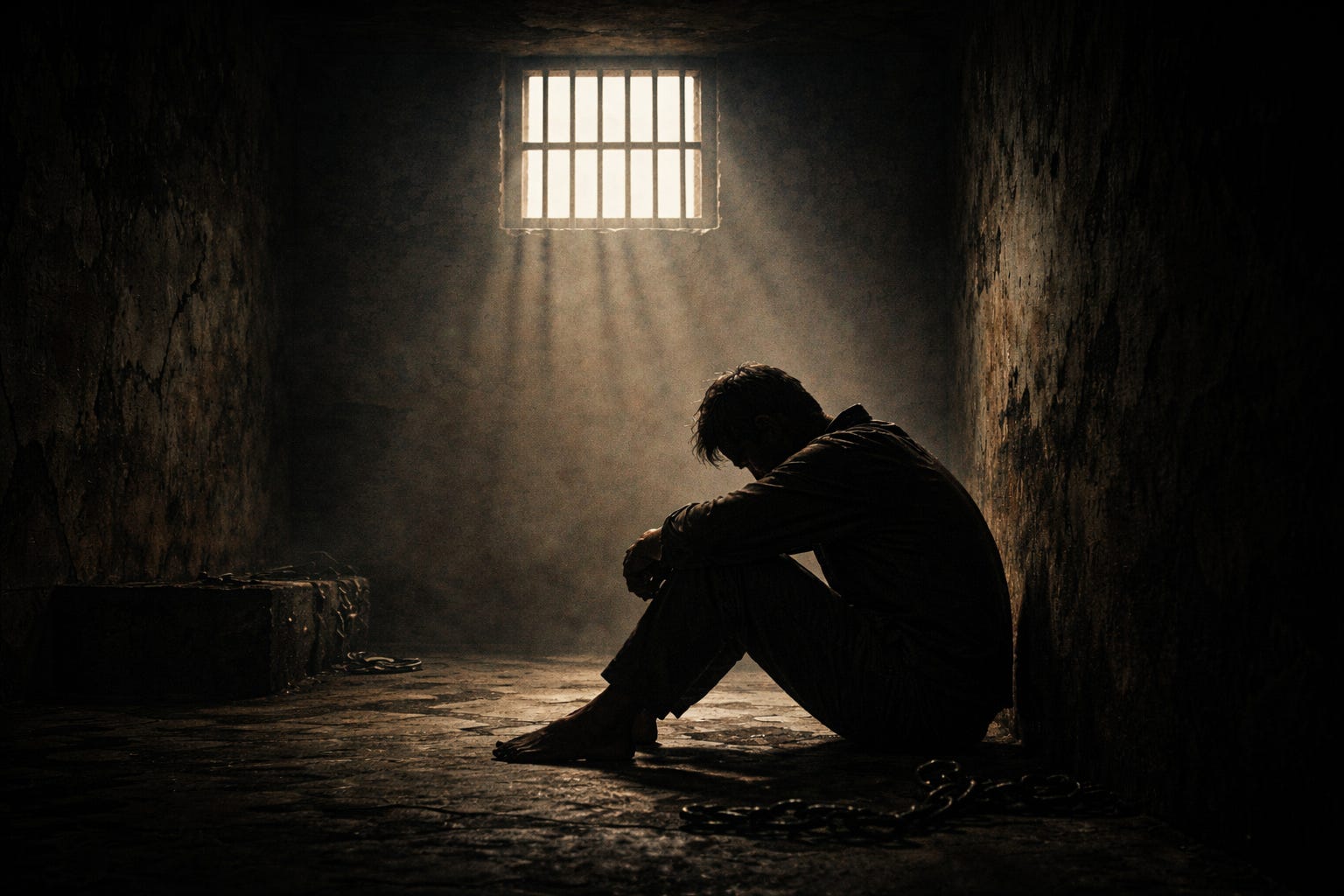
September 1965.
James Stockdale launches off the USS Oriskany in an A-4 Skyhawk, headed into North Vietnam. Soon after, the plane is hit. He ejects over a village.
Stockdale is still in the air when he hears bullets ripping through the parachute. He hits the ground injured, gets surrounded, beaten, and taken prisoner.
They move him to Hỏa Lò Prison in Hanoi, the place American prisoners of war would later call the Hanoi Hilton.
At first, they keep him alone for months. Isolation. Months where the world goes silent.
No updates. No timeline. No sense of what is happening outside those walls. Time stops feeling like time. It becomes weight.
That is where the mind starts reaching.
Relief becomes the goal. A deal becomes tempting.
A date becomes the deal.
Stockdale later described how some men would tell themselves, “We’ll be out by Christmas.” Christmas would pass. The mind would scramble for another landing point. Easter. The next one. Each missed deadline did not disappoint them. It broke something inside them.
Stockdale refused that bargain. He held onto the belief that he would make it out someday, while staying honest about what he could not control today.
That refusal is a form of critical thinking. It’s the ability to stay anchored in reality when your mind is begging for a story.
What self-governance actually governs
Most people describe self-governance as controlling your demeanor. Some even treat it as self-control, like it’s a behavior-only problem.
In reality, self-governance is the ability to govern your actions, thoughts, beliefs, values, and principles deliberately.
That definition matters because actions do not lead. Belief leads. Thought follows belief. Behavior follows thought. When values and principles bend, everything downstream starts rationalizing the new direction. You can still look disciplined while your inner direction slips.
I want to pause here, because people tend to merge three ideas that should stay separate.
Coherence is the easy state. The one you get when life is calm and alignment feels natural. You do what you believe. You believe what you value. Friction stays low because the pull stays low.
Discipline shows up when coherence breaks. It’s the mechanism of realignment. The return. The moment you notice you slipped and choose to come back.
Self-governance decides whether that return happens on purpose. It’s the ability to practice realignment deliberately, especially when your mind has a cheaper option available.
That’s why the Stockdale story belongs here.
In captivity, the first drift wasn’t behavioral. It was cognitive. A bargain offered itself: invent certainty, pick a date, attach your sanity to it. That bargain would have felt calming. It also would have been a gamble.
Stockdale chose the harder route. Faith in the long run, honesty in the present. No invented deadlines. No comfort purchased through a story the world could break.
That is self-governance. Discipline aimed at the belief layer.
And it scales.
Your life may never resemble a prison cell, and I hope it never does, yet the same pattern shows up all the time. Comfort is always available. It rarely comes free.
This raises a question.
Are we as capable as Stockdale to think clearly when we’re stressed?
The environment is not neutral
A few decades ago, a person could live with a smaller surface area of inputs.
Today, you wake up into a feed that never asks whether you have the bandwidth for it.
News. Clips. Screenshots. Commentary arrives preloaded with conclusions. Narratives get delivered at high speed, designed to feel complete. It takes opening Substack, or any social app, to see how quickly a story gets packaged as certainty.
There’s a cost to constant contact.
Your mind keeps updating its sense of reality while the feed keeps moving. That pressure makes belief formation fragile. Borrowing conclusions becomes cheaper than verifying. Repeating becomes easier than evaluating.
We no longer know if what we’re seeing is true on the first pass.
Then AI shows up and makes the problem sharper. Trusting your senses immediately starts feeling like a luxury.
Falsehood has always existed. What changes here is the surface. The volume. Artifacts that resemble evidence. A longer stretch of uncertainty between “this looks real” and “this is real.”
So even if you want to be careful, careful costs more.
And when careful costs more, the brain looks for shortcuts.
Why your brain cuts corners under load
There is a basic constraint most people ignore.
Your mental workspace is limited.
You can only hold so much in working memory at once. When inputs exceed capacity, the mind adapts by simplifying. It drops nuance. It leans on pattern matching. It defaults to what requires the least effort to keep moving.
Stress narrows that channel.
This is where neuroscience matters, because the failure mode isn’t moral. It’s mechanical.
The prefrontal cortex is deeply involved in judgment, inhibition, planning, and flexible reasoning. Under stress, the brain releases chemicals that shift your system toward fast response. Those same chemicals can disrupt prefrontal function, which makes it harder to pause, weigh options, and stay deliberate.
So the part of you that is supposed to govern becomes less available right when life demands it.
Another vulnerability shows up after that.
Familiarity starts feeling like truth.
When you see a claim repeatedly, it becomes easier to process. That ease can be misread as credibility. Repetition starts acting like evidence, even when the claim is wrong.
Put that inside a world that repeats everything and the effect compounds.
Now add synthetic media. The cues that used to signal “real” become easier to imitate. A polished surface can register as proof before your mind has done any verification.
This is the backbone for a simple point.
The environment pushes your brain toward shortcuts.
Shortcuts can become drift.
Critical thinking is the skill that pushes back.
When thinking becomes drift
Drift is always there. It’s unavoidable. Your job is not to eliminate it. Your job is to notice it early enough to return.
For something to become drift, it has to deviate you from the direction you intended to take.
Critical thinking becomes drift when reasoning starts working against your willingness to stay on that direction.
It doesn’t look irrational. It looks reasonable. That’s the danger.
It often starts with one move: finding a justification that lowers friction.
Reason can sabotage you while sounding clean.
Here are some of the shapes it tends to take.
Rationalization
Reasoning that shows up after the decision, built to make the decision feel justified.
“I deserve a treat,” said in the middle of a diet.
“This stock will keep climbing,” said in the middle of a hype wave with no foundation besides momentum.
The story sounds like thought. It functions like permission.
Bias fog
Shortcuts shape your judgment while you still feel objective.
Bias fog does not announce itself. It feels like common sense. You can hold evidence in your hand and still miss it because your mind is filtering reality through what it already prefers.
A common example is confirmation bias: the tendency to interpret new information in a way that protects what you already believe. You filter for news that supports your position and skip what challenges it.
Doublethink
Orwell gave language to a version of this in 1984. He called it doublethink, belief in contradictory ideas simultaneously.
Doublethink isn’t stupidity. It’s tolerance of incoherence because coherence would cost you something.
Comfort. Certainty. Belonging. Pride.
So the contradiction stays. Direction becomes unstable. Self-governance depends on a direction that can hold.
An example is carrying these two ideas at the same time:
“I value connection.”
“I keep avoiding hard conversations and letting resentment grow.”
Identity defense
Thinking that serves pride or belonging instead of truth.
Belief becomes part of who you are. Evidence starts feeling personal. The mind protects image. Realignment gets treated like humiliation.
If you identify as the patient parent, then your kid melts down and you snap, and your mind scrambles for a story: “They pushed me too far.” “Any parent would’ve done the same.” “It was for their own good.”
The story might contain truth, yet its main function is protection.
Winning mode
Thinking turns into a weapon.
You optimize for points and reactions. You aim for the closing line. Even when you win, you train your mind to value dominance over accuracy. That mindset leaks into decisions.
In a couple conversation, your partner says, “I felt alone last night,” and instead of hearing the feeling you go lawyer mode: “That’s not what happened.” “You’re exaggerating.” “Remember when you did X?”
You build a case. The relationship becomes a courtroom.
Analysis paralysis
Analysis becomes a way to delay commitment.
It looks responsible. It feels careful. It also keeps you safe from choosing. The cost shows up later. No choice means no movement. Drift becomes structural.
In writing, you outline forever. You research endlessly. You refine the structure again. You call it quality control, yet the work never ships.
Cynicism
Cynicism can sound like wisdom.
It can also be a place to hide.
If everything is flawed, nothing deserves your full effort. If everything is corrupt, nothing deserves your trust. If everything is complicated, nothing deserves your commitment.
The result is predictable. You stop moving toward your values and start orbiting your critique.
You hear a useful idea and instantly go: “That’s motivational fluff.” “That works for other people, not real life.”
Your critique might contain truth, and it might make you feel smart, yet its function is avoidance.
Theory overfitting
Frameworks stop being tools and become shields.
You can describe your behavior with perfect language while repeating the same pattern. Reality stops updating you because the model is always allowed to win.
For instance, you learn a model and start labeling everything. Every conflict becomes “ego.” Every setback becomes “limiting belief.” Your vocabulary becomes sharper, while your behavior stays the same.
When thinking drifts, it can feel like coherence because tension drops. Discipline pulls you back. Self-governance is choosing that pull even when a cheaper story is available.
What we can do with this today
The first thing is to stop treating critical thinking like a personality trait.
It’s a practice. It’s a cost you pay to stay free.
The Stockdale story makes something visible. When uncertainty becomes your environment, the mind starts begging for relief. It tries to buy certainty. It tries to anchor sanity to a date, a guarantee, a story that feels stable.
That bargaining doesn’t stay in a prison. It shows up in normal life in forms that look justified.
It shows up when you borrow conclusions because verifying feels exhausting. It shows up when you repeat what’s loud because slowing down feels socially expensive. It shows up when you accept contradiction because resolving it would force a decision.
So what do we do with what we learned today?
Start by taking uncertainty seriously. Stop demanding a timeline from a world that cannot give you one. Keep faith in direction without tying inner stability to conditions you cannot enforce.
Most of the damage in modern life is not caused by one catastrophic decision. It’s belief pollution. A slow accumulation of borrowed certainty that turns your inner compass into a weather vane.
Critical thinking is how you protect that compass.
You can exercise it by reading the same claim from sources that disagree and watching what holds up, by going to primary material when it exists, and by keeping a boundary between observation and conclusion. You can decide what evidence would change your mind before you commit to a position, and you can track your state while consuming information, because emotion often arrives before distortion does. When certainty spikes, treat that as a cue to slow down and verify.
Practice and repetition make this feel familiar. Not effortless, not perfect, yet stable enough that you stop getting dragged by the first story that lands.
What you can take home
The bargain is real, especially under stress.
When pressure rises, the mind reaches for comfort and gives it a respectable name. It reaches for certainty and sells it as clarity. It reaches for repetition and treats it like proof.
That’s why self-governance becomes more expensive, and more necessary, in the modern world. The feed rarely stops, and the brain adapts to survive it. That adaptation moves people off course.
People want coherence. People want self-governance. Critical thinking is one of the skills that makes self-governance possible.
In tomorrow’s paid companion, we’ll explore how to develop awareness for drift in your thinking.
For now, notice how your mind reacts when what you value is at stake. Pay attention to your inputs. Watch how fast you move from signal to conclusion. The speed of that jump tells you a lot.
Have a wonderful week!
✨ Ideas Worth Exploring
If this piece resonated, here are a few more that go hand-in-hand.


