


This last week I went to watch The Odyssey, Christopher Nolan’s adaptation of Homer’s classic epic.
I was honestly anticipating this movie, and it didn’t disappoint. In my opinion it was masterful. Not because of the cinema, directorial aspect of it; Nolan always delivers. I just think it was a masterful piece of storytelling, and you don’t need to be a film connoisseur to see that.
I remember reading the book in my teenage years.
Free weekly reflections for sustainable discipline.
Straight to your inbox.
When I read the epic, I did so with the eyes of a dreamer, and I didn’t focus on the more complex details of it. I followed the adventures of Odysseus, the main character, on his journey home after the war — I’ll leave it like that to avoid explicit spoilers, you truly must watch this movie — but that was it. The shallow part of it, and I’m not saying it in a bad way. I was a teenager, and this was 20+ years ago, so I didn’t have even half of the experience I have today. So, you can only experience other experiences through the lenses you can see through in the moment.
But I admired Odysseus. I remember telling my wife, when I saw the big banner at the cinema, I have to watch this one.
Said and done. And I would watch it again without any problem.
I think watching it now, through a more experienced lens, with storytelling very well executed, and an incredible cinematographic quality, changed the perception I grew fondly with, into something even more solid. Because at the end of the day, we all are Odysseus.
One way or another. Let me explain. But first a warning.
Warning
This article might mention parts of the story that show up in the movie one way or another. I will intentionally try to avoid spoilers, but in some cases something can escape from it.
Read at your own risk.
The Odyssey is a story of return
To start, the story is pretty literal. The story narrates the return of Odysseus from the Trojan war. Well…the attempts of Odysseus to go back home.
The movie in itself shows all the adventures, obstacles and vicissitudes that kept Odysseus from getting back home all at once.
It also narrates what happens in the meantime, how life changes and everything evolves when you are not physically present in a space that used to belong to you, how people change, and how time erodes life and reminds us of the mortality and fragility of us humans.
Of course, if you want to watch it for entertainment, it is very entertaining. But sometimes there are elements that you know and you see, that you can’t unsee, so for me it was a journey within the self on every frame the movie displayed.
I don’t resemble physically to Odysseus, let alone have the same physical prowess. Let’s not even talk about the mental fortitude. But if there is something I share with him is that we are both humans and that we have both drifted from where we thought we would be.
This makes the Odyssey a story of human nature. An epic of the struggle to fight drift, to find redemption once we fell prey to it, and how can we rise and return, because it’s never too late.

👉 Want to actually train this, not just read it?
Each week inside Discipline Circle, I publish a short Paid Companion you can work through in 10 minutes on a slow day, so the idea sticks when a hard day hits.
$9.99/month.
Returning to the self
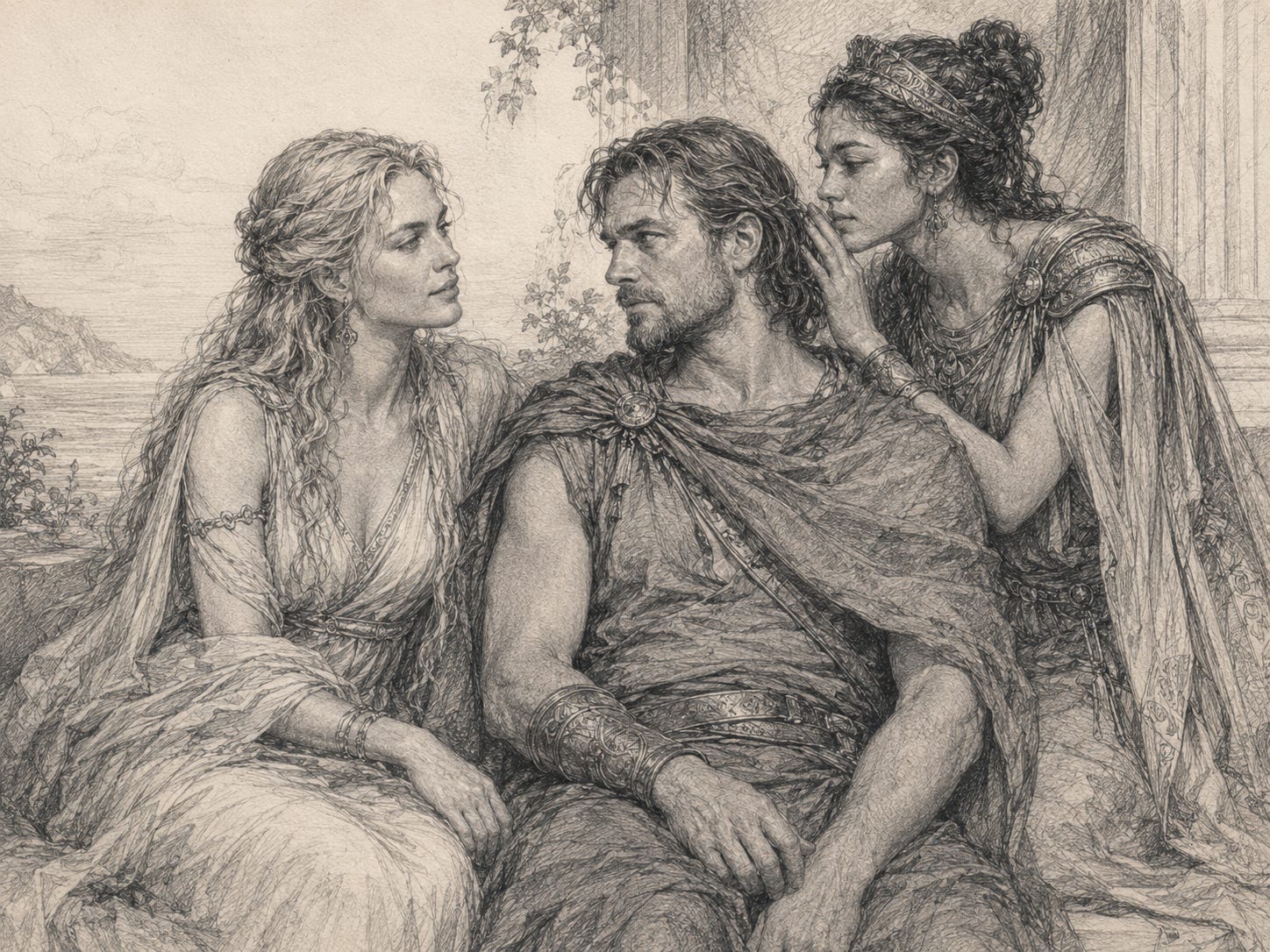
In the movie, we see Odysseus struggling to find himself. His self is prisoner of his own decisions, and Calypso without knowing acts as the enabler. On the other hand, he has the wise Athena acting as his consciousness, sort of a Greek Jiminy Cricket adaptation. Always there, keeping Odysseus not only prisoner of himself, but prisoner of fate…or the gods, so to speak.
During this stage, questions about meaning come out. Think of this as the moment where you are in deep shit and you don’t know you are there.
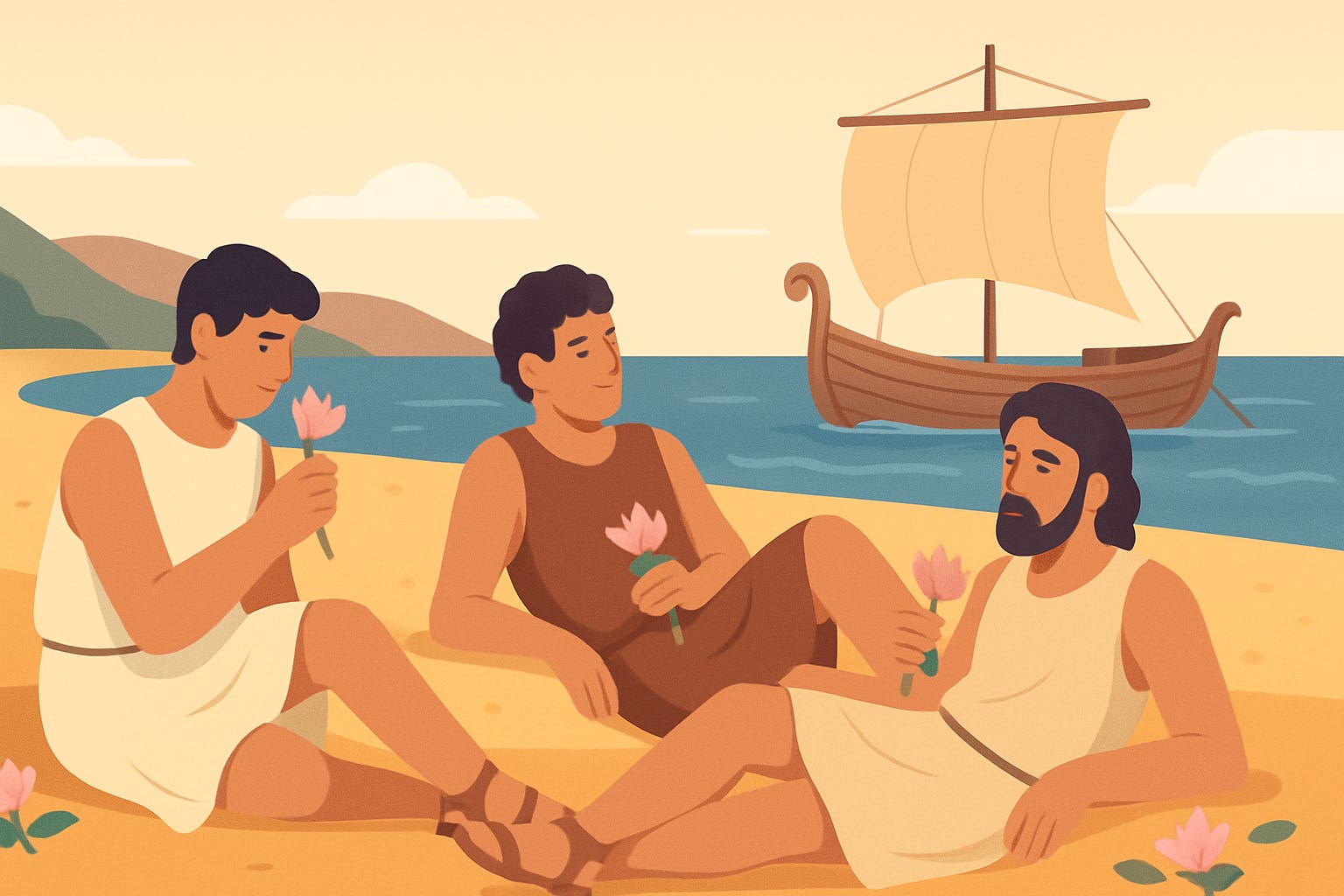
The lotus tastes good, you know it does…and that’s the problem.
You wake up one day and realize you don’t recognize the person in the mirror. Not because you’ve changed — you have, and you see it, even if you are afraid to admit it, but that’s not the disturbing part — but because you can’t trace when or where it happened, it just catches you out of guard. There was no moment, no decision. You just… drifted, and the drift felt fine. More than fine, sometimes. Comfortable. Like a safe space. Like home.
Numb in a way that felt like relief, like a warm blanket. Like mom’s hugs.
We can’t be judges. We all have a version, even if it was short. Maybe it started as a way to cope… maybe a drink to take the edge off. Using games as a distraction to avoid hard conversations. Cutting ties with people who reminded you of who you used to want to be, because seeing them hurt too much.
You told yourself it was temporary. It was just for now. Just until things got easier.
Just until it hurt less.
But things don’t get easier when you’re eating the lotus. They get quieter. Softer. Distant. Then you blink, and it becomes unreachable. But strangely, that distance starts to feel like peace.
Until one day, the questions come:
Who am I?
What happened to me?
Where was I supposed to be?
And the worst part is, that you’re the one keeping yourself there. It’s not Calypso — or any version of Calypso in your life. It’s not fate.
It’s you.
You’re the jailer and the prisoner, and you’ve been choosing this every day without realizing you had a choice.
How do you return to yourself, when you are the one eating the lotus that is keeping yourself prisoner?
Some people never figure it out. They drift, and the drift becomes the life. Drugs, alcohol, gambling, isolation — any way to dissociate yourself from yourself. Some people die that way. Prisoners of themselves. Prisoners of fate.
The movie shows how Odysseus struggles on his return to himself. How, against all odds, he breaks the chains that hold him unknowingly against his will and sets the return to something bigger: home.
Returning home
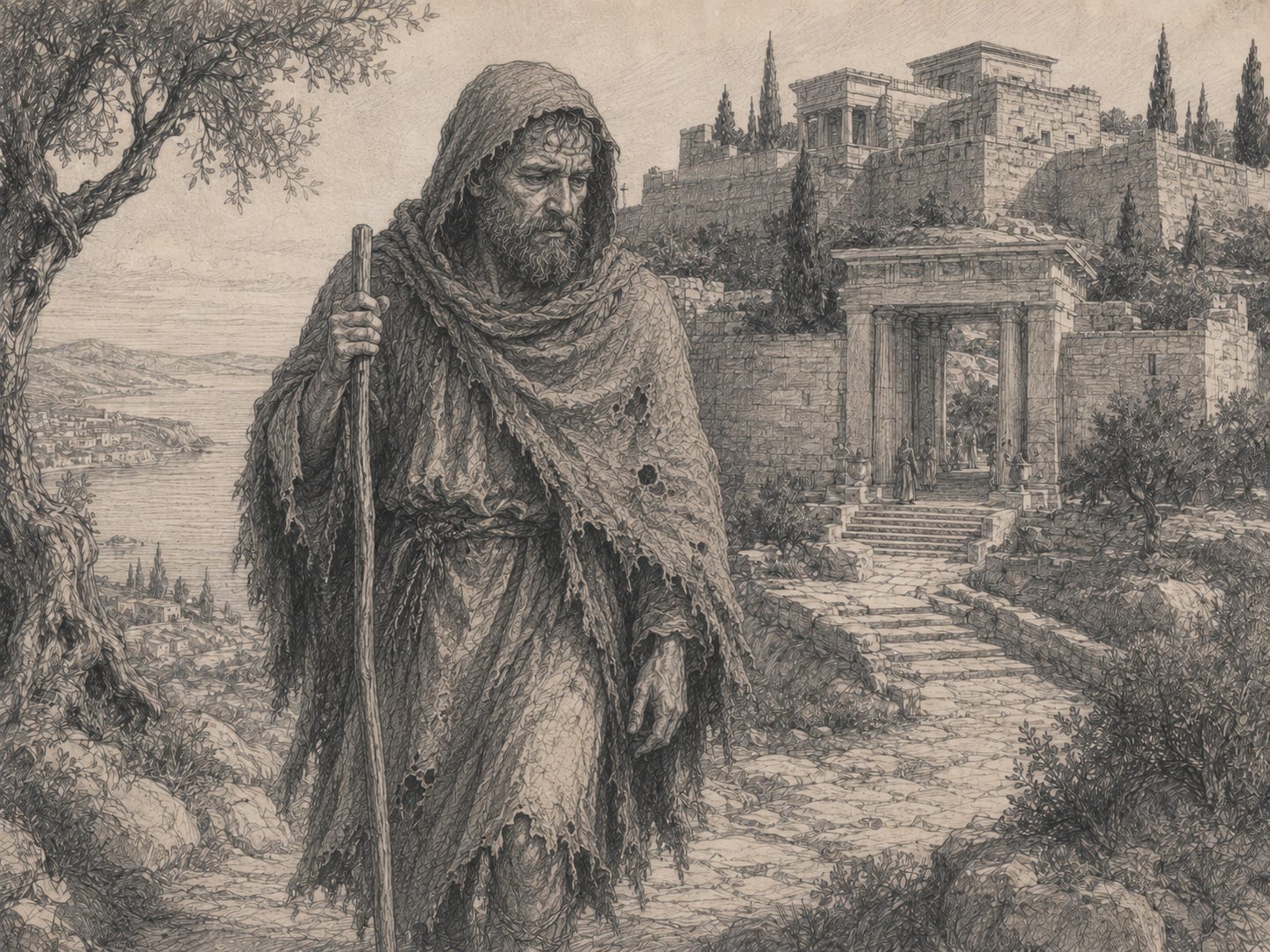
The return to the self is not always the only return we need to make.
We don’t live in isolation, we are gregarious beings. We wish to return to something. Odysseus knew it, deep inside. Returning home.
Home is still there. You know it is, you just don’t know what state it is in. And that scares you. You’ve seen the texts you haven’t answered and heard the voicemails you can’t bring yourself to listen to. You know they’re waiting, because they keep trying, yet you keep refusing to accept it. The thing is that makes it worse.
Because now it’s not only the distance you created, but the silence you’ve let build. I bet that if you are reading this right now, you are probably thinking of one of those moments. We’ve all had one. Mom texted and we didn’t respond right away because we didn’t know what to say.
How do I apologize?
Should I apologize first?
Every day you don’t reply is another day that makes going back harder. Another bite of the lotus that keeps you imprisoned.
Another stone in the wall between you and the people who still remember who you were.
You stand at the threshold. Your finger hovers over the call button, you leave the message draft half-written… that apology you’ve rehearsed a hundred times but never sent.
And right before you do it, you freeze.
What if they don’t want me back?
What if they’ve moved on?
What if the version of myself they remember doesn’t exist anymore, and they see right through you to the hollow thing I’ve become?
So you step back. You delete the draft and silence the notification. You tell yourself you are being compassionate, even kind… it’s kinder this way… less painful for everyone if I just stay gone.
The problem many times is that we think that the return is not deserved, that whoever returns to that home won’t be recognized, will be rejected, hence it’s not a worthy effort. Even worse, we think that we have been forgotten, displaced and irrelevant.
We then decide, we prefer stay where we are, comfortable in the void of the drift. Eating the lotus forever.
There will many, many times where we drift, keeping ourselves away from the path we set back, and when we drift, we might leave things behind, we might leave people behind, but if they are the right ones, they will be waiting, no matter how long, for us to return.
For us to be back home.
They might stop trying, but they won’t stop waiting, they will secretly hope, like Telemachus, Odysseus’ son, that a part of you is still out there, and it’s waiting to get back.
So if you are ever in that position where you think you are too far gone to make a comeback, remember, as long as you are alive, there’s always a way back.
And the people that really want you there, will be waiting for your return home.
On our next paid companion we will work in katas to help us return to the self, that help us stop eating the lotus and help us remember who we are, and what’s our path.
Until then, go check the movie. Best ~3h spent, no doubt.
I hope you have a wonderful week!
✨Ideas Worth Exploring
If this piece resonated, here are a few more that go hand-in-hand.


