


Do you need resiliency in order to return?
Or does resiliency develop when you return?
I’ve been struggling with this question for a while. Ever since I started writing about discipline and how to engineer it, I wondered if resiliency had something to do with it, or if discipline was what made us more resilient in the first place.
Free weekly reflections for sustainable discipline.
Straight to your inbox.
How do I explain this? How do I make it fit in my ideas?
Turns out that there is no need to “make it fit”.
It’s just reframing the whole relationship of discipline with resiliency.
I had a half-ass picture
For a long time, I had the notion that resiliency was the ability to withstand and endure whatever life throws you.
And I moved through life thinking that. So in tough moments I would try to act tough. I would try to act “resilient”.
Looking back, I think I wasn’t necessarily wrong. But I didn’t have the whole picture.
Being resilient involves being able to endure, sure, but can you call yourself resilient if after enduring enough you still eventually break?
It’s a tough question, and I don’t mean to sound harsh. I know many of us might have identified as resilient under those conditions.
Let me make it a little bit more visual, so you can understand the context.
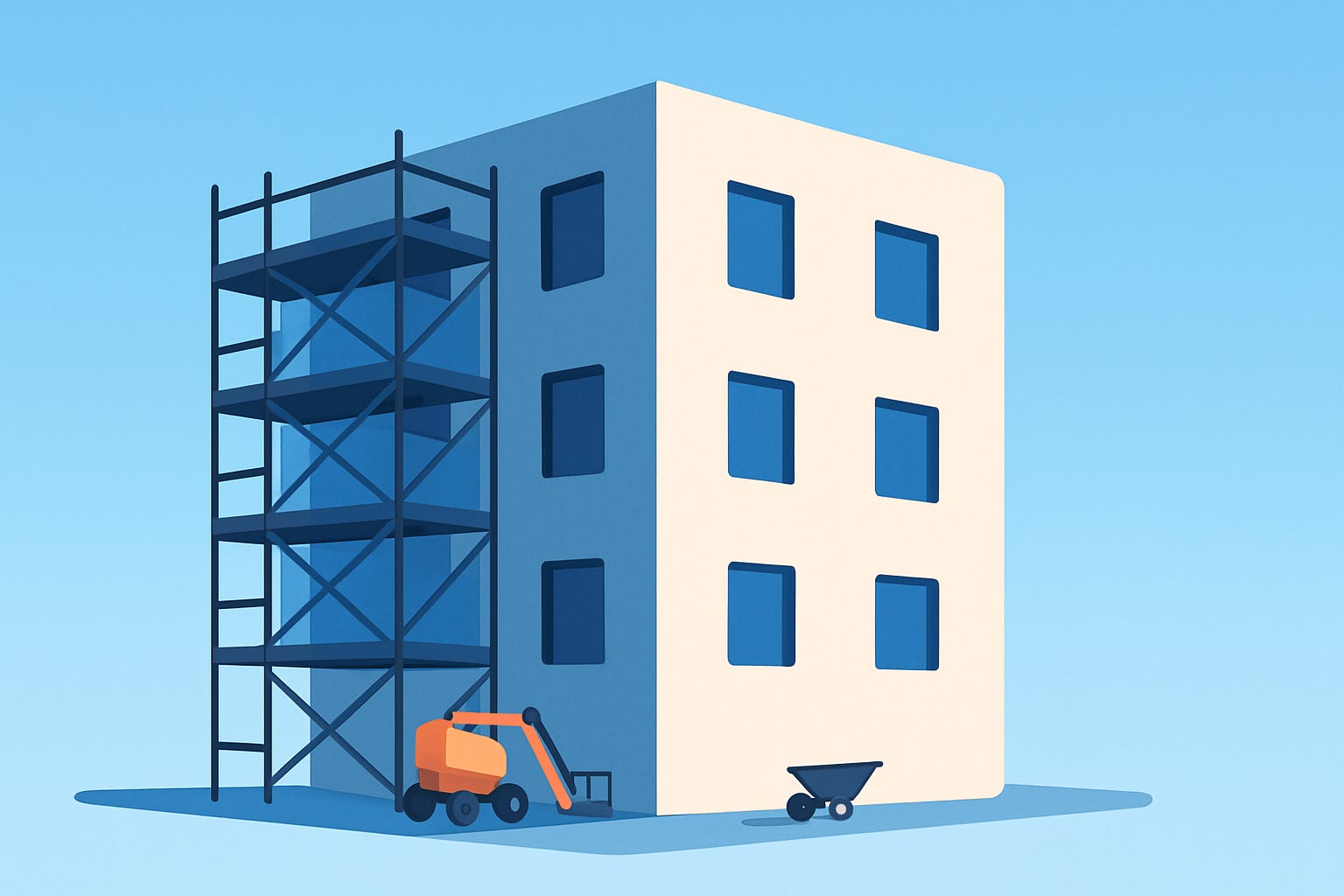
When it comes to earthquakes buildings typically fall in two big buckets: do they break, or do they resist?
Back in the past, the big majority of buildings were built falling in the first bucket. I’d dare to say that in big part of the world, especially in those with not too many, or close to zero earthquakes, the majority probably fall in that bucket.
Not modernizing the infrastructure might seem like cost saving in those cases. Until an earthquake hits.
Here in the Seattle area, there has been an initiative to help modernize the infrastructure to be able to withstand earthquake damage1. We live in a seismic area.
Not as seismic as Chile.
Coming from a seismic country, I was raised in a culture shaped by earthquakes and being the son of a civil constructor, I came to learn that Chile has one of the most stringent standards for seismic building. That code was the one that helped the majority of modern buildings to not collapse and behave exceptionally following the earthquake we experienced in 2010, which by the way was an 8.8-magnitude one, and I lived through it myself...it was terrifying.
Modern buildings in Chile are built in a way that help them absorb the energy coming from the seismic waves, while decoupling from the ground flexibly enough to be able to sway safely rather than remaining rigid.
I couldn’t find a video from Chile, but if you are interested here is how these buildings work during an earthquake.
My point with all of this is that these buildings are built to withstand earthquakes and prevent collapse.
After an earthquake these buildings don’t remain just like that. They still need to be assessed for foundational damage and repaired, but the chances of them being repaired are definitely higher than the ones of a building that collapsed.
As a result, if the foundation is great, then the repairability of the building is higher.
But what happens if the building doesn’t get repaired? It can be because of negligence or simply because you got another earthquake right before you started the repair, or during the repair.
What happens if that building doesn’t get repaired over and over?
Well, eventually that building collapses.
The same earthquake, different damage
Same happens with us.
When we think of resiliency we tend to think on toughness and endurance.
Many of us are able to withstand the earthquakes that life bring us, we withstand a couple and we call ourselves resilient.
The problem is that after the residual damage the earthquake brings, we just keep moving. Our foundation starts collapsing slowly. Drift starts permeating.
Until our resiliency is no more.
The difference between somebody that is really resilient, vs somebody that can endure through some seasons, is that the latter may or may not break under it, while truly resilient people repair, and do so quickly.
Take Frida Kahlo, for example.
Most people think of Frida Kahlo as a famous painter, but fewer people know what her life looked like before that work became known.
When she was eighteen, she was in a bus accident that left her with severe injuries and chronic pain for the rest of her life. She went through multiple surgeries, long recoveries, and extended periods where she could barely move. This was not just a temporary setback that would pass after enough effort. Her body didn’t go back to what it was.
She went through crap...but the story doesn’t end there. That is why I think she is a useful example of resiliency.
Frida didn’t simply endure a tough season and then went back to the life she had before. That life was no longer available to her like it was before.
While she recovered, her family helped set up a mirror above her bed and gave her a way to paint while lying down. She adjusted to the conditions she had, instead of waiting for those conditions to disappear.
Frida could have chosen just to give up. To break completely. Instead she adapted to what life threw at her, and did with that what she could.
And good thing she did.

👉 Want to actually train this, not just read it?
Each week, alongside this reflection, I publish a short practice guide — something you can work through in 10 minutes on a slow day, so the idea sticks when a hard day hits.
It’s called the Paid Companion. $9.99/month.
Where return and resiliency meet
Turns out that resiliency is not an ability that is reserved for just some people. Like returning, becoming resilient is a skill that you practice.
We just do it unconsciously, whenever life throws hits at us. Like what happened to Frida.
This brings us to the questions that opened this article.
Do you need resiliency in order to return?
Or does resiliency develop when you return?
Turns out that they are linked.
If you think about the idea behind resiliency, that is not only enduring, but repairing quickly, you’ll realize that it resembles our idea of increasing your comeback speed.
Essentially, the ability of repair is to return to what matters, in a specific context: returning to yourself.
Frida didn’t stop doing what she loved after her accident. She adapted so she could return to do what she loved.
So becoming resilient is actually an application of discipline. The practice to repair quickly over time.
How do you train resiliency?
Now you know that you can practice — and hence train — resiliency.
But how?
Part of the answer is that resiliency does not come from one single place in the brain. It depends on a few systems working together.
The prefrontal cortex helps you pause, regulate your emotions, and choose a response instead of just reacting. The amygdala helps detect threat and emotional salience, which is useful, but can also make things feel more intense than they are. The hippocampus helps with memory and context, which matters because part of resiliency is recognizing what is actually happening in front of you instead of letting the past take over the present.
The system we just described helps you, for example, to endure a breakup. You feel the intensity of it, especially when it’s recent, but as time goes by, your brain helps you with some memory nudges, that avoid that 3am text to your ex.
Then there are other regions, like the anterior cingulate cortex and the insula, that help you notice when something feels off, catch internal shifts earlier, and realize you are starting to spiral before things escalate. And then there is the broader stress-response system, which helps determine whether your body can come back down after stress, or whether it stays activated for too long.
That matters because resiliency is not only about enduring pain. It is also about noticing what is happening, responding to it with some level of clarity, and recovering instead of staying trapped in the aftermath.
So what helps train that?
The usual suspects matter for a reason.
Exercise helps regulate stress and improve recovery. Sleep helps your brain recover and makes emotional regulation easier. Mindfulness and breathing practices help you notice activation earlier, before it fully takes over. Reflection, journaling, or any practice that helps you reinterpret what is happening can also help, because part of resiliency is learning not to collapse under the first meaning your mind gives to a hard moment...to not collapse with the first earthquake.
And then there is manageable challenge.
Doing hard things on purpose, as long as they are hard in a way you can recover from, helps train your system too. That is part of how you learn that pressure is not the same thing as collapse. You activate, you recover, and over time you get better at returning.
If I had to pick one with the most leverage, I would probably pick exercise. Which is a little ironic, because it is also something I need to work on myself. But that is probably part of why it stands out to me so much.
It helps with stress regulation. It supports recovery. It improves sleep. And it gives your body repeated practice at effort, which is followed by return.
A lot of resiliency is not built by avoiding activation; it is built by going through it, and learning that you can come back from it. Then, the next step is learn to do it faster.
That is why exercise is such a high-leverage place to start.
And to be fair, this is not something we only learn alone. A lot of what we understand about resiliency comes from watching other people go through hard things and still find a way to keep moving. Families teach it. Communities teach it. Sometimes whole cultures do. I know that has been true for me too.
What to do with this
When we reframe discipline, we unlock a plethora of other meanings. One of them is resiliency, that just as discipline it’s not a trait; it’s a practice.
You can become resilient by practicing. By doing hard things. By putting yourself through the motions. By resting, and letting your mind and body return to the baseline each time.
When you complete the cycle of practice -> enduring -> repairing, then you are reinforcing the skill. Your brain learns that you will go through hard times, but that you will recover. That will lead to less stress, because you will be able to trust the process and take more risks that you used to.
Now, this is not an invitation to suffer. If you have been in this publication enough, you know that I’m not in favor to suffer just for the sake of it.
The key is in putting yourself through hard things that you can recover from, gradually, so your body learn to take bigger hits without suffering. The same way you would train to run a sprint so your legs don’t cramp.
In our next paid companion, we will present some exercises to help you develop resiliency with the little things. Because working out and doing hard things is already a big commitment. So we will work on the baby steps.
For now, remember that damage compounds, so if life shakes you a bit, focus on recovering, dust off, and then get back into it.
Have a wonderful week!
✨ Ideas Worth Exploring
If this piece resonated, here are a few more that go hand-in-hand.


👏👏👌🏽👌🏽