


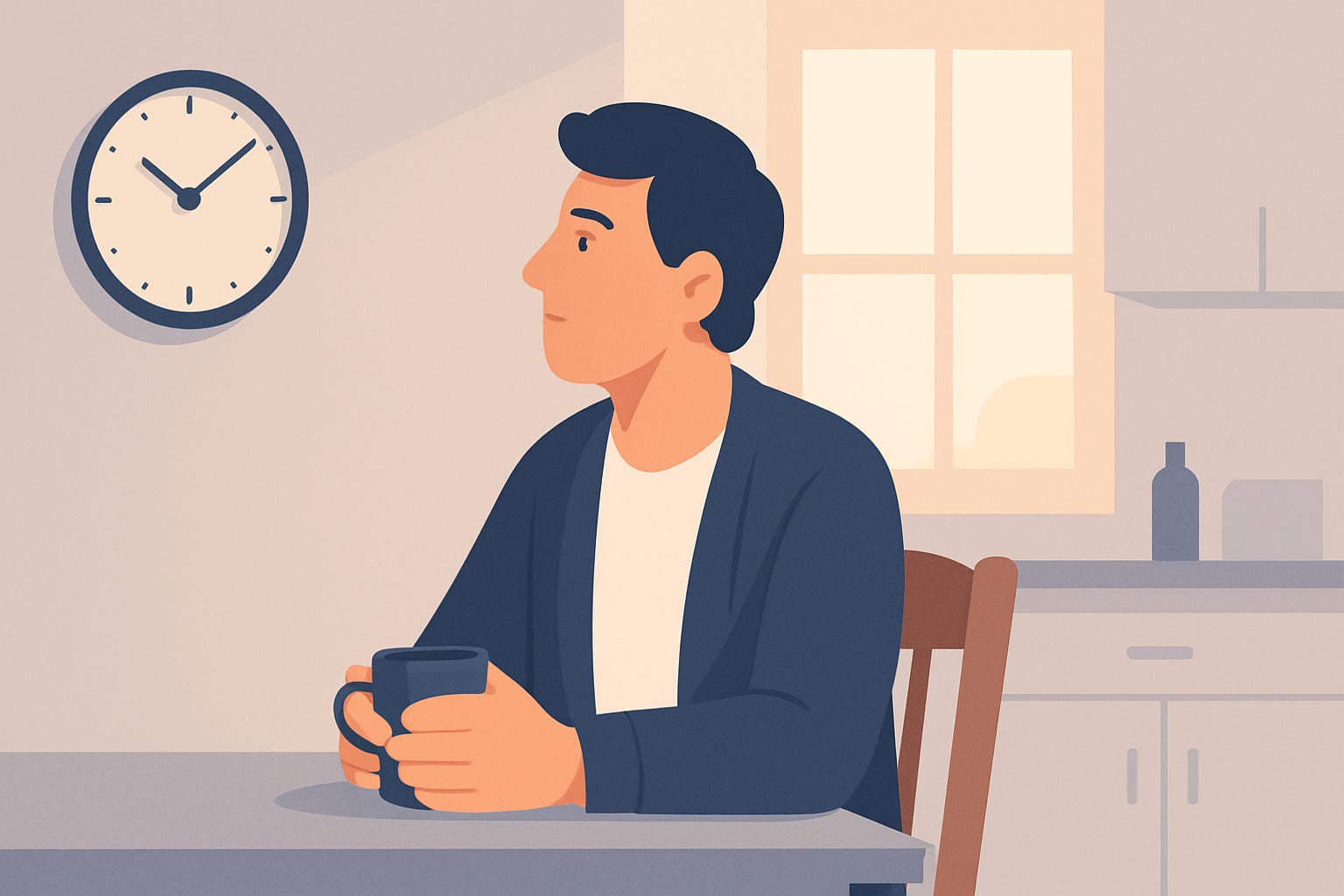
Most of my friends here are either turning 40 or getting close to it.
I’m not there yet, but it has been interesting to see how that has been developing. I don’t know whether it’s correlated, but I’ve seen a lot of changes happening in my circles. As they say, correlation doesn’t mean causation.
We like to joke that they’re having a 40-year crisis, and sometimes I wonder what mine will be.
A while ago, I went to one of my friend’s birthday parties. Because the joke was on topic, I jokingly asked another friend what his crisis was. All of this happened while I was pouring myself a drink.
His answer was actually a pretty deep one, and it started a profound conversation. I wasn’t really prepared for that, but I decided to follow up and ask for more details.
He started jokingly with “which one of them?”
He then shared that, in general, all fronts were well covered. He loved his family a lot, but work was making him feel sort of trapped. He felt like his best years were going away fast, and that he had less and less control over where his life was going. Apart from that, he had started feeling the finiteness of time more clearly, along with the realization that his parents weren’t going to be there forever.
Boom.
He was feeling the way I’d felt in the past.
Living abroad makes these thoughts a bit more pronounced. Then he said:
What do you think about this?
I see you as rock solid, like you have everything clear. I feel like you have it figured out, so I’d like to hear your thoughts.
I didn’t know what to say. First, I felt flattered, and then I felt like an impostor.
I told him:
Thank you for the kind words, man. I really appreciate it.
The truth is, I’m still figuring things out. We all have our own battles, but I’ve been where you are, and AI redefining our work doesn’t make it better.
Then I asked him more about his situation, and we tried to make sense of it all.
The truth is, yeah, I’ve been through a lot of shit and a lot of changes. My perspective on life has changed, but I’m not immune to struggle. After all, life hasn’t proved to be stable. I’m just doing the best I can with the cards I’ve been dealt through the years. But I’m still wondering what would have happened if I’d decided or done things differently.
The conversation left me with a question: Why, as we approach middle age, do we seem to reconsider our lives and our choices?
Free weekly reflections for sustainable discipline.
Straight to your inbox.
When the infinite becomes finite
My life has not been terrible. Let’s start with that.
I’ve had a phenomenal childhood, despite the obstacles my parents had to deal with as I grew up and the health scares I had when I was younger. I think that childhood, in part, set the foundation for me to develop a kind of resilience.
My school years were just average. I learned a lot, I grew a lot, and I discovered friendships that I’ve kept despite time and distance.
My college years were amazing, and I keep the best memories from that time. I learned a lot about life, independence, and reality.
My adult life has been amazingly and incredibly crazy. I mean, I’m a husband and a dad. I love it, and I wouldn’t change any of it.
Yet I’ve had my fair share of crap.
I’ve lost my dog Kobe in a horrible way — I wrote about it a while ago — and I’ve lost my job more than once. I’ve had my share of therapy and burnout. I’m human. I’ve drifted too. I think that, at this point, if you’ve read this publication, you probably know that already.
My identity, shaped for the most part by my career and accolades, received a kick in the nuts and left me in shambles. I faced the challenge of redefining who I was while expecting our second child, along with the pressure to remain present and helpful to my family.
I have never felt more vulnerable in my life.
On top of that, just as my friend mentioned, I have the constant reminder of the relentless nature of time. I’ve been studying Stoicism, as you may already know, and I know that we all die: memento mori.
This means I know that my kids are growing faster than I’d like them to. While I’m trying to build a life abroad, life in Chile continues. My parents are growing older, and my family there just moves on because they have to. And, while it is a choice, time is unforgiving. As the days go by, the days we leave behind open questions about whether we are doing enough.
Whether I’m doing enough. I think this is what hits most people as they approach midlife.
This has a name in science: Socioemotional Selectivity Theory (SST). Our perception of how much time remains can influence our goals and priorities.
This theory, developed by psychologist Laura Carstensen, is a theory of motivation that states that our goals change based on our perception of our time horizon rather than pure chronological age.
Essentially, if we think we have little time, or that our loved ones have little time, that influences what matters.
In my case, my experiences have taught me that life can be cut short, so we have to get the best out of it, in a mature way, of course. That has definitely shaped how I want to be there for my family and for myself.
I once identified myself purely as an engineer working in tech. That has changed. Now I can say that I am a husband, a father, a son, a sibling, a writer, a speaker, and a builder. I am all of those things, and what once mattered above everything else doesn’t matter as much anymore.
What mattered to me at 25 is not the same as what matters to me now. This helps explain why so many people face a similar crossroads as they get closer to midlife.
Fantastic. We know now that SST partly explains the why, but what happens when these new priorities begin to conflict with a life we have already built?
The danger of confusing change with escape
We know that our priorities change, our goals change, and what seems coherent to us changes with them as we begin to perceive time’s unforgiving nature.
In many cases, this helps us pursue a more meaningful life, leading to lasting changes that really mark a difference between who we were and who we are. Other times, this dissatisfaction can lead to an overwhelming desire to escape.
Many times, that desire is fed by stories that sound amazing and that we can see ourselves in, without really measuring the consequences of what they entail. We mistake dramatic reinvention for a path toward peace.
An example is the trend that followed the book — and later the movie — Eat, Pray, Love. Elizabeth Gilbert’s memoir follows a woman who seems to have everything — success and a comfortable life — but realizes she is deeply unhappy. She travels through three countries, each representing something she feels is missing: Eat (Italy), Pray (India), and Love (Indonesia).
The story is inspiring, intriguing, and tempting to follow. The danger comes when our interpretation replaces the experience the author actually describes. The message could be understood as learning to reconnect with yourself, finding balance, and reconsidering a life that no longer feels meaningful. Or it could become an instruction to leave everything behind, travel the world, and start over. People who have pursued a similar adventure have found that it doesn’t necessarily produce the transformation they were looking for.
So why do we sometimes interpret other people’s transformative experiences as instructions for our own lives?
Every journey is different, so we should first understand what is important to us and what is necessary for the journey to happen successfully. When we mistake someone else’s journey of self-discovery for a universal blueprint for our own lives, we risk bringing unwarranted chaos into our lives for the sake of a temporary escape. I think this is especially true when it leads us to question whether our past decisions were right or wrong. Discovering that something no longer matters as much doesn’t mean it was a mistake to pursue it in the first place, and I think that’s one of the particular issues we face when we fall into a crisis like a midlife crisis.
In some cases, we decide that what we once deemed coherent is no longer coherent. From there, everything tied to it — commitments, responsibilities, decisions — is suddenly wrong, and sometimes even spared from acknowledgment. The thing we tend to forget is that the decisions we made in the past were made with the information we had at hand, not with the information we hold today. Hindsight is 20/20. The consequences of those decisions remain; they don’t disappear just because our perception of those decisions has changed.
I think you would agree that spiraling once we get to this point is very easy. There are plenty of phenomena that tend to crystallize this impulse, such as confirmation bias: the tendency to favor information that confirms existing beliefs or expectations. We start looking for validation of our situation with friends, family, the internet, and so on. We experience cognitive dissonance when our behavior contradicts our principles, and the outcome of this transformation can be a version of ourselves nobody else recognizes — while we still don’t achieve the exact version of ourselves we were looking for.
We become incoherent.
People mention the idea of taking action rather than dwelling, but taking action on an idea that hasn’t been challenged enough can lead to results that, in some cases, are catastrophic. We need a way, then, to recognize when we’re losing perspective, especially when our own reasoning feels completely justified.
Equanimity, return, and self-governance
Life is not black and white.
Sometimes our decisions are rational and grounded in objective evidence. Other times, we get biased in ways we don’t notice, which can lead us to rationalize our decisions even when the signals point toward an outcome we otherwise wouldn’t prefer. All of this can happen while we try to fix the hole created by the urgency of the crisis. We become so fixated on the little time we have left that we spontaneously act from fear under the guise of reason, making decisions that can cost us more of the time that is passing by.
I’ve had those moments, for sure. This is why I was taken aback at first by the question my friend asked me.
How did I manage to remain so seemingly grounded?
What I told him is that I haven’t eliminated fear. That’s impossible. We are human, and we are instinctive. The best thing we can do, by knowing our nature — something I learned from the Stoics — is to acknowledge the instinct and allow ourselves to feel it, so we can take control of ourselves again.

👉 Want to actually train this, not just read it?
Each week inside Discipline Circle, I publish a short Paid Companion you can work through in 10 minutes on a slow day, so the idea sticks when a hard day hits.
$9.99/month.
Marcus Aurelius talks about dealing with the nature of anger in his Meditations:
When you wake up in the morning, tell yourself: The people I deal with today will be meddling, ungrateful, arrogant, dishonest, jealous, and surly… I cannot feel angry at my relative, or hate him. We were born to work together like feet, hands, and eyes…
The same goes for fear. When I feel fear, I know what it will make me feel and how I might react. Because I’ve learned to identify this instinct, I know I can go back to myself. But that wouldn’t have been possible without experiencing it first: the fear of losing financial stability, the fear of losing my identity, the fear of losing my loved ones, my relationships — the fear of losing myself.
So I know that I will feel fear. I know there will be times when I will be pulled into rumination. God, I live in a country where there is, unfortunately, an abundance of school shootings — the worst nightmare for every parent. I was telling my wife the other day, given the recent news, that I was not having an easy time with it because my kids are getting close to that age, and I can’t even fathom something like that. The fact that they have to prepare for that kind of thing in school. The fact that they even have to learn about it at such a young age.
I simply can’t, and it breaks my heart. I feel fearful, and I lose my ground, but that also shows me that I do have control over something: how I spend time with my family, how I take care of my kids, and how I show my family that they are the most important thing in my life.
Knowing that I can act on what’s within my control gives me a sense of agency. By learning to make decisions that are coherent with my principles, I develop self-governance.
Of course, I won’t always make the best decisions. I’ll make mistakes, misjudge situations, and sometimes drift away from what matters to me. But that’s where I think the skill of returning comes in handy. I can recognize when I’ve drifted, reassess my choices, and correct my course.
As I practice this more and more, I become better at recognizing when I’m drifting and finding my way back. That helps strengthen my capacity to govern myself, creating a virtuous cycle in which better self-governance helps me return faster, and returning helps me develop better self-governance.
With this, I want to briefly go back to a point I mentioned before that I think is worth connecting to: the consequences of the decisions we have made in the past remain.
The transformation we think we deserve doesn’t erase the responsibilities we currently have, so a skill like returning becomes crucial to remaining coherent in this scenario. In the end, self-governance isn’t only about choosing what serves you today; it involves recognizing the responsibilities and consequences that remain from yesterday’s choices.
I know that transformations of any type are hard, especially because we are constantly changing, so sometimes the lines become blurry. There is where we have to rely on our circle — not to validate us, but to challenge us to be the best versions of ourselves, objectively and respectfully.
In our next paid companion, we will navigate strategies to identify when we are trying to escape rather than change, along with practices that will help us develop a better sense of equanimity.
As for me, I wonder what my crisis will be. I’m still thinking about what my friend told me, about how I seem so rock solid. I think all the work I’ve put into these reflections and my daily practice is paying off.
I think I’ve been unintentionally preparing myself to face something like this with equanimity. So if it ever happens, I hope to focus on who I am, who I want to become, and how to make my responsibilities a central part of whatever changes I decide to make.
If you are going through something like that, I think talking with family and friends and being vulnerable can help. And, as always, if you don’t feel safe talking with your circle, I’d recommend talking with a professional, like a therapist. It works wonders.
I hope you have a wonderful week!
✨ Ideas Worth Exploring
If this piece resonated, here are a few more that go hand-in-hand.


