


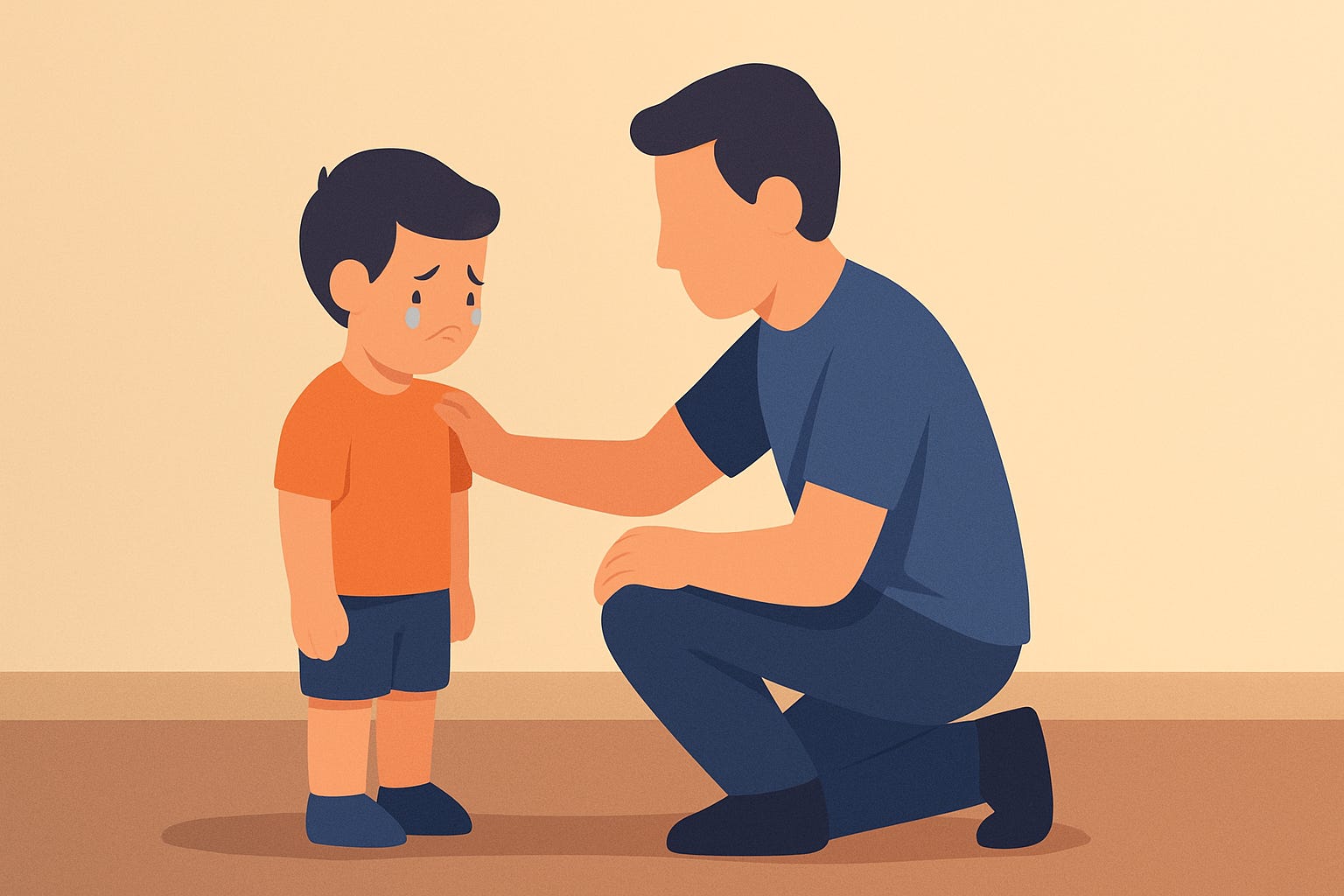
I remember when I was little being told not to cry. Crying was not for boys, but for little girls.
I didn’t hear this in my household, truth be told. It always came from outside. Teachers, other family, friends — who heard it and internalized it as well. Many times indirectly, but it was so socially repeated that you end up internalizing it a bit.
In some cases, like mine, with a touch of shame. In others, as a full burial of feelings and emotions.
Free weekly reflections for sustainable discipline.
Straight to your inbox.
I think — and this is my opinion, and a very narrow one that I’m willing to rethink and reassess — that boys used to have it harder than girls growing up when it came to processing our feelings. Furthermore, I think this was universal. Take a 90s boy from Chile, one from the U.S. and one from, I don’t know...China(?), and probably the feeling is shared.
There are surveys, like this one, that talk a bit more in detail about this, applied to U.S. youth. There, nearly 6 out of 10 young American men said that their parents taught them that a “real man” should act strong even when he was scared or nervous.
And it’s not only people in our circle. It’s also the media, the damaging, toxic culture that is being spread about what it means (wrongly, in my opinion) to be a man, which borders on misogyny. There is a very good documentary called Louis Theroux: Inside the Manosphere that reinforces this idea.
We are in a society that is teaching youth, especially boys, that being vulnerable is a weakness and that feeling emotions is a recipe for failure.
Today, I’d like to dive deeper into my thoughts on why bottling up your feelings is dangerous and why I think that is a channel for drift.
You can run but you can’t hide

My wife and I like to watch a series called Alone; we watch it on Netflix, and while entertaining, it leads to good conversations at night. We always joke that if it were us, we probably wouldn’t last long there. But it’s nice to see other people demonstrating their abilities to survive in harsh conditions and bringing different skill sets to the show.
The premise is simple: ten contestants go into the wilderness, in isolation, completely on their own. They can carry ten survival items, and there are no production or camera crews with them. They record themselves while surviving. The winner is determined on a last-man-standing basis; as the show progresses, competitors tap out when they feel they can’t continue, or when medical crews determine — during periodic check-ins — that they cannot continue.
We’ve been watching the show since ~2021, and we caught up with seasons older than that. While entertaining, it is also educational, not only in survival skills but in different aspects. For me, one has been progressively becoming more outstanding: noticing human behavior in those conditions.
You’ll see, one of the things I’ve noticed about the series is that people tend to leave for the following main reasons:
Psychological Struggles — people having to deal with themselves in isolation
Medical leave, voluntary or involuntary
I asked ChatGPT (because I’m a nerd) to help me catalog the exits across all the seasons of the series (including Alone: Australia), and actually my notes were not too far from the actual results: physical/medical only was the main cause of exit, with 54% of the share, while psychological only followed with 29.3% of the exits.
What is surprising, to me at least, is that many competitors who seem very skilled — and whom I have identified as potential candidates for winning, although I know zero about this type of stuff — end up quitting because of emotional struggle. The reasons for that can vary, but ultimately narrow down to them feeling the weight of the isolation. Here is where the internal fight takes place, and where that 29.3% of exits happen.
One case that stood out to me, mainly because it’s recent — for me, we just watched 2024’s season — and because the internal struggle is real and I think more than one person has faced it before, is the case of Peter.
Peter showed amazing skills at the beginning of the show, but as the show progressed, you could see him struggling with his own internal fight. That’s what isolation does. In one of the episodes, he began to open up about his way of dealing with his emotions by bottling them up. He mentioned that his philosophy was that if you bury your feelings deep enough, they just stop existing. Furthermore, he mentioned that he was trying to pass that trait down to his kid, alluding to the fact that he was sensitive and would express big feelings, and when he would do that, his reaction would be to try to make him suppress them and stop crying.
When I was watching this, I was commenting to my wife, a little frustrated — that is not how you deal with the feeling; you have to feel the feeling. Feelings eventually find their way out. Said and done. Peter himself acknowledged the fact that this way of operating as an “elite robot” didn’t account for isolation and, in reality, was working against him.
Interestingly, what made him tap out was that during that process, he realized he needed to stop burying his feelings and resolved to get back home as a more whole human being for his son. He eventually resolved what I was criticizing from the other side of the screen: he resolved to stop denying his feelings and to face them instead.
That’s what isolation does. Your environment becomes more predictable and stops demanding more attention, so your mind shifts its attention inward. Your internal world gets louder. The feelings you thought you could run from eventually come back, and come back with all their might.
You can run, but you can’t hide.
Why I think bottling up is dangerous?

Well, for starters, let’s start with a note. For many, bottling up is a synonym for expressive suppression — which I think is how psychology calls it. But this is just one way to bottle things up.
The Department of Psychology at the University of Utah describes expressive suppression as:
...an emotion regulation strategy that consists of top-down, conscious control of reflexive behavioral expression of emotion (e.g., stifling laughter or crying, or maintaining a neutral facial expression to hide emotions; Gross & John, 2003).
Basically, changing your behavior when emotions happen so you can hide them, at least on the outside. Bottling things up, though, is more than that. It includes experiential avoidance — plainly avoiding the experience or the feeling — as well. That’s what Peter, in our example above, did.
I think the previous section gave away a big part of my argument: you can run from the feelings, but you can’t really hide from them. If you bottle them up, all you’re doing is telling yourself a story that, at some point, under certain conditions, especially solitude, will come back with more might.
Bottling things up can change how others see you, but it doesn’t change how you feel on the inside.
And that’s not all. It comes at a cost, physical and mental.
I don’t know if you read my article on burnout; there, we talk about the self-reinforcing nature of burnout. Well, something very similar happens with the nature of expressive suppression and experiential avoidance.
Before I begin talking about this, though, I want to introduce an idea: the perseverative cognition hypothesis. This is a framework that, in a nutshell, states that a physical stressor doesn’t need to be there to keep causing stress. Hold onto this because it’s important for what I’ll describe next.
This is my understanding of this cycle, so please take this with a grain of salt.
There is a stressful event that takes place.
You bottle it up and try to put the feeling aside. The issue is still there; you are just pretending it doesn’t exist. You keep functioning.
Your body tries to regulate and compensate, for instance by increasing your cardiovascular activity. This capacity is called allostasis: the capacity of your organism to achieve and maintain stability through change.
For some people, it works until it doesn’t. When this happens occasionally, it’s all good; your body is configured to regulate under these circumstances. The problem comes when you are exposed to repeated activation without returning to a meaningful baseline first. And this starts becoming costly. It can impact other areas, like your sleep, your cognitive capacity, your ability to regulate stress, etc.
The physiological wear that is created as an outcome is called allostatic load.
We briefly talked about allostatic load before, which increases your vulnerability to drift exercising its pull on your behavior.
Bottling up as a channel for drift
Allostatic load is described in more depth as “the strain on the body produced by systems under challenge and the changes in metabolism and wear and tear on a number of organs and tissues”.
Why is this important?
If you thought bottling things up, hiding your feelings, whatever you want to name it, would just stay buried and not impact anything, that’s not quite true. We just saw the tax it pays on the body and the mind. Allostatic load is the name of that tax.
The thing is that burying your feelings not only impacts you as an organism, but also how you interact with others, your identity, how you perceive yourself, and, consequently, your own behavior. Bottling things up is then a channel for drift. It allows drift to exercise its pull on your behavior and enables you to act in ways that don’t align with what you deem coherent. Furthermore, because allostatic load can be associated with other issues like burnout, we can say that the feelings you don’t process and hide instead can eventually have an impact and start other cycles that mutually reinforce each other. Let me give you an example.
A couple of weeks ago we talked about burnout. We talked about how our brain changes when subjected to constant stress, and how the mechanisms that help our brain’s cleanup get wonky. This leads to issues like glutamate buildup that can affect our cognitive capacity.
The thing is that when we talk about burnout, we tend to talk about work. Work stress affects our performance over time and creates more stress in a self-reinforcing cycle. Manufacturing urgency as a compensation tool to try to be more productive doesn’t help with that either, if not done carefully. If anything, it can create more allostatic load. But we don’t necessarily get stressed just because of our workload or work environment. Any sort of event that makes our brain feel threatened will elevate our levels of stress. That includes emotion-triggering events, like an argument, trauma, etc.
Now, why do I say that?
Let’s connect the dots. If we experience these sorts of events and we don’t process them but set them aside, then our body takes a toll. But a one-time event is recoverable; we can get back to our baseline with or without help. The problem is that real life doesn’t work like that, and it’s not only one event every now and then. We are human. We disagree. We have hard moments. We live a rich life with family, friends, and work. It’s natural that there will be different environments in which our emotions will play a role.
If we put the emotions aside, and if the perseverative cognition hypothesis is true, then those emotion-triggering events can continue affecting us, even though physically they are no longer there, if our mind keeps them active — for example, through rumination, worry, or recurrent thoughts. Add to that the fact that our brain tends to forget details about events, so what you remember today might not quite be the real details of what happened. This means that every event adds stress to your mind and body, and as new events happen, if they are not processed, then your allostatic load starts increasing, and it starts spilling over into other areas, which makes things worse.
For instance, if it impacts your sleep, then your performance can be hindered at work, and hence your levels of stress will gain a new edge. Eventually, you will have two vicious cycles: your undealt-with emotions self-reinforcing and impacting your allostatic load, and that same load serving as input for a chronic, self-reinforcing stress loop that also feeds your emotional cycle, perpetuating and self-reinforcing the cycle with every loop. In the end, it’s not that these emotions necessarily accumulate, but that the consequences of them being bottled up can generate more stress.
Emotions enable drift to pull on your behavior, making you act maybe in ways you wouldn’t if you were operating under the right conditions. This means we need help figuring out what those right conditions are and how we can get to them.

👉 Want to actually train this, not just read it?
Each week inside Discipline Circle, I publish a short Paid Companion you can work through in 10 minutes on a slow day, so the idea sticks when a hard day hits.
$9.99/month.
What can we do instead?
Just break the cycle. That’s it.
Said no one, ever.
No. If you have been following Self Disciplined for a while, you know that I like to talk about the return loop. For those of you who are new, the return loop consists of four stages: notice the behavior, regulate, choose what to do next, and then act and close the gap.
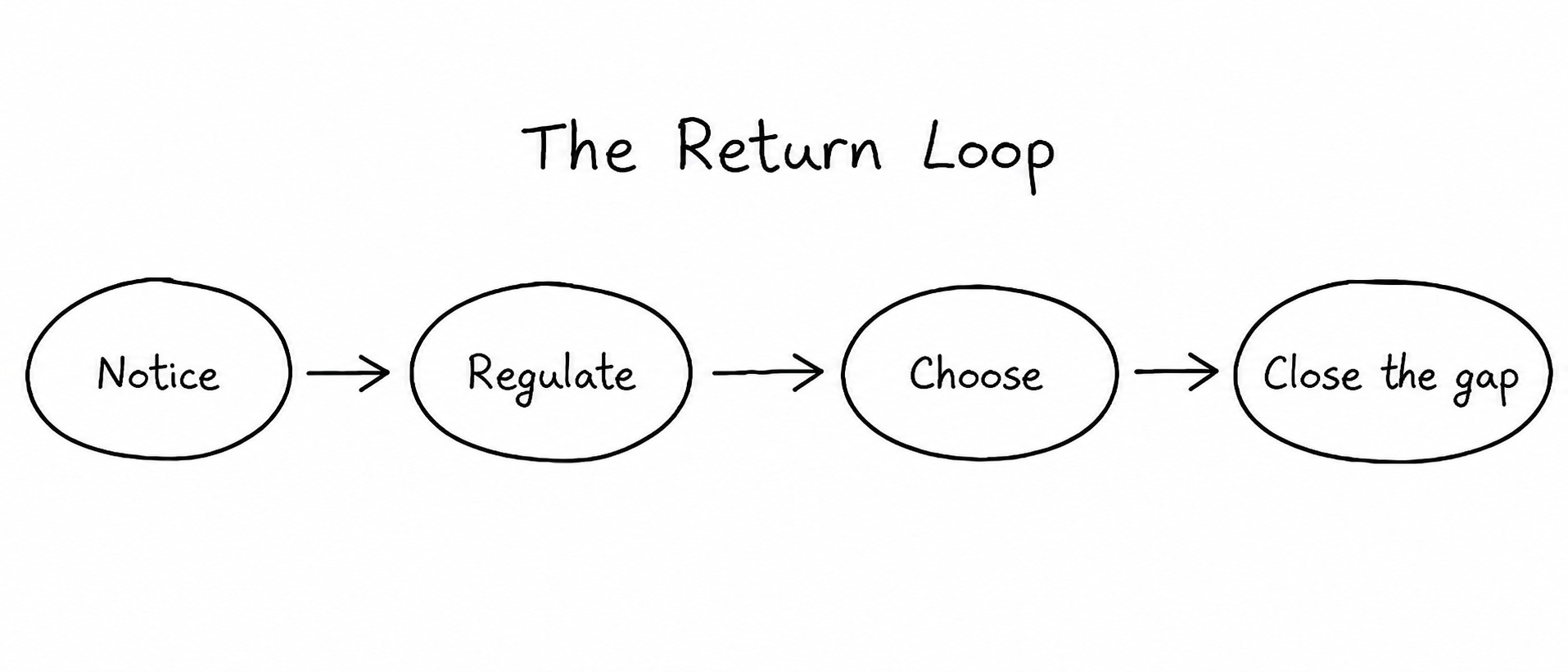
Right now, if you identify with this article, then you just noticed.
Probably, when assessing your own reality, there will be a lot of uncomfortable feelings coming your way. That’s natural, and it’s normal.
We enter regulation.
Feeling uncomfortable when trying to change something we know could be positively different is a normal and necessary part of becoming more coherent. You are getting out of your comfort zone, so while it is uncomfortable, you should feel proud of yourself. If you need help navigating these feelings, there are different options available to you, but my go-to options are (1) meditate and (2) talk with a professional who can help guide you.
Then see what options are available that can help you with your particular behavior, and choose. This can be done with the help of a professional, or you can research and see what fits best — of course, if it’s something that could put you at risk, you need to discuss it with an expert.
For this particular scenario (I’ve been bottling up my feelings and it’s impacting my relationships, work, life, etc.), I would recommend learning more about cognitive reappraisal.
Cognitive reappraisal does something fundamentally different from avoidance: it changes our interpretation of a situation in order to change how it impacts us.
Powerful, eh?
Here is how we deal with a feeling in the scenarios of avoidance, suppression, and reappraisal:
Avoidance: “I don’t want to deal with this feeling. It never happened.”
Suppression: “I’m feeling this, but I’m not going to show it. I don’t want people to think I’m weak.”
Reappraisal: “Okay, so I’m feeling this. What does this really mean? How am I interpreting this, and why?”
If you notice, reappraisal here dives right into the feeling and the experience so you can understand it better, effectively making it different from avoidance.
I would dare to say that if you can apply this and you are already in this emotionally exhausting cycle, this model can help you break it. Because it enables you to feel the feeling and decide how to deal with it. Once it’s dealt with and resolved, then you don’t carry it with you for who knows how long. One less thing to be stressed about. One bit of peace you get back for yourself.
For example, let’s say somebody at work criticizes your work.
You can automatically think: “shit, they think I’m incompetent.”
That appraisal can bring some feelings with it: shame, worry, anger, you name it.
If we tend to avoid, our response will be along the lines of:
Whatever. I don’t care.
Now, if you respond like that, the feeling is not going anywhere. While doing more work, or even when you are at home, the thought might come back: “they think I’m incompetent.” You might start replaying the conversation every now and then, modifying your behavior and your output so they don’t think I’m incompetent, etc. This is an example of what I was mentioning before as perseverative cognition.
Let’s do some reappraisal. What if we said:
Hold on right there. What just happened?
And get curious about the options:
Maybe they were having a bad day; my team hasn’t really complained, and so far everything works as expected.
Maybe they were criticizing a decision within my work that they would have made differently. The job was still performed correctly. It was a matter of preference.
Maybe the work didn’t go as expected. Mistakes happen; we are human after all. How can I make sure it won’t happen again? What can I ask that can help me grow?
Or even, That was uncalled for. Why did they call me that? Of course I will be angry after that. We will have to talk later, maybe when we’ve both calmed down.
One thing that is important, and that the last point in the list above tries to show, is that reappraising is not positive thinking. It’s not asking, “How can I rethink this in a way that makes me feel better?” In fact, sometimes reappraisal can confirm that something bad happened.
For instance, if somebody betrayed your trust, it’s not about saying “maybe they didn’t mean it”, but about examining what happened rather than just shushing it away.
What they did violated something I hold dear. That’s why I’m hurting right now. I can’t change what they did, but I can decide what boundary I can set after this.
Honestly, I think “letting go” after reappraising is also valid, as long as letting go stems from a real acceptance of the situation rather than avoidance.
In the end, cognitive reappraisal is a mechanism that can help us understand more accurately what happened so we can process our feelings correctly.
Once we choose what to do, then we act and close the gap. In the case of cognitive reappraisal, if you decide to follow this method, then you have to commit to actually taking action on it, even when it’s uncomfortable.
Once you start doing it, you might start noticing that some cycles that used to spawn when bottling your feelings up start gradually disappearing.
In our next companion, we will practice cognitive reappraisal so we have ways to internalize this model and make it part of our day-to-day.
Remember, brushing things off is okay, as long as you really deem them unimportant. Otherwise, reappraise.
I hope you have a wonderful week!
✨Ideas Worth Exploring
If this piece resonated, here are a few more that go hand-in-hand.


👍👍👏👏👏