



This article is dedicated to my aunt Teresa de la Fuente, who taught me — and opened my eyes to the fact — that nobody but me is responsible for what is within my control.
Gracias, tía.
I think I’ve mentioned a couple of times that I’ve been trying to practice Stoicism for a long time. At this point, we’re talking about years.
Stoicism has been crucial in changing my mindset into one that is more compassionate, responsible, and strong, and more willing to take risks rather than actively avoid them. That, combined with the ability to acknowledge what I can control and what I can’t, has helped me bounce back — what I call return — faster, because now I know which factors I have control over and can keep going.
Free weekly reflections for sustainable discipline.
Straight to your inbox.
My personal laptop died a couple of weeks ago. I used it for all my personal projects and to do the paperwork that keeps the household running. Believe it or not, it burnt out. At least part of it did. I believe it was the speaker.
Thankfully, the laptop was fairly new — anything less than a year old is new to me — so the warranty was still valid, and I used it. Long story short, I had to send it in for inspection and repair, and since then I’ve been without a laptop.
I’m telling you this because writing these articles on my phone has not been easy. My wife has kindly supported me by lending me her laptop for the final editing process, but I don’t want to abuse her goodwill when I can just write the draft on my phone after the kids go to sleep.
There is something different about writing on a phone versus writing on a laptop. Writing on my phone helps me get my ideas out faster, while on a laptop I feel like I’m writing the final version right away. But I still like writing on the laptop. This led me to think that maybe I should just take some time off from writing until the laptop came back. But a part of me kept saying, “That’s not the responsible thing to do. You committed to something; you should see it through.”
You see, I didn’t want to fall into a victim mentality. Yes, the laptop died, and that was out of my control. But instead of blaming the world for my demise, throwing a tantrum, and not writing, I decided to play with the cards I had. After all, that’s what I learned from Stoicism.
That led me to think — because I can think, lol — that, in my experience, this mentality is one of the most prominent ways drift channels itself.
Think about it: how much of your behavior has come, at some point, from the idea that it was someone else’s fault or they did it first?
Today, we’ll explore the nature of a victim mentality, how it impacts our behavior, and how we can manage it so we can act on the things that are within our control.
Responsibility starts with your part
I think I’ve talked about this before, but I went on a trip to Europe just after I graduated from college in 2014. It really changed my perspective on things, for a multitude of reasons. It was my first solo adventure: 40 days, 10 countries, 16 cities, and tired as hell.
My parents helped me pay for the trip, along with savings from my first job. My plan was to stay in different hostels along the way, take the Eurotrain, and tour around, learn, and enjoy myself.
My first stop was Madrid, and this was strategic. I had an aunt living there. Well, she isn’t directly my aunt. She’s the sister of one of my dad’s sister’s husbands. Now you know why I call her my aunt — it’s easier, haha. She, Teresa de la Fuente, left Chile in the ’70s, right around the time of the coup d’état. There, she put down roots and spent her life as a journalist, working for the Spanish TV channel Televisión Española — TVE — and doing a bunch of cool work.
I remember my aunt — my dad’s sister — calling us to let us know that my aunt Teresa was going to be on TV a couple of times, back when I was a kid. I never really appreciated the weight of all her experience, but she did some cool things and learned a lot. Because of that, it was always great to chat with her when she visited Chile. I’ve known her for as long as I can remember, so to me, she’s still family.
The thing is, she was living in Madrid, and she offered to send me an invitation letter so I wouldn’t have issues entering Spain, and to let me stay at her place for the first week or so. I accepted the invitation and stayed with her during that time.
It was great. She took me to different places. We went to Malasaña, a very bohemian neighborhood, to a tablao to watch some flamenco, and she took me to have dinner with some of her friends.
During that dinner, I did something that felt naive to me back then, but that, as a more adult and mature person, I now consider a bit disrespectful. I kept looking at my phone. I didn’t even have internet, so I think I was just looking at the time because I had a reservation somewhere else. But of course, it was noticeable, and my aunt, out of all of them, noticed it the most. She didn’t like it, and with good reason.
Back at her place, she didn’t say anything until we sat down to chat about life. The topic came up naturally, but she brought it up with curiosity, asking what had happened. My answer was defensive. I remember feeling defensive, and she didn’t like it.
During my time there, I learned that Spaniards don’t yell; they just talk loudly and are effusive. Her answer was effusive but, surprisingly, respectful: “I have noticed that when you talk, you place the blame everywhere around you, but you forget to look inside. When will you realize that you have to own your part to make a change?”
Low blow, right down there.
I don’t think anyone had ever talked to me so raw. Not in that way. Some people had, maybe with the intention of making me feel bad. I mean, that defensiveness didn’t come out of nowhere. But her words pierced differently because I knew she cared. I knew she wasn’t trying to be mean and that she was trying to choose her words carefully. “You have to see your responsibility. You can’t keep blaming others. Otherwise, you won’t grow.”
She was right. And that changed my perception in a way that nothing had before, not with that strength.
In part, I’m thankful that she did it during the first week I was there because I carried that lesson — painfully, still — throughout my whole trip. But it also gave the trip a different flavor. Life is not always fun. It also comes with responsibilities. And they are your own, and yours only.
I kept that lesson with me, even until today. When things happen, the responsibility isn’t always on just one person. If something concerns me, then I play a part in it — with my kids, with my wife, and with my friends.
Not too long ago, I came across a concept that gave a name to the mentality I used to have before that conversation: victim mentality.
But what drives us to develop this type of mentality in the first place?
What develops this mindset?
I don’t think we’re born with this mindset.
One important thing to note is that this is not a diagnosis or a medical issue, but a label we attribute to a way of thinking.
Now, as with many patterns we see around us, if we develop it, I think it must have started somewhere along the way in our lives. Researchers haven’t established a single brain mechanism for this mindset, but they believe there are a couple of processes involved that may contribute to its development.
The following is just my opinion, and my thesis on why I believe this mindset can develop. I’ll use science to support my claims, but keep in mind that this is just the result of my research into things like shame, helplessness, and control, in an attempt to confirm whether my understanding made sense.
I do think this mindset can develop during childhood, though not intentionally or consciously. No parent thinks, “I want my kid to feel powerless and externalize blame.” My wife certainly doesn’t want our kids to feel that way, and kids don’t think, “I will blame others so I don’t have to be accountable as a trauma response.”
In my opinion, this type of mentality can stem from multiple processes that happen when we are young, and it isn’t necessarily tied only to how we were raised by our parents.
Many kids grow up in households that are overly and unnecessarily strict. Some parents believe you need to teach kids that the world is a tough place, and they try to show their children that toughness through limited real-life examples. They do it as a way to protect them — we all want the best for our kids — without realizing that this can make children develop a feeling of powerlessness and shame: the world sucks and I have little control over it, so I suck… I don’t want to suck.
Later, when society starts becoming more influential than parents, events may be used as confirmation of that worldview. We reach for an explanation that makes us feel better in situations that would otherwise be too hard to accept. For instance, if we fail a class: the world is unfair, the teacher doesn’t like me. Or, welp, I gotta suck it up and move on.
Maybe the assessment is partially right. Maybe the teacher doesn’t like us. But attributing the failure solely to that, without even assessing our own responsibility, is the problem. Externalizing the blame helps remove the fear of not being enough for a world that demands more.
We also have the case of kids whose childhood was marked by apprehension rather than strictness: You should be careful. You don’t want to make them mad. What will they say about you?
Kids brought up in these types of environments may feel like they’re walking on eggshells when they grow up. Research has associated parental psychological control with a reduced ability to assert autonomy, including in relationships outside the family.
When you are brought up in this type of environment, you can progressively become less autonomous. Getting out of your comfort zone becomes unthinkable. You prefer to remain silent, and when your goals aren’t fulfilled, you may place the blame on that environment because nobody believed you could do it on your own. You felt like you had to ask for permission to take risks, and now those opportunities are gone.
So you stop believing in yourself and instead leave yourself at the mercy of circumstances. After all, it’s not your fault; it’s whoever took away that opportunity, and whoever else conditioned you not to do anything about it. Externalizing the blame can then become a way to protect ourselves from the shame we associate with inaction.
Again, none of this happens because parents are necessarily ill-willed. Often, these parents are doing what they think is best to protect their kids from a world that could be ruthless.
Finally, I see a third possible avenue through which this mindset can proliferate: when kids are overvalued as they grow up, and/or when there is a lack of boundaries in their upbringing. This may sound terrible, but hear me out.
Because my kids are more social now that they are a bit older, we get to know children who aren’t necessarily my kids’ friends but who share events or moments with them. Those scenarios help you see different parenting styles and their consequences, sometimes in real life. Parents may be able to confirm this.
I once went to a birthday party my kid was invited to. While I was talking with another parent, he pointed to a kid and said:
— Do you see that kid?
He subtly pointed to a kid who was causing chaos.
— I can bet his parents never tell him no.
After we talked more, it turned out that this parent knew the kid and his parents, and they effectively didn’t want to tell him no. So this kid naturally learned to feel entitled to do whatever he wanted. When he was scolded, it wasn’t his fault.
The thing is that, many times, because parents had a hard upbringing, they don’t want to do the same to their kids, so they do the exact opposite — which, in this case, can be damaging.
When you feel entitled to your actions, then all of a sudden there are no rules that need to be followed. If you face consequences for not following them, it’s their fault, not yours. Because you feel special, you expect to be exempt from the rules.
Now, I think childhood can influence how we develop this mindset, but I also think it can develop as a sort of trauma response, no matter your age.
For instance, say you have worked in good work environments and know what a good culture is. Then you move to a company whose culture is toxic. They punish honesty — for instance, communicating deadline risks on time — retaliate, or promote behaviors like backstabbing.
All of this can create a trauma response, which may cause you to develop this type of mindset because you now feel like these kinds of behaviors could happen in other environments too. Then, in a new job, even though the feedback you receive is fair and well-intentioned, you might take it as another unfair attack without considering your responsibility in it.
These are possible pathways, not a complete explanation. People can experience and feel harm without being responsible for causing it; our role is to manage our behavior whether we are responsible or not, and that’s what we’ll see next.

👉 Want to actually train this, not just read it?
Each week inside Discipline Circle, I publish a short Paid Companion you can work through in 10 minutes on a slow day, so the idea sticks when a hard day hits.
$9.99/month.
How can we manage it?
Now we know some of the ways we could potentially develop a victim mentality, and, as I said, this is based on my understanding, so please take it with a grain of salt.
We also saw how it impacts our behavior. Essentially, in order to prevent shame or protect our entitlement, we engage in behavior that is sometimes out of coherence with what we say we value, and that happens more when we are under stress, when there’s something at stake.
So what can we do when this happens? Because it has happened to me, clearly, through the story I told about myself and my aunt in Madrid. It’s common, and we all have a little bit of it. It’s not inherently bad; it just is.
But it’s drift. It shows up as behaviors that we want to address in order to remain coherent.
In this newsletter, we talk about drift not as something you need to eliminate, but as something you need to manage. The question then is: How can we manage this?
Because if it’s drift, then it’s data. And if it’s data, then you can take action on whatever it tells you.
What I would say here is that, just as with the other ways drift manifests, we have to put this through our return loop — the loop I’ve been talking about in previous issues.
We have to go through the four main steps: noticing, regulating, choosing, and acting.
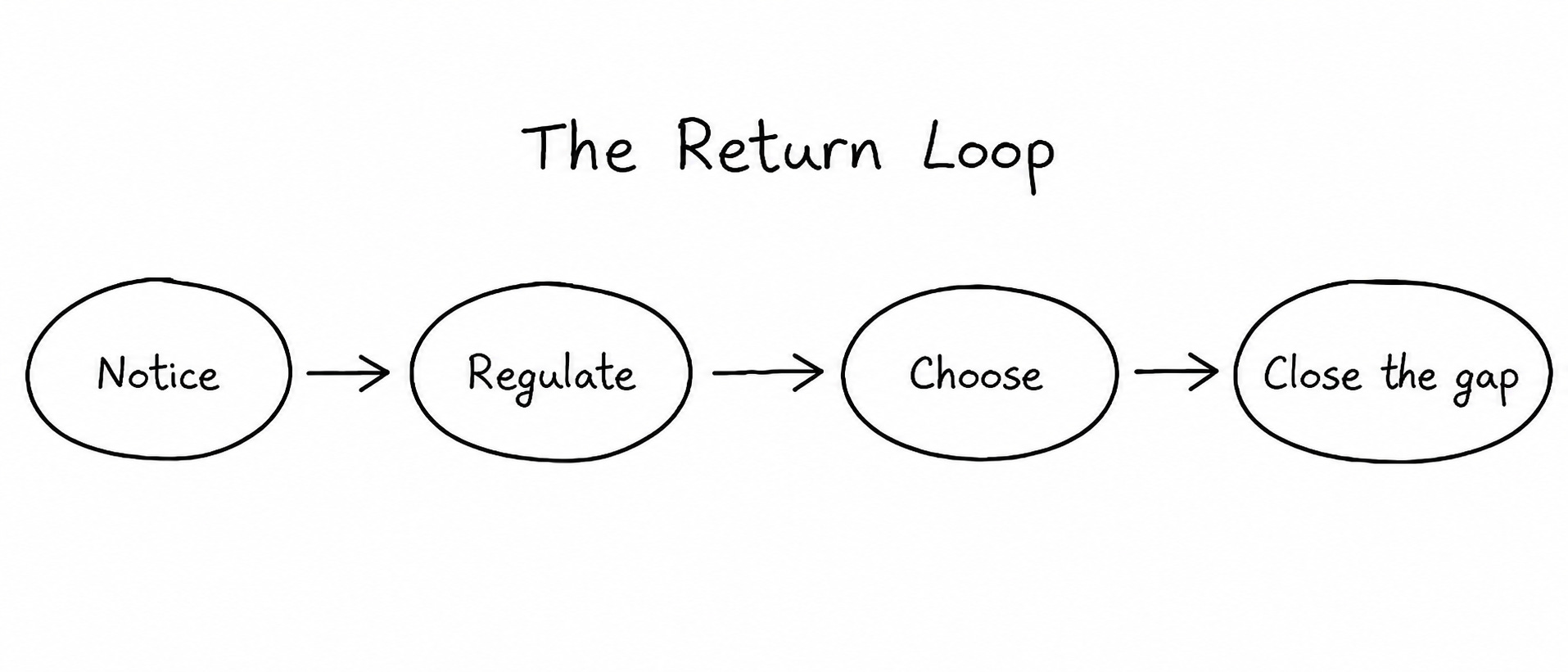
I know it’s hard. This is not something we typically catch in the moment. We cannot expect that tomorrow we’ll be able to manage it with a snap of our fingers. It takes longer.
What we want to do is move away from this default behavior. We don’t want to eliminate it, because eliminating it is a futile game. We want to make sure that if we see ourselves going in that direction, we return as fast as we can. With enough practice, we can try to make that our default.
If that happens at some point — if a fast return becomes the default — it would mean that, when we’re in situations that usually would have triggered a victim mentality, we’re less prone to go in that direction and more likely to move toward what we deem aligned with what we want.
So the strategy here is divide and conquer. We can’t expect to go through the entire return loop on a whim. We have to train this in parts.
First, we start with noticing. We have to build the habit of noticing when we’re engaging in this behavior.
What can we do to develop this habit?
There are techniques that can help, such as meditation and other mindfulness practices. The idea is to be present when these things happen, when your behavior pulls you to act in a way that doesn’t feel coherent.
If you’re not present, you’re not going to be able to identify the trigger that makes you switch into this victim mentality. Because it’s not everything that triggers it. Many times, it’s specific moments, especially if they’re associated with past trauma or your upbringing, as I mentioned before.
So we have to do the work of remaining present and mindful. I use meditation to help me with this. There are different techniques that can help you develop mindfulness, and breathing techniques can help you focus on what you’re saying, how you’re acting, and what you’re feeling. That way, you can start identifying when the pull begins.
Once you’ve done this a couple of times, you’ll start noticing that the triggers become more and more obvious. Your own physical cues will start telling you that you’re uncomfortable and engaging in this sort of protection or defense mechanism.
You might start clenching your jaw, your breathing may accelerate, your heartbeat might get faster, or you may even have racing thoughts.
Then you’ll start looking for someone to blame.
Once you start developing that awareness, you move to the next step: regulating.
Okay, I’m feeling all of this. Now, what do I do?
What we want to do with regulation is be able to stop and pause rather than act impulsively. We’re not expecting to calm down right away or simply switch our behavior. It’s like when you teach regulation to a kid: you don’t want them to just stop crying or suck it up; you want them to learn how to cope better with those feelings.
So we stop and assess. Mitigate first, then investigate. Look for ways to calm yourself down, to bring yourself toward a baseline, and then try to understand what’s behind all of that.
That’s regulation in a nutshell.
I don’t know your upbringing, of course, so it will be your task to start understanding your triggers.
Some good questions to keep handy when you catch yourself moving in this direction:
Why did this comment or action trigger this response from me?
Why am I feeling this way?
Is there anything I need to address?
What is my responsibility in this?
To be frank, I think this is the most important part because sometimes we can fairly assess that we have no responsibility in something at all. The thing is, that might be true, but we need to anchor that assessment in something real. That’s where the trap is.
We can feel all of this and still let our brains trick us into thinking that the responsibility isn’t ours. So we need evidence. I think that’s the key: finding evidence to determine whether the responsibility is ours, rather than deciding it isn’t just because we feel like it.
Given the nature of this mindset — which we just discussed — our emotional response can have more influence over how we assess what’s happening because we’re trying to protect ourselves. Stress can make some of our prefrontal functions less effective and pull us toward more reactive responses — what people often call an “amygdala hijack.”
I’m not trying to explain victim mentality with this, though. This is more about what can happen at the regulation stage: stress can make it harder to question our initial response and think through everything that’s happening.
We need to understand and, at some point, accept that this can happen, and then work with it. We need to look for evidence that doesn’t necessarily support our claim and be our own devil’s advocate. We need to look for objective evidence that helps us put together a timeline and tell a more objective story.
Having regulated ourselves, the next step is to choose what we’re going to do next. Once we understand our patterns and triggers a little better, and we’re steady enough to make a choice, we check our options.
Many times, once we have the objective evidence, the clearest option is to accept our responsibility in the situation. Sometimes that evidence will show that we have no responsibility at all, that we play no part in it. At that point, we can state that, but not from a defensive point of view. We can explain the story as it is.
When we do play a part, we lead with that part. Instead of pointing fingers, we first address the role we played and ask: How can we make it better next time?
We can choose to learn how to prevent our part from having the same impact and come up with action items that help prevent it from happening again. We can ask whoever we’re talking to, to hold us accountable next time because we’re making that commitment in public.
And this is necessary. When you apologize for things you did but don’t really try to change that behavior, what’s the point? You’re going to keep engaging in it.
If our behavior caused a problem, we have to try to address it. I’m not saying we necessarily have to correct our behavior, because sometimes our actions are the right ones and the other party’s response isn’t. But our commitment should be to help, at least, and to act in a way that can lead to a better resolution.
For instance, one night my wife asked me to take the towels out of the dryer, and that’s what I did. I took them out, folded them, and put them upstairs. The next morning, I got grilled — with fair reason — because I forgot to put the clothes that were in the washer into the dryer. As a disclaimer, I know this example is somewhat lame, but I think it’s a good way to illustrate it because it’s a version we all experience at some point.
I could have placed the blame on my wife and said, “You didn’t tell me I had to put the clothes in the dryer. It’s your fault,” and started an argument. It’s very easy to take that road and, out of shame, respond defensively.
Because I’ve been working on all of this, my response was, “Oh, I’m sorry. I didn’t know. You told me to take the towels out of the dryer, so that’s what I did. But, yeah, I should have checked at least. I’m sorry. I’ll do that next time.”
She told me, “You take things too literally sometimes.” And she’s right, so I didn’t argue. Next time, as I told her, if I take things out of the dryer, I’ll check the washer and move those clothes into the dryer.
Problem solved. It’s not a big deal. It’s nothing critical, so I shouldn’t let my ego get in the way. But that’s the problem we typically have: we let our ego get in the way. In order to defend it and prevent shame, we engage in something reactive instead of acknowledging, “I think I have a responsibility in this.”
Maybe we’ll engage in the same behavior again. The important part, I think, is that we’re not perfect. I know that at some point I might forget to take the clothes out of the washer. I’m forgetful, but I’m going to do my best to have a system or a way to minimize how often this happens. And if it happens, I’ll make sure I hold myself accountable for it.
That’s what comes with the choice. It’s being objective about who is responsible for what and what comes next. It’s not necessarily placing the blame on yourself just to keep the peace.
Finally, the last step is to act. We made a choice. We’re going to assume our responsibility and put things in place to prevent this from happening again. The next step is making it happen, and sometimes that’s the hard part. You can commit to many things, but you have to see them through.
So my invitation for you is to try to understand where this comes from. If you’re reading this from a baseline, try to understand whether you engage in these behaviors and why they happen. Don’t beat yourself up, and don’t blame your parents or whatnot. Try to understand the root cause so you can be compassionate toward yourself and, at the same time, start choosing better and addressing the issues in a more responsible way.
Once you start doing this work, you will start seeing a change. Things that used to become arguments will start becoming conversations and opportunities to learn. You will start to see growth, and you will start moving from a victim mindset toward a growth mindset.
And that’s, I think, a payoff worth pursuing.
In our next paid companion, we’re going to practice regulation: ways we can stop and assess objectively so our choices come from a place of caring rather than ego.
Until then, make sure to challenge your brain when it pulls you to externalize the blame onto others.
I hope you have a wonderful week!
✨Ideas Worth Exploring
If this piece resonated, here are a few more that go hand-in-hand.


