


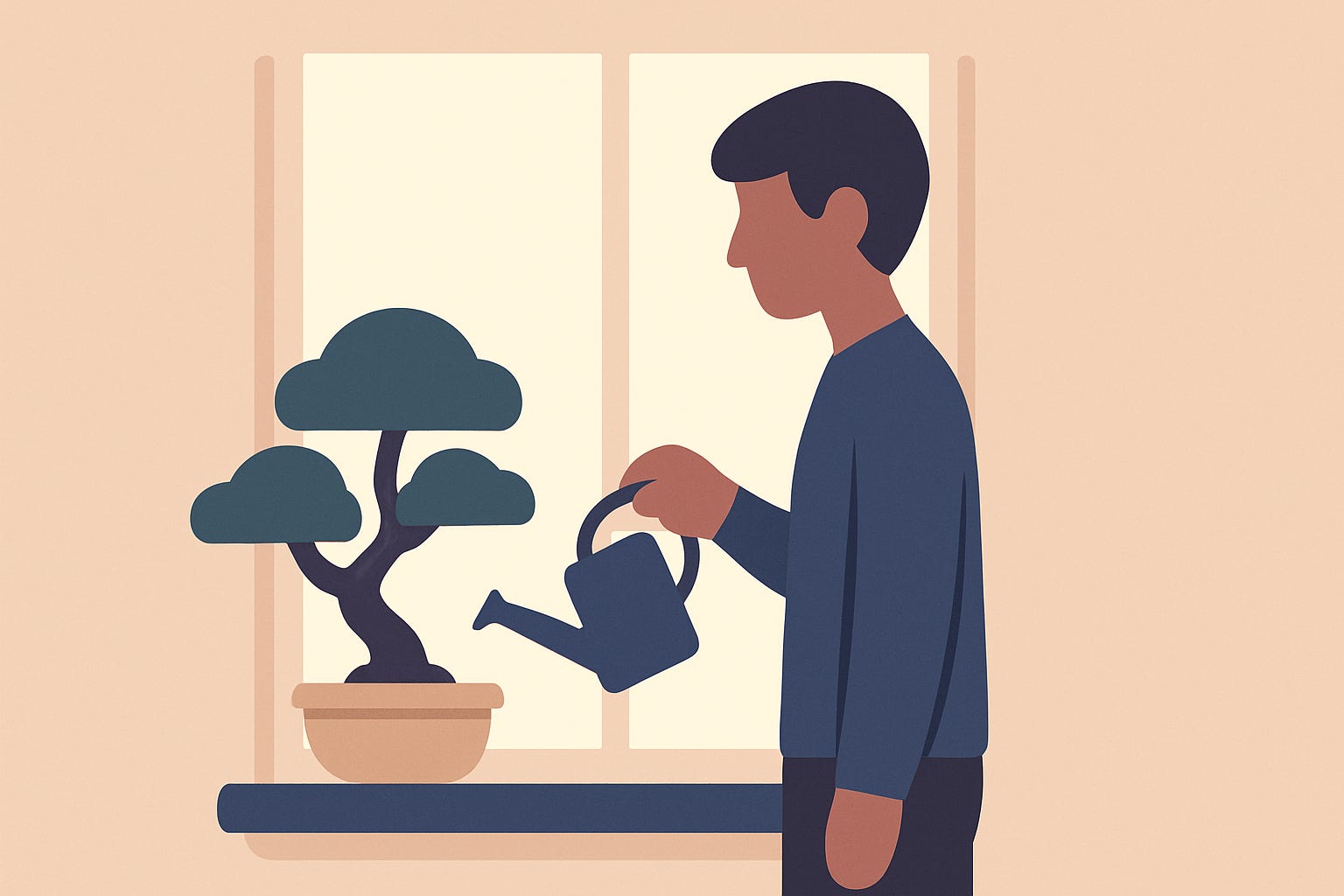
I am part of a bonsai Facebook group. It’s kind of my adult hobby, I think I’ve talked about it before in previous articles. I try to take care of my plants.
I have a bonsai.
Well, the bonsai I wrote about a while ago unfortunately didn’t make it. Bonsais are hard. They are trees that require a very specific level of care, patience, and maintenance.
Free weekly reflections for sustainable discipline.
Straight to your inbox.
I didn’t give up, but after around two years, that bonsai didn’t make it. Learned a lot from the process, which included some grief as well. Two years of efforts hurt when the results are not the ones you expect. I also felt responsible for the bonsai to die, and I don’t take that lightly.
After a while I moved on, and during one of my visits to the local Farmer’s Market, I got a new one. A juniper.
Beautiful tree.
Since then, I’ve been trying to keep it alive. It’s not that it’s too demanding, but it does require care and consistency. For instance, if I travel, it becomes harder for me to take care of it, and that has already created some issues with that juniper I have now.
But I try to do my best.
That’s the thing.
I try to do my best.
I’ve been learning. I’ve been reading. As I mentioned in the beginning, I’m part of a Facebook group for people who take care of bonsais, which makes me feel like an old man saying it, but whatever. It has helped me learn more about caring of my own.
The problem is that when I look at that group, it’s very easy to get a little jealous. Especially now in spring, when so many of those bonsais look beautiful. Full of flowers. Well groomed. Carefully shaped.
The other day, someone posted an azalea tree, and it was just beautiful. Full of beautiful red flowers. Perfectly maintained, pristine. Ah...you should have seen it. I lost the picture because my feed refreshed after like 10 seconds, but that was enough to feel sort of triggered.
When I looked at it, I compared it with the bonsais I have had at home. Mine are humble...they have tried their best. I know comparing is the thief of joy, but I’m not comparing to feel miserable, but to see where can I get in my own journey.
It sets the bar high.
I think bonsais require a very specific dedication from those who really want to get into the craft. I’m very new to all of this. Everything I’ve learned has been through trial and error, or by reading around, and even then, it has been hard, because it’s not only about learning the materials, the techniques, the timing, or how to care for the tree. It also requires patience. Real patience.
You need time to take care of the bonsai, but you also need time to see it grow, because it is a slow process.

👉 Want to actually train this, not just read it?
Each week, alongside this reflection, I publish a short practice guide — something you can work through in 10 minutes on a slow day, so the idea sticks when a hard day hits.
It’s called the Paid Companion. $9.99/month.
From what I’ve read, and maybe people who actually know bonsais can correct me here, it can take decades to see a really well-developed bonsai, depending on the type of tree and the technique you’re applying to it. So it takes dedication.
It takes patience.
And I started thinking to myself:
How am I able to take care of a tree with that level of dedication and precision, while there are still parts of my life that I don’t tend to?
Parts I don’t take care of.
And yes, as cheesy as it may sound, that led me to this reflection: Our life should be treated like a bonsai, because it is precious.
With a bonsai, you can mess it up. It’s not ideal, because it is still a living being, but you can try again.
With life, there is one component we don’t get back, and that is time.
So we should be focused on taking care of our life in every aspect, and that’s where drift comes into play, because drift is the mechanism that makes the tree of life grow by default.
Your tree will keep growing, it will keep moving in different possible directions, and it is your job to prune the directions you don’t want in your life, so you can keep your tree growing the way you want it to grow. In this case, the mechanism you use to keep your tree aligned is returning. The idea of return as a meta-skill.
Returning is how you make sure the parts you don’t want to grow don’t take over.
You keep pruning, even if one area of your life starts growing in a direction you don’t want, that’s okay. Drift is the default. It will happen.
Returning is how you prune it. It is how you come back to the main trunk of your life. The main direction. The spine of it.
We should take care of our bonsais. We all have one, and it is the most precious one.
Something I want to leave clear though: this all may sound overwhelming, but don’t worry. If you take a direction you thought you wanted, and later realize that wasn’t it, you can change direction. Your tree of life will keep growing, and you can still shape it in the way you want.
So my message to you, my invitation, is to reflect on this: think of your life as something to tend. Something to take care of holistically.
Look at the areas of your life. Look at the directions you are taking. Ask yourself if those are the directions you actually want, and then ask yourself what direction you want to follow in those areas.
That is how you shape the tree of your life.
The way you want, only the way you want.
In our next paid companion, we will navigate how to prune our bonsai. We will look at some techniques to shape it the way we want to see it, and the way we want to experience it.
Because that bonsai is ours, and only ours.
Have a wonderful week!
✨Ideas Worth Exploring
If this piece resonated, here are a few more that go hand-in-hand.


👌🏽
Patience the secret sauce