


These last couple of weeks have been a hit to my mental health.
I won’t get into details as it’s personal, but it has been hard.
It has been a challenge to be present for my wife and for my kids, but I can attest that it’s possible. If there have been tough moments where they haven’t noticed it, it’s because internally I’m trying to apply everything I know and have learned on my journey, to try to remain as solid as possible.
Free weekly reflections for sustainable discipline.
Straight to your inbox.
The best depiction of how I’ve been feeling is me walking on a road, having an invisible hand trying to pull me out of there, and me finding the way to return to it every time I get out of it. Every day.
Reading and talking to people around, it seems I’m not the only one going through tough times, but this is not a competition. The stakes are real for many; the world right now is madness on different fronts, from immigrants having a harder time everywhere, to the economy and the job market being insane right now.
It’s understandable to feel helpless, powerless, or like you are drifting.
But it’s possible to return.
I’ll talk from my situation, but if parts of this sound like your own experience, please keep reading, because while not a template, you can get some understanding on why it happens that way and how to work on it.
What does it look like?

What I’ve been experiencing is less emotions, and more behavior. If I’m making any sense.
In the past I would get emotional when in distress. Irritable and impatient.
These days, even under the pressure that my own anxiety tries to impose, I feel level-headed, but I see the impact of it on my attention and memory.
For instance, I lost myself in my own thoughts way more often now, during conversations or when alone. It’s easy to spiral, and just lose track. Along with that, my memory is being affected, and I think it’s related to my attention as well. It’s not that I fail to remember big events or that I’m losing my memory, no. It’s more forgetting about small-ish commitments like “don’t forget to dry the clothes before going to bed”, “don’t forget to cook dinner”.
If you are going through a similar state, if you think you are struggling and feel like it’s getting out of control, or you feel like you just don’t know what to do, know that there is always light at the end of the tunnel, and that you can return.
The conditions matter more than the practice
Throughout my journey I have learned a couple of things here and there, which have changed the way I think about this type of experience: the practices matter less than the conditions around them.
Let me lead with an example.
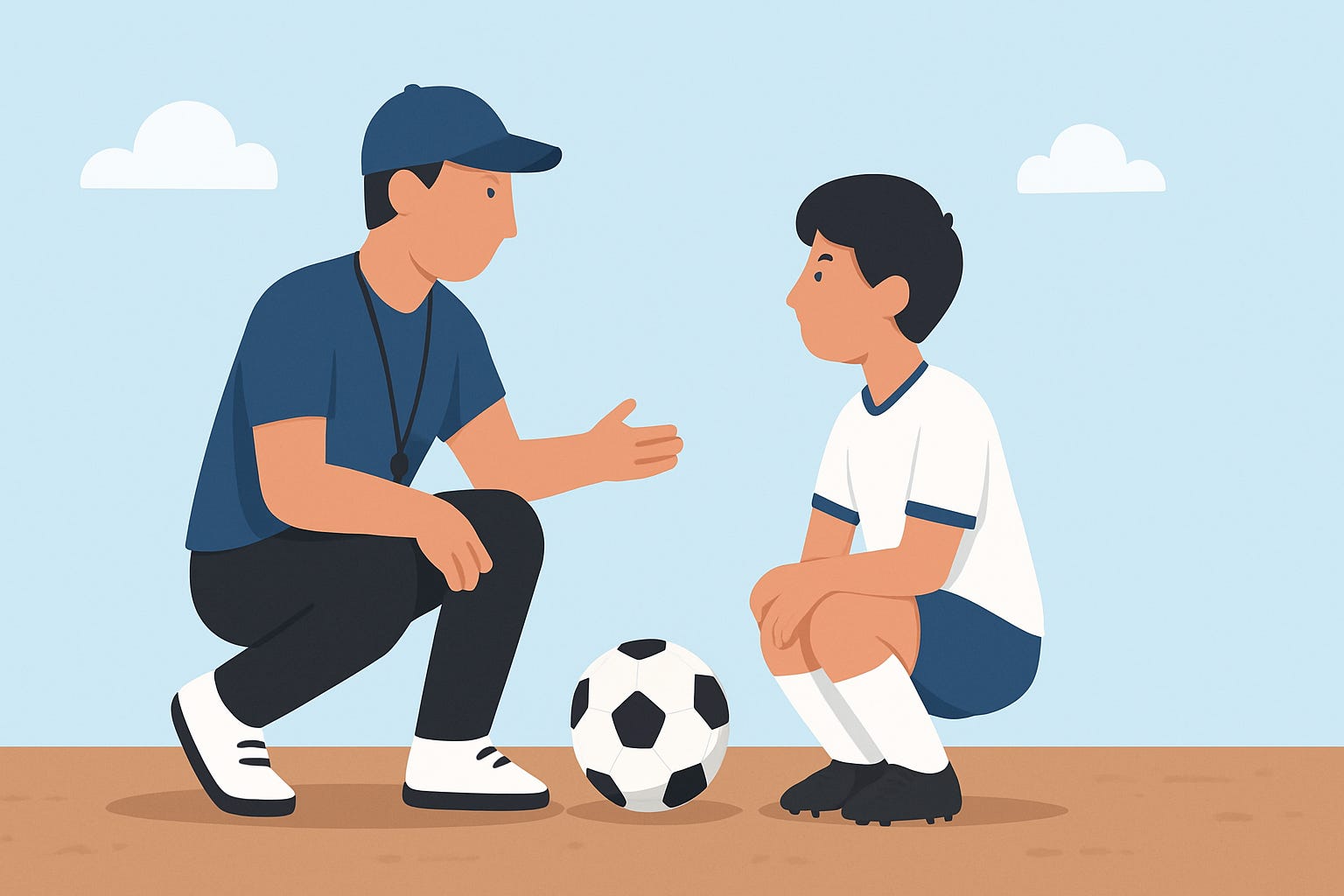
Two different soccer coach scenarios: we’ll call them coach 1 and coach 2 — super original.
Coach 1 coaches in a dirt soccer field, which unfortunately is not very well maintained. He coaches the soccer team of the neighborhood, and relies on the city’s subsidy to actually afford materials to coach, but that’s not always the case. Clearly struggling. Many of the kids are really talented, mainly because they use soccer as a means to escape a harsh reality waiting for them at home. Truth is that many of those kids don’t really continue practicing as they grow up, because they need to start supporting the household. They are vulnerable.
Coach 1 believes that this space should be a safe space for kids to be who they are, and have an authority figure supporting their growth. He wants to be part of the change.
He doesn’t get paid much.
Coach 2, on the other hand, coaches in a turf field, for the junior division of one of the wealthy soccer clubs in town. Has all the resources at his disposal, and receives a hefty salary. For Coach 2 this is just a job, he gets there, addresses the kids for an hour, and then forgets until the next practice session. He is good, and he has a good strategy. But he has a reputation for lacking patience, and getting visibly frustrated with the kids during the games. Some of the parents have reported their kids not wanting to go to practice.
The kids practicing soccer with Coach 2 have it all, but they don’t feel safe during the drills, or the games. They don’t feel that they can communicate what they are going through with their coach, because he hasn’t shown interest in them.
The kids practicing with Coach 1 eagerly wait for the practice sessions because they know they can trust their coach with their problems, ask for advice, and be themselves in and outside the field. Besides, Coach 1 really seems passionate about what he does, which is contagious, and the kids keep wanting to learn new techniques and plays.
The question is, who do you think offers better conditions to practice soccer?
The answer is obvious. The conditions are not defined by the field, the resources, or the talent. It’s whether the kids feel safe enough to actually practice.
The same is true for the practices I use to return. Talking, exercising, meditating, writing — they all work, but only when the conditions are right. Let me show you what I mean.
What do I do to keep returning?
Just as a disclaimer, this suggestion is going to be just that. A suggestion, based on my experience and how I operate. So please take this with a grain of salt. This is not a one-size-fits-all solution. It’s circumstantial, and my main goal is to show you how to remain resourceful yourself, and what resources are there for you if you feel helpless.
Let’s start with the fact that at some point, we all feel helpless. There is no escape from that.
But we can control how we react to that, and how long we feel like that. In some cases that feeling lasts a little bit longer, and it starts impacting how we behave, and how we relate to others.
So, when that happens, what can we do?

👉 Want to actually train this, not just read it?
Each week inside Discipline Circle, I publish a short Paid Companion you can work through in 10 minutes on a slow day, so the idea sticks when a hard day hits.
$9.99/month.
Talk

As lame as it may sound, talking is the first way to let off steam.
Find somebody you trust, family, friends. If you think you don’t want to talk with them, understandably out of guilt, shame, anything that you think can affect your relationships, or if you think it’s affecting you more than it should, please talk with a professional.
We should all feel heard and supported — it changes how we process things. Studies show that simply talking about and expressing your feelings and concerns relieves the emotional stress that, left unexpressed, takes a toll on the amygdala and the hippocampus, the regions that regulate stress and process memory.
Remember when I said that I felt my memory and attention were being impacted?
There you go.
So, talking helps. It doesn’t only strengthen the bonds with our loved ones, but also helps us, word by word, to regain control over ourselves and see things from a different perspective.
The only condition is that you feel safe enough to be vulnerable.
Exercise

My cadence at the gym sucks. Let’s start with that.
For a good while, because I had so many things to do, I stopped going to the gym. For a while, while I was going, it felt like my body needed it. After a while, and with cortisol overriding my way of thinking, it just became a chore. And I eventually stopped doing it.
The thing is, exercise is necessary. Not only because it helps you be healthy — and because ultimately I want to be around for longer — but because it helps your brain cut some slack.
Remember a couple of weeks ago, I talked about grounding techniques?
Well, turns out exercise is an excellent tool for grounding as well, it helps you move your focus to a different goal, and gives your brain a fulfillable task that is short-lived.
Apart from that, it helps you oxygenate better, meaning that your brain gets sharper after a good workout.
I personally started hitting the gym again, and it really helps me start the day grounded, which makes for a good return when drifting.
Meditate

While talking requires a safer psychological environment, meditation needs a safe inner environment — a moment where you can let your thoughts come without bracing.
I know, I know. You tried, it didn’t work.
It means there’s a chance you might not have tried it correctly, which is okay and understandable. At some point I thought meditation was closing your eyes and trying not to think about anything. Many people think like that still.
No, meditation is the act of letting yourself observe your thoughts as a third person, without judgment. Just letting them flow freely. It’s hard as hell but I can guarantee you that once you learn how to do it right, your brain will ask for it.
You don’t need to sit down with your eyes closed to make this happen. I want to be clear on this. You can do it in the shower, while walking your dog. In whatever environment you feel at ease and comfortable.
Some people avoid meditating — or at least this form of meditation — because it really triggers things in them. If you know you have thoughts in the back of your head that could maybe trigger you in this sort of environment, talk with a professional first. Sometimes having a guide in the process can help you unlock this type of experience, and you can win a lot by doing that.
Now, how does meditation help you return faster?
Meditation is proven to help decrease cortisol levels, and it makes sense. When you process your thoughts, when you just see them, with no emotions attached, your “emotional battery” gets recharged and your cognitive load (the one that holds those pending things, those repeating, pounding messages that you don’t want to forget) starts decreasing. This causes the prefrontal cortex (PFC) to start taking over control again, helping you eventually make better executive decisions, rationalize better, and keep stress at bay; on top of that, and as a chain reaction, when your cortisol levels decrease, this allows the hippocampus to operate with normalcy, bringing your memory functions and your ability to manage stress back.
I’ve been meditating since I was in college, and now I meditate on different moments of the day, which is especially helpful when you have two toddlers that are eager to ask questions and play with dad when they are back from daycare. This is what allows me to be present for them and be there to answer their questions, play with them, and remain leveled.
Write

Writing needs a space where you can be true to yourself, on paper (or the computer).
Think of writing as meditating and talking, and putting the results on paper.
I know, I’m oversimplifying it, but the benefits of writing at the very core are the same ones that meditating and talking offer, with the addition of improving your communication skills, which helps verbalize feelings, emotions, thoughts that could have been waiting to get out, and can now do so in a healthy manner.
For me, writing is therapeutic. It lets me let the thought in, analyze it, and communicate it in a way that helps me heal in the process. Like this article.
I also think writing is a great way to go back to your thoughts, and learn retroactively.
Engineer the Conditions, Train Your Defaults, Practice Return
So here is where I wanted to get.
Those practices I just described work, but they won’t always work in the same way, or with the same level of success.
Why? you would ask.
The answer: the conditions that surround the practice.
Depending on how good the conditions are to actually perform the practice, we will get positive results. To practice return in general, through the Return Loop you then need to work on improving the conditions that allow you to perform the practice. The magic is that, the more you improve the conditions, the better and the faster you train your defaults, then you return faster.
How do I improve the conditions for my return, then?
I put together a free framework named Adaptable Discipline, that has everything you need to get it done, so you can improve your discipline.
Practicing return constantly has led to training my defaults. For instance, now instead of panicking when things don’t go as I expect, I stop, reassess and move on. And it sounds light when I write it here, but it has definitely changed how I approach things.
Everything I mentioned has worked for me. If you are in a similar situation, I hope it works for you, and that as time goes by, your defaults improve too.
If you need to talk, feel free to send me an email or a DM. You are not alone.
In our next companion, we will work on some katas that can help us return when we feel powerless, losing control and stressed.
Until then, make sure you check the framework. It can make a real difference in your life. Let me know how that goes.
Hope you have a wonderful week!
✨Ideas Worth Exploring
If this piece resonated, here are a few more that go hand-in-hand.


